
Standard Mileage vs. Actual Expenses: Which 2026 IRS Method Saves You More?

For independent contractors, especially the burgeoning population of rideshare and delivery drivers, the annual tax season presents a recurring dilemma: how best to deduct vehicle expenses? The choice between the IRS Standard Mileage Rate and the Actual Expense Method can significantly impact one’s taxable income, directly influencing the amount of tax owed or the refund received. Understanding the nuances of each method, particularly as we look towards the 2026 tax year, is critical for maximizing deductions and ensuring IRS compliance. Drivers frequently grapple with the fundamental question: should they meticulously track every fuel receipt and repair bill, or simply log their mileage? This article delves into both methods, highlights a crucial IRS rule, and provides insights to help drivers make an informed decision for 2026.
Navigating the 2026 IRS Standard Mileage Rate
The IRS Standard Mileage Rate is a streamlined approach to deducting the costs of operating a vehicle for business purposes. Instead of itemizing every expense, taxpayers can deduct a set amount for each mile driven for business. For the purpose of this analysis, we will explain the 2026 IRS Standard Mileage Rate as 72.5 cents per mile. It is important to note that the IRS typically announces the official mileage rates in late fall of the preceding year (e.g., late 2025 for the 2026 tax year). The 72.5 cents per mile stated here serves as a hypothetical rate for the sake of this detailed discussion and should be verified with the official IRS announcement once available.
This rate is designed to cover the majority of vehicle operating costs, including fuel, oil, maintenance, repairs, tires, insurance, and the crucial element of depreciation. When you elect to use the standard mileage rate, the IRS assumes that this per-mile allowance accounts for these typical expenses. This method significantly simplifies record-keeping, as drivers primarily need to track their business mileage, dates, and the purpose of their trips. For comprehensive guidance on vehicle deductions, taxpayers can always refer to official resources like IRS Publication 463, Travel, Gift, and Car Expenses.
What the Standard Mileage Rate Covers
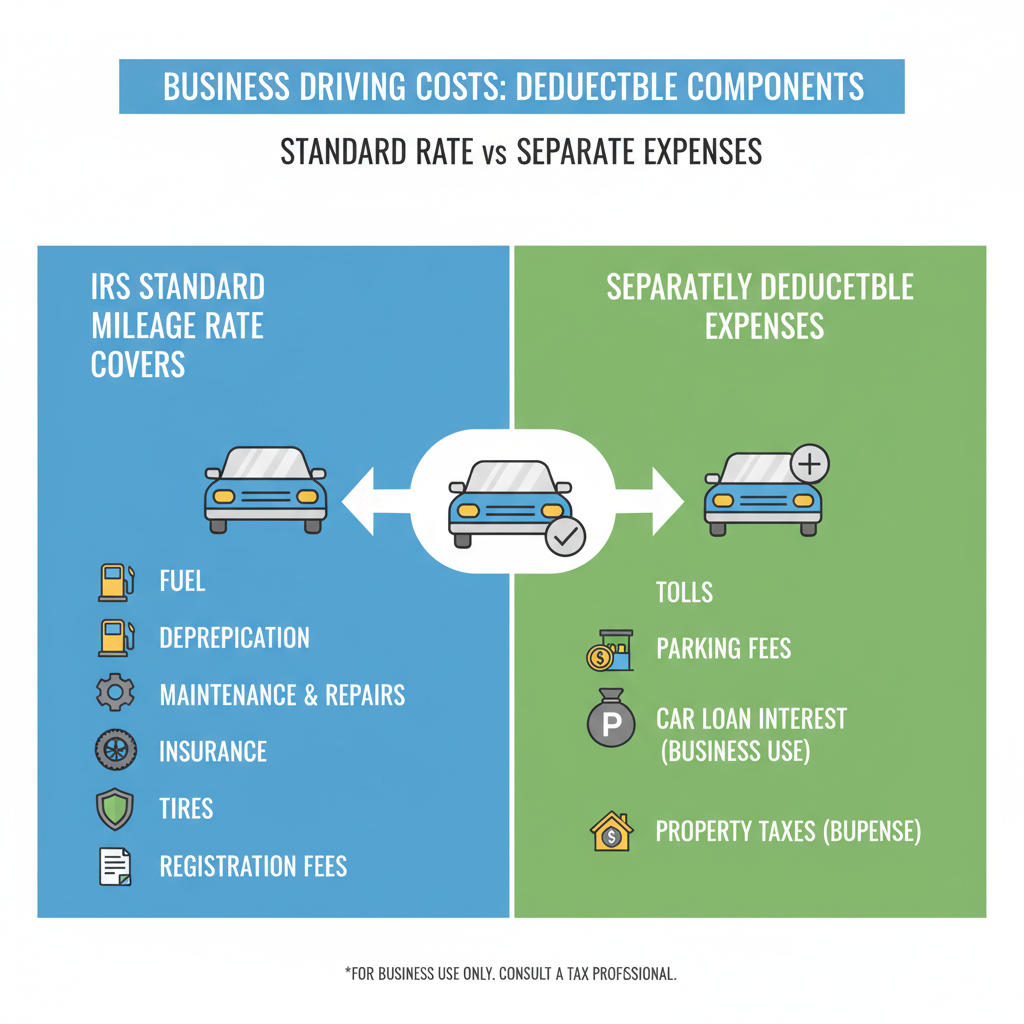
The standard mileage rate is a comprehensive deduction intended to encompass the ordinary and necessary expenses of operating your vehicle for business. These typically include:
- Fuel: The cost of gasoline, diesel, or electricity required to power your vehicle.
- Oil and Fluids: Expenses for routine oil changes, transmission fluid, brake fluid, coolant, and other essential vehicle fluids.
- Maintenance and Repairs: All costs associated with keeping the vehicle in good running condition, from routine tune-ups and scheduled service to unexpected repairs like brake replacements or engine work.
- Tires: The purchase and installation costs of new tires as they wear out.
- Insurance: A proportionate amount of your annual vehicle insurance premiums.
- Depreciation: A significant component built into the mileage rate, accounting for the decrease in the vehicle’s value over time due to wear and tear from business use. This is a crucial element that distinguishes the standard mileage rate from simply deducting fuel costs.
- Vehicle Registration Fees: A portion of these fees attributed to the business use of the vehicle, as distinct from personal property taxes.
What the Standard Mileage Rate Does NOT Cover
While the standard mileage rate simplifies most vehicle expenses, certain costs can still be deducted in addition to the per-mile rate. These are typically expenses that are not directly tied to the mileage itself but rather to the circumstances of business travel. These often include:
- Parking Fees: Any fees paid for parking meters, garages, or lots while conducting business activities (e.g., waiting for a rideshare passenger, making a delivery drop-off).
- Tolls: Costs incurred for using toll roads, bridges, or express lanes during business trips.
- Interest on a Car Loan: If you finance your vehicle, the business portion of the interest paid on the loan can be deducted. This is a significant additional deduction for many drivers.
- Personal Property Taxes: Taxes levied on the value of the vehicle by state or local governments. These are often distinct from registration fees and can be deducted proportionally to business use.
Advantages of the Standard Mileage Rate
The primary draw of the standard mileage rate is its simplicity and reduced administrative burden. It virtually eliminates the need to save every single receipt for gas, oil changes, or tire replacements. For drivers who put many miles on their vehicles for business, and whose actual expenses (excluding the depreciation component) are not exceptionally high, this method can often result in a higher deduction than the actual expense method. This is particularly true for newer, fuel-efficient vehicles that might not incur significant repair costs or substantial fuel expenses relative to the number of miles driven. It also reduces the administrative burden and the time spent on tax preparation, making it a favorite for many independent contractors, especially those new to self-employment. The predictability of the per-mile deduction also aids in financial planning.
Disadvantages of the Standard Mileage Rate
While convenient, the standard mileage rate might not always yield the largest deduction. It may underrepresent the actual costs for vehicles that are expensive to maintain, consume a lot of fuel, or have high insurance premiums. Furthermore, because the standard mileage rate incorporates a depreciation component, using this method means you cannot also deduct actual depreciation or claim Section 179 expensing or bonus depreciation for the vehicle. This can be a significant drawback for new, high-value vehicles where large upfront depreciation deductions are possible, potentially leaving money on the table. Finally, there are specific IRS rules regarding eligibility and switching methods, which we will discuss shortly and are critical for long-term planning.
Record-Keeping for Standard Mileage
Despite its simplicity, accurate record-keeping remains paramount. The IRS requires taxpayers to substantiate their mileage deductions. This involves maintaining detailed records that clearly distinguish business use from personal use. Key elements include:
- Mileage Log: A detailed, contemporaneous record of all business trips. This should include the date, starting and ending odometer readings, total miles driven for each trip, the destination, and the specific business purpose. Many drivers use smartphone apps for this.
- Odometer Readings: Recording the vehicle’s odometer reading at the beginning and end of the tax year provides a yearly total mileage, which is crucial for calculating the business-use percentage if you switch methods later.
- Proof of Vehicle Ownership/Lease: Documentation showing your legal right to use the vehicle.
Modern mileage tracking apps can automate much of this process, using GPS to log trips and classify them as business or personal with minimal effort from the driver, thereby reducing the chance of errors or missed deductions.
Deciphering the Actual Expense Method
In contrast to the simplified standard mileage rate, the Actual Expense Method requires taxpayers to meticulously track and deduct the actual costs incurred in operating their vehicle for business purposes. This method often appeals to drivers with high vehicle expenses, expensive vehicles, or older vehicles requiring significant maintenance. For those considering this more complex approach, understanding all the deductible categories is essential.
Detailed List of Deductible Expenses Under the Actual Expense Method
When opting for the actual expense method, you can deduct a proportionate amount of the following costs based on your vehicle’s business use percentage. This means if 70% of your total driving is for business, you can deduct 70% of these total expenses.
- Fuel: The total cost of gasoline, diesel, or electricity used for the vehicle. This requires keeping every single fuel receipt, whether from a gas station or a charging station.
- Oil and Other Fluids: Expenses related to oil changes, transmission fluid, brake fluid, coolant, windshield wiper fluid, and other essential vehicle fluids.
- Repairs and Maintenance: All costs associated with keeping the vehicle in good working condition, including routine tune-ups, brake jobs, engine repairs, scheduled maintenance, and replacement parts. This category can vary greatly year-to-year.
- Tires: The full purchase price and installation costs of new tires.
- Insurance Premiums: The annual cost of your vehicle insurance policy, including liability, collision, and comprehensive coverage. For a deeper dive into insurance deductibility, especially for US drivers, you can explore whether rideshare insurance can be deducted on US taxes.
- Vehicle Registration Fees: Annual fees paid to register your vehicle with the state, distinct from personal property taxes.
- Lease Payments: If you lease your vehicle, the portion of your lease payments attributable to business use is deductible. It’s important to note that specific IRS rules, including “luxury lease limitations,” may apply, which can cap the deductible amount for higher-end vehicles.
- Depreciation: For owned vehicles, depreciation is often the largest single deduction under this method, accounting for the decline in the vehicle’s value over its useful life.
- Section 179 Expensing: This provision allows businesses to deduct the full purchase price of qualifying equipment (including certain vehicles) placed in service during the tax year, up to certain limits. For heavy SUVs, trucks, and vans (with a gross vehicle weight rating over 6,000 lbs), this can be a substantial first-year deduction, often allowing a write-off of a significant portion of the vehicle’s cost.
- Bonus Depreciation: This allows businesses to deduct a large percentage of the cost of new or used qualifying business property in the year it is placed in service, in addition to regular depreciation. For 2026, the bonus depreciation rate is set to decline to 80% (from 100% in prior years), further decreasing in subsequent years. This remains a powerful tool for substantial first-year deductions.
- Standard Depreciation (MACRS): If Section 179 or bonus depreciation isn’t used or applicable (e.g., if you don’t qualify, or prefer to spread the deduction), you’ll use the Modified Accelerated Cost Recovery System (MACRS) to depreciate the vehicle over several years, typically five years for cars and light trucks. There are also “luxury car” limits that cap the amount of depreciation you can claim each year, regardless of the vehicle’s actual cost, which can impact the overall deduction.
- Garage Rent: If you pay for a separate garage or parking space specifically for your business vehicle, a proportionate amount of this rent can be deductible.
- Car Washes: Costs incurred for washing your vehicle, particularly if it’s necessary for maintaining a professional appearance required for business use (e.g., rideshare drivers needing to keep their vehicle clean for passengers).
- Loan Interest: If you have a car loan, the interest paid on that loan can be deducted proportionately to the business use of the vehicle.
- Personal Property Taxes: Any state or local personal property taxes paid on the vehicle, usually based on its value.
Apportionment of Expenses (Business-Use Percentage)
A critical aspect of the actual expense method is determining the business-use percentage of your vehicle. You can only deduct the portion of the expenses that relate to your business activities. For example, if you drive a total of 20,000 miles in a year, and 15,000 of those miles were specifically for rideshare driving, your business-use percentage is 75% (15,000 business miles / 20,000 total miles). You would then multiply your total actual expenses (e.g., total fuel, total insurance, total repairs) by 75% to arrive at your deductible amount. Accurate tracking of both business and personal mileage is absolutely essential for this calculation.
Advantages of the Actual Expense Method
For specific situations, the actual expense method can result in a significantly larger deduction than the standard mileage rate. This is often the case for:
- New, Expensive Vehicles: The ability to take substantial depreciation deductions (especially Section 179 or bonus depreciation in the first year) can lead to a very large write-off that far exceeds what the standard mileage rate might offer.
- Vehicles with High Operating Costs: If your vehicle is a gas-guzzler, has unusually high insurance premiums, or frequently requires expensive repairs due to its age or type, the actual costs might consistently exceed what the standard mileage rate provides.
- Lower Mileage Drivers with High Fixed Costs: If you don’t drive a lot of business miles but have high fixed costs (like a significant lease payment, high insurance, or a large vehicle loan), actual expenses might be more beneficial because fixed costs are less diluted by low mileage.
This method also provides a more accurate reflection of your true vehicle operating costs, potentially allowing for maximum deduction if meticulously tracked.
Disadvantages of the Actual Expense Method
The most significant drawback is the onerous record-keeping requirement. You must keep detailed, verifiable receipts for every expense. This can be incredibly time-consuming and challenging to manage throughout the year. The calculations are also more complex, especially when factoring in various depreciation methods, “luxury car” limits, and accurately determining the business-use percentage based on total mileage. The increased complexity can lead to a higher likelihood of errors and potentially increase the risk of an IRS audit if records are not impeccable or cannot be easily substantiated. The administrative burden can detract from actual driving time and overall business efficiency.
Record-Keeping for Actual Expenses
Meticulous record-keeping is non-negotiable for the actual expense method. This level of detail is necessary to justify each deduction if audited. You need:
- Comprehensive Mileage Log: Just like with the standard mileage rate, a detailed log of all business and all personal miles driven is essential to calculate the business-use percentage accurately.
- All Receipts: Keep every single receipt for fuel, oil, maintenance, repairs, tires, insurance payments, lease payments, car washes, and any other deductible expense. These should ideally show the vendor, date, amount, and a clear description of the item or service. Digital copies, stored securely, are highly recommended.
- Vehicle Purchase/Lease Documents: Proof of ownership or lease agreement, including the purchase price or lease terms, is vital for depreciation calculations.
- Loan Interest Statements: Annual statements from your lender showing the total interest paid on your car loan.
- Tax Documentation: Records of any state or local personal property taxes paid on the vehicle.
For more information on the business use of cars and related deductions, IRS Tax Topic 510 offers valuable insights.
The Critical IRS Rule: First-Year Election for Rideshare Drivers
Among the various IRS regulations concerning vehicle deductions, one rule stands out as particularly critical for rideshare and delivery drivers, and it dictates strategic planning from the outset:
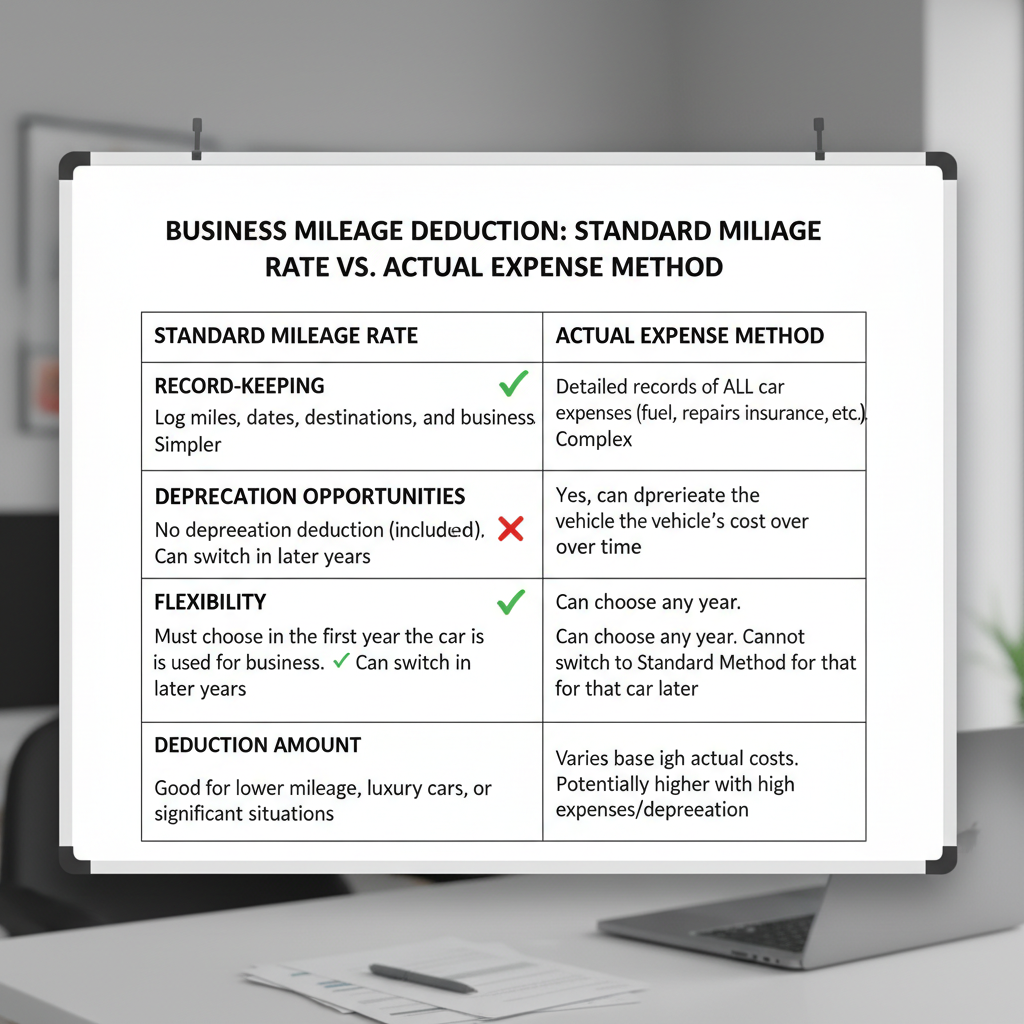
You must choose the Standard Mileage method in the first year you use the car for rideshare (or any business use) if you want the option to switch between methods later for that specific vehicle.
This is not merely a suggestion but a firm IRS mandate outlined in tax law. If you elect to use the Actual Expense Method in the very first year that you place your vehicle in service for business (e.g., your first year driving for a rideshare company with a particular car), you are permanently locked into the actual expense method for that vehicle for all subsequent years that you use it for business. You will never be able to switch to the standard mileage rate for that specific car.
Conversely, if you choose the Standard Mileage Rate in the first year you use the vehicle for business, you retain the flexibility to switch to the Actual Expense Method in later years. However, there’s a caveat: if you do switch from standard mileage to actual expenses, you must use the straight-line depreciation method for the remaining depreciable life of the vehicle. You cannot then switch back to the standard mileage rate for that vehicle once you’ve opted for actual expenses with straight-line depreciation. This limits the depreciation options available in subsequent years but still allows for the shift to actual expenses for other costs.
Why This Rule?
The IRS implements this rule primarily to prevent taxpayers from “double-dipping” on depreciation. The standard mileage rate includes an allowance for depreciation within its per-mile calculation. If a driver were allowed to deduct actual depreciation (which can be substantial with Section 179 or bonus depreciation) in the first year, and then switch to the standard mileage rate in subsequent years, they would effectively be claiming depreciation twice: once explicitly through the actual expense method and once implicitly through the standard mileage rate. This rule ensures fairness, prevents excessive deductions, and simplifies the IRS’s enforcement.
Implications for Rideshare Drivers
This rule makes the initial decision extremely important and requires foresight for rideshare and delivery drivers.
- Scenario 1: New Vehicle with High Value: If you purchase a new, expensive vehicle primarily for rideshare driving, and you anticipate significant depreciation deductions (like Section 179 or bonus depreciation) in the first year, using the Actual Expense Method initially might seem very appealing due to the potentially massive first-year write-off. However, doing so forfeits the ability to switch to standard mileage in future years if your actual expenses decrease (e.g., after the initial depreciation is fully claimed, or major repairs are no longer needed). You’re committing for the vehicle’s entire business life.
- Scenario 2: Older Vehicle with Little Remaining Depreciation: If you start rideshare driving with an older vehicle that has little remaining depreciable value, the standard mileage rate might be your best bet from the start, especially if it’s relatively fuel-efficient. Electing standard mileage in the first year keeps your options open, allowing you to transition to actual expenses later if unexpected, costly repairs arise.
- Strategic Flexibility: For many drivers, particularly those who are unsure of their long-term vehicle costs or who might upgrade vehicles frequently, starting with the standard mileage rate in the first year is the safer, more flexible approach. It allows you to assess your actual expenses in subsequent years and switch if a clearer benefit emerges from itemizing. You can always switch from standard mileage to actual expenses (albeit with the straight-line depreciation limitation), but never the other way around if you start with actual expenses. This flexibility can be invaluable as vehicle conditions and tax laws evolve.

Choosing the Right Method: A Strategic Comparison
Deciding between the 2026 IRS Standard Mileage Rate and the Actual Expense Method requires a careful evaluation of several factors unique to your situation. There’s no one-size-fits-all answer, and what works best for one driver might not be ideal for another. The optimal choice involves a blend of financial analysis, risk assessment, and personal preference for administrative tasks. To understand the various facets, Investopedia provides a useful comparison of standard mileage versus actual expenses.
Key Factors to Consider
-
Vehicle Age and Value:
- New, High-Value Vehicle: This category often benefits significantly from the Actual Expense Method, especially in the first year, due to substantial depreciation deductions (Section 179 or bonus depreciation). Forgoing this in the first year for standard mileage means losing a potentially massive deduction that year.
- Older Vehicle, Low Value: For vehicles that are already several years old and have minimal remaining depreciable value, the depreciation component of the actual expenses will be small. In such cases, the Standard Mileage Rate might be more favorable, especially if your actual maintenance costs aren’t exceptionally high.
- Mid-Range Vehicle (3-5 years old): This category could go either way. It necessitates a careful comparison of the projected standard mileage deduction against your actual fuel, maintenance, and insurance costs.
-
Annual Business Miles Driven:
- High Mileage: The more business miles you drive, the higher your deduction will be under the Standard Mileage Rate. If your actual costs per mile are consistently lower than the standard rate (e.g., you have a very fuel-efficient car with low maintenance), this method will likely be more beneficial. This is a common scenario for full-time rideshare drivers who rack up tens of thousands of business miles annually.
- Low Mileage: If you don’t drive many business miles for work but still incur significant fixed costs (like insurance, registration, or a substantial car payment), the actual expense method could yield a larger deduction, provided these fixed costs are substantial. The fixed costs are spread over fewer business miles under the actual method, potentially making each mile ‘worth’ more in deductions.
-
Fuel Efficiency of Your Vehicle:
- Fuel-Efficient Car (e.g., hybrid, EV): If your car consumes less fuel, your actual fuel expenses will naturally be lower. The standard mileage rate, which includes an allowance for fuel costs, might result in a higher deduction than your actual fuel outlays, making it a better choice.
- Gas-Guzzler: For vehicles with poor fuel economy or those that require premium fuel, actual fuel expenses can be very high. In these instances, the Actual Expense Method might be more advantageous, as your real costs could easily surpass the fuel component embedded in the standard rate.
-
Cost of Insurance and Maintenance:
- High Insurance/Maintenance Costs: If your insurance premiums are very high (e.g., for a younger driver or an expensive vehicle), or if your vehicle requires frequent, expensive repairs, these actual costs might push the Actual Expense Method to be more beneficial. These costs are often fixed or unpredictable but can be significant.
- Low Insurance/Maintenance Costs: Conversely, if these costs are minimal and your vehicle is reliable, the standard mileage rate might offer a better overall deduction, as it provides a consistent per-mile allowance that might exceed your actual low costs.
-
Personal Preference for Record-Keeping:
- Dislike of Paperwork: The Standard Mileage Rate is ideal if you prefer minimal receipt management and want to spend less time on tax-related administration. It simplifies tax preparation significantly.
- Organized and Detail-Oriented: If you are diligent about saving receipts, meticulously logging expenses, and comfortable with more complex calculations, the Actual Expense Method gives you the flexibility to pursue potentially larger deductions by capturing every possible expense.
-
The “First-Year” Rule’s Implications: As discussed, this is the most strategic decision point. If you start with actual expenses, you lose flexibility forever for that specific vehicle. If you start with standard mileage, you can always switch. For new rideshare drivers, using the standard mileage rate in the very first year provides a safety net and keeps options open for subsequent tax years, allowing for a more informed decision down the line.
Scenario Examples for Illustrative Purposes
-
Scenario A: Brand New Luxury SUV for Rideshare (First Year):
- Initial thought: The Actual Expense Method seems compelling due to the potential for massive Section 179 or bonus depreciation deductions in the first year. This could be tens of thousands of dollars in write-offs.
- Consideration: If you choose actual, you’re permanently committed to it for this vehicle. Will the subsequent years’ actual expenses (lower depreciation, potentially high fuel/maintenance) continue to make it worthwhile, or would standard mileage be better later?
- Strategic Tip: If the first-year actual expense deduction is truly overwhelming and significantly outweighs the standard mileage option, it might be worth the permanent commitment. However, carefully project future years’ expenses to ensure you don’t regret the lack of flexibility.
-
Scenario B: 5-Year-Old Fuel-Efficient Sedan for Rideshare (First Year):
- Initial thought: Standard Mileage is likely the best choice. There’s little depreciation left to claim with actual expenses, and the car’s fuel efficiency means lower actual operating costs.
- Consideration: This choice allows crucial flexibility. If in year two or three, the car starts needing significant, costly repairs, you could then switch to actual expenses to deduct those large repair bills.
- Strategic Tip: Start with standard mileage to keep options open. It’s often the safest bet for older, reliable vehicles.
-
Scenario C: Older, High-Maintenance Pickup Truck for Delivery Services:
- Initial thought: Actual Expenses. The vehicle likely consumes a lot of fuel, and older trucks often incur frequent, expensive repairs and maintenance.
- Consideration: The sheer volume of repairs and fuel costs might make actual expenses a clear winner from the start, consistently outpacing the standard mileage rate.
- Strategic Tip: Even if actual seems obvious, compare it against the standard mileage rate by tracking both for a period. Collect data for a few months (e.g., 3-6 months) to be sure before committing, especially if it’s the first year for business use.
Ultimately, the best approach is often to track both your mileage and your actual expenses for at least a portion of the tax year, especially in the first year of business use. This parallel tracking allows you to perform a direct comparison at tax time and confidently select the method that yields the greater deduction. Many tax software programs and professional tax preparers can help you run these comparisons before you file, providing a clear financial picture.
Record-Keeping: Your Best Defense Against the IRS
Regardless of whether you choose the standard mileage rate or the actual expense method, meticulous record-keeping is not merely a suggestion; it is a fundamental requirement by the IRS. Poor or incomplete records are a leading cause of disallowed deductions during an audit, potentially leading to additional taxes, penalties, and interest. Robust documentation is your primary defense.
For Standard Mileage Rate, your records should clearly show:
- Date of each business trip: Essential for substantiating the timing of your work.
- Starting and ending odometer readings for each trip: Or a consistent method to calculate miles per trip.
- Total miles driven for business: The cumulative figure is what gets multiplied by the IRS rate.
- The destination of the trip: This provides context for the travel.
- The business purpose of the trip: (e.g., “Rideshare passenger pickup/drop-off,” “delivery,” “picking up supplies for business”). This is critical for proving the business nature of the travel.
- Annual odometer readings at the beginning and end of the year: This establishes the total miles driven and helps justify your business-use percentage if ever questioned.
For Actual Expense Method, your records must include everything listed above for mileage, plus comprehensive financial documentation:
- All the mileage data required for the standard mileage rate: This is fundamental to establish your business-use percentage for all actual expenses.
- Every single receipt for fuel, oil, maintenance, repairs, tires, insurance, lease payments, car washes, and any other deductible expense: These receipts should ideally show the vendor, date, amount, and description of the item or service. Missing receipts mean missing deductions.
- Statements for car loan interest and personal property taxes: Official documents from lenders and government bodies.
- Purchase or lease agreement documents for the vehicle: Including the original cost and dates of service, crucial for depreciation calculations.
Leveraging Technology for Record-Keeping
Fortunately, numerous technological tools can significantly simplify this otherwise daunting task, making it easier to comply with IRS requirements and maximize your deductions:
- Mileage Tracking Apps: Apps like SherpaShare, Everlance, Stride Tax, and MileIQ use GPS to automatically track your drives. They often allow you to easily classify trips as business or personal with a swipe, generate detailed reports, and integrate with tax software. This automation significantly reduces the burden and improves accuracy.
- Expense Tracking Software: Apps like Expensify, QuickBooks Self-Employed, or even dedicated features within banking apps can help you photograph, categorize, and store digital copies of your receipts. These often offer reporting features that streamline tax preparation.
- Cloud Storage: Utilize services like Google Drive, Dropbox, or OneDrive to store scanned or photographed copies of all your physical receipts. This provides a secure, accessible backup and reduces the risk of losing important documentation. Organizing these into folders by month and year can make retrieval effortless.
Consistent and accurate record-keeping not only helps you maximize your deductions but also provides robust documentation should your tax return ever be selected for review by the IRS. It’s your primary defense and crucial for peace of mind, allowing you to confidently assert your rightful deductions.
Conclusion
The decision between the 2026 IRS Standard Mileage Rate and the Actual Expense Method is a pivotal one for rideshare and delivery drivers, directly impacting their take-home pay. While the standard mileage rate, projected here at 72.5 cents per mile, offers unparalleled simplicity and often provides a robust deduction for high-mileage drivers, the actual expense method can yield greater benefits for those with expensive vehicles, significant depreciation opportunities, or consistently high operating costs. The critical IRS rule regarding the first-year election—requiring standard mileage in the initial business-use year to preserve future flexibility—underscores the need for careful strategic planning and long-term foresight.
Ultimately, the optimal choice hinges on your specific vehicle characteristics, your annual business driving habits, the magnitude of your actual expenses, and your comfort level with meticulous record-keeping. By understanding the intricacies of both methods, making an informed first-year decision based on projected costs and potential benefits, and diligently maintaining comprehensive records, rideshare and delivery drivers can effectively navigate their tax obligations. This proactive approach ensures they claim every deduction they are legally entitled to for the 2026 tax year and beyond, optimizing their net income. When in doubt, consulting a qualified tax professional is always the wisest course of action to ensure compliance and maximize your tax savings.

Leave a Reply