
Can I Deduct Rideshare Insurance on My US Taxes?

The burgeoning gig economy has opened up significant earning opportunities for millions of Americans, with ridesharing services like Uber and Lyft standing out as prominent examples. Drivers for these platforms operate as independent contractors, a designation that carries unique tax responsibilities and potential deductions. Among the most common questions these drivers grapple with is the deductibility of their vehicle insurance. The landscape of auto insurance for rideshare drivers is complex, involving personal policies, specialized rideshare add-ons, and sometimes full commercial policies. Understanding how each of these is treated by the Internal Revenue Service (IRS) is crucial for maximizing deductions and ensuring tax compliance when filing your US taxes.
The confusion stems from the dual nature of the vehicle itself – it serves both personal and business purposes. This dual function necessitates a careful allocation of expenses. The IRS offers two primary methods for deducting vehicle-related expenses: the Standard Mileage Rate and the Actual Expense Method. The choice between these two methods profoundly impacts whether, and how, rideshare insurance can be deducted. Ignoring these nuances can lead to either missed deduction opportunities or, worse, disallowed deductions and potential penalties from the IRS. Navigating this landscape requires not just a basic understanding of tax rules, but meticulous record-keeping and strategic decision-making to accurately deduct rideshare insurance costs.
The Independent Contractor Status: A Foundation for Understanding Tax Obligations
Unlike traditional employees who receive a Form W-2 and have taxes withheld from each paycheck, rideshare drivers are classified as self-employed individuals. This means they are responsible for their own income tax, self-employment tax (which funds Social Security and Medicare), and often estimated taxes paid periodically throughout the year. As independent contractors, drivers report their income and expenses on Schedule C, Profit or Loss from Business (Sole Proprietorship), when filing their Form 1040, U.S. Individual Income Tax Return. This distinction is paramount because it allows for the deduction of ordinary and necessary business expenses – costs that are common and helpful for carrying on a trade or business. Vehicle expenses, including insurance, fall under this category, but only to the extent they are related to the business. Understanding this fundamental classification is the first step toward unlocking potential tax savings and avoiding common pitfalls regarding US taxes.
Vehicle Expense Deduction Methods: Standard Mileage vs. Actual Expenses
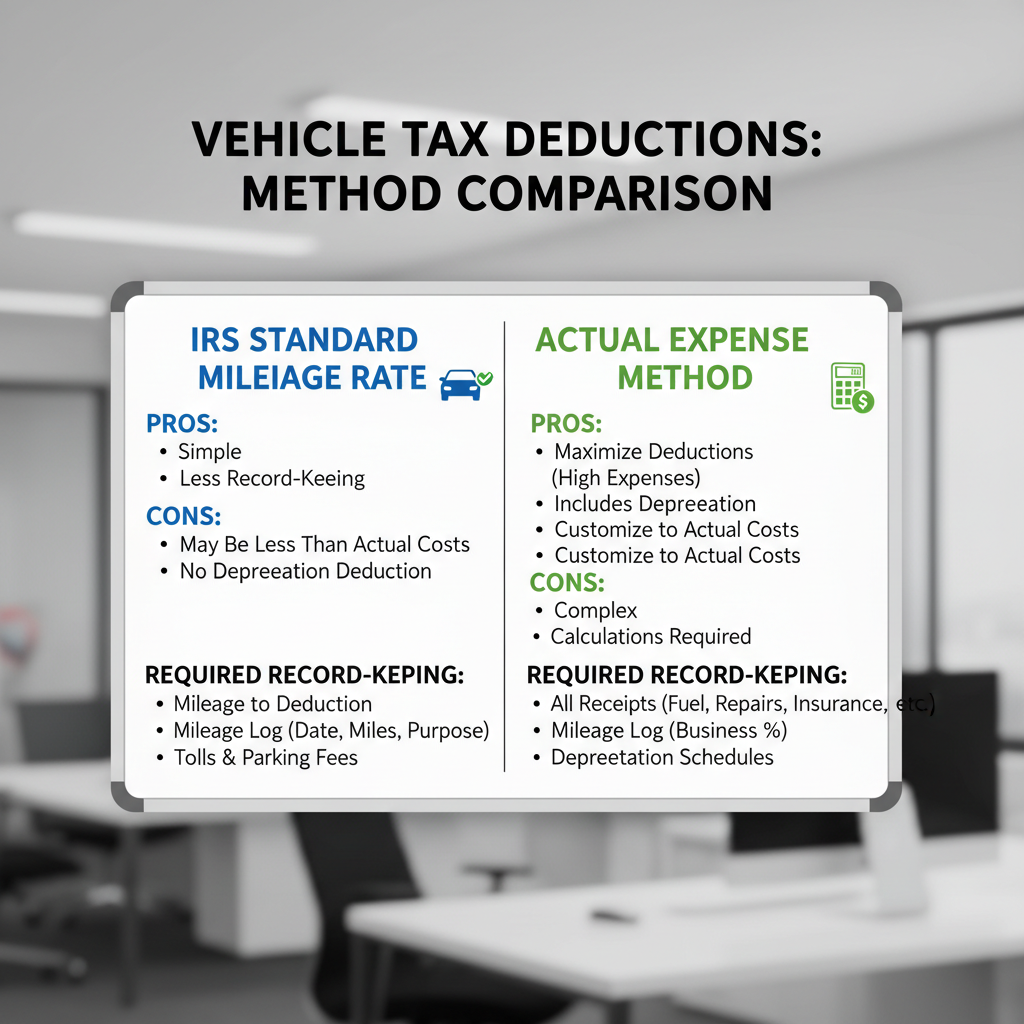
The IRS provides two distinct methods for deducting the costs associated with using your vehicle for business. The choice between these can significantly affect your tax liability and, crucially, how you treat your insurance premiums. It’s not merely a matter of convenience; it’s a strategic decision that should be re-evaluated annually based on your specific circumstances.
1. The Standard Mileage Rate Method
The IRS Standard Mileage Rate is designed to simplify tax deductions for vehicle use, making it an attractive option for many rideshare drivers who want to minimize administrative burden. Instead of tracking every single expense, drivers can deduct a set amount per business mile driven. This rate is comprehensive; it’s calculated annually by the IRS to include the average costs of owning and operating a vehicle. These costs typically encompass depreciation (or a portion of lease payments), fuel, oil, tires, repairs, maintenance, and, most importantly for this discussion, vehicle insurance.
For tax year 2024, the standard mileage rate for business use of a car is 67 cents per mile (this rate changes annually, so drivers must use the rate applicable to the tax year in question). When a driver opts for the standard mileage rate, the IRS considers that a portion of this rate has already accounted for their vehicle’s insurance expenses. Therefore, attempting to deduct insurance premiums separately when using the standard mileage rate would be a form of double-dipping, which the IRS explicitly disallows. This simplification eliminates the need to itemize various car-related costs, demanding only accurate tracking of business mileage. Many drivers find this method preferable due to its straightforward nature and reduced need for retaining dozens of receipts.
Implication for Insurance Deduction: If you choose the Standard Mileage Rate, you cannot deduct your rideshare insurance (or any vehicle insurance) separately. The cost of insurance is already built into the per-mile rate you are claiming. This simplicity is often appealing to drivers who prefer less record-keeping, as they only need to accurately track their business miles. However, it means foregoing the ability to deduct actual insurance premiums as a line-item expense, which might be higher than the embedded insurance portion of the standard rate, especially for newer vehicles or those with specialized rideshare policies. This is a critical point for rideshare drivers looking to understand how to deduct rideshare insurance on their US taxes.
2. The Actual Expense Method
For drivers choosing the Actual Expense Method, the path to deducting insurance premiums is clearer, but also significantly more demanding in terms of record-keeping. Under this method, a driver can deduct the actual, ordinary, and necessary costs associated with operating their vehicle for business purposes. This includes, but is not limited to, gas, oil, repairs, maintenance, depreciation (or a portion of lease payments), vehicle registration fees, interest on a car loan (if applicable), and, directly relevant to our topic, a portion of their vehicle insurance premium.
The critical caveat here is the “business-use percentage.” Since most rideshare drivers also use their vehicle for personal activities, they cannot deduct 100% of their vehicle expenses. Instead, they must determine the percentage of their total vehicle usage attributable to business. This percentage is calculated by dividing total business miles by total miles driven for the year. For instance, if a driver logs 30,000 total miles in a year, and 21,000 of those miles were for rideshare driving, their business-use percentage is 70% (21,000 / 30,000). This percentage must be applied to all actual vehicle expenses, ensuring that only the business portion is deducted.
Applying the Business-Use Percentage to Insurance: If a driver paid $1,800 in annual vehicle insurance premiums and their vehicle’s business use was determined to be 70%, they could deduct $1,260 ($1,800 * 0.70) as a business expense under the Actual Expense Method. This calculation applies to any type of vehicle insurance premium they pay – whether it’s a standard personal policy, a rideshare add-on, or a commercial policy. Meticulous record-keeping of mileage (both business and personal) and all vehicle-related expenses is absolutely essential to justify these deductions in the event of an IRS audit. This method requires a high degree of organizational discipline, as every claimed expense must be supported by appropriate documentation.
Deciphering Insurance Types for Rideshare Drivers and Their Tax Treatment
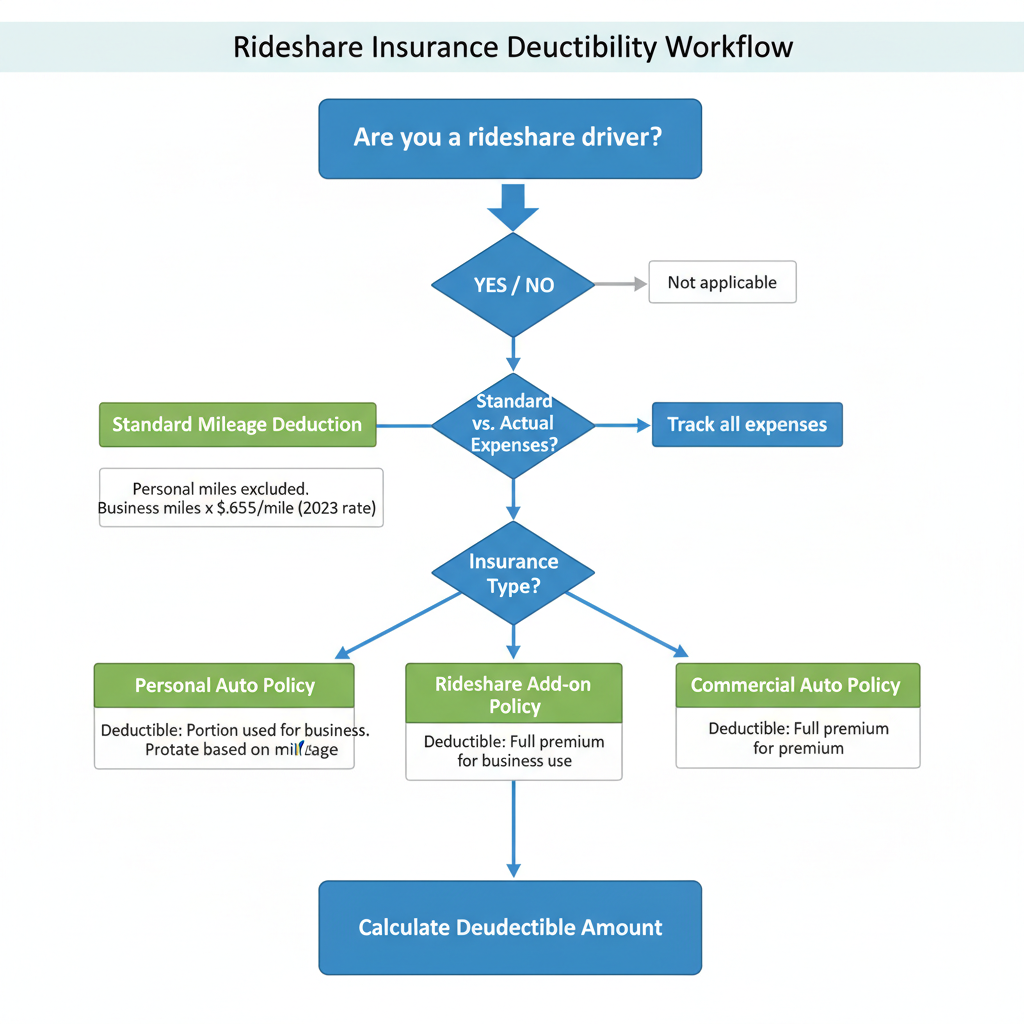
The type of insurance a rideshare driver carries is another layer of complexity influencing deductibility. The insurance market has evolved to address the unique risks associated with ridesharing, leading to different policy structures, each with its own tax implications regarding how you can deduct rideshare insurance.
1. Standard Personal Auto Insurance
A standard personal auto insurance policy is designed to cover personal use of a vehicle. Crucially, most personal policies explicitly exclude coverage for commercial activity or “for-hire” transportation. This means if you get into an accident while logged into a rideshare app (especially without a passenger), your personal insurer might deny your claim, leaving you unprotected and potentially liable for significant costs. This coverage gap is a serious financial risk for rideshare drivers.
Tax Treatment: Unless you have a specific endorsement or your personal policy is specifically designed to cover rideshare activity (which is rare for a “standard” policy), merely having personal insurance does not qualify it as a directly deductible business expense specifically for rideshare operations. However, if you are using the Actual Expense Method, a prorated portion of your personal auto insurance premium can be deducted if that vehicle is also used for business, regardless of its specific coverage for rideshare operations. The deduction here is based on the vehicle’s overall business use, not necessarily the policy’s adequacy for rideshare. It’s a general cost of having the car available for business. While this offers a deduction, it’s vital to remember that relying solely on personal insurance for ridesharing is a significant risk due to coverage gaps during business activities.
2. Rideshare Insurance Add-ons (Hybrid Policies/Endorsements)
Recognizing the gap in coverage between personal policies and commercial activities, many reputable insurance providers now offer “rideshare endorsements” or “hybrid policies.” These are typically add-ons to a personal auto insurance policy that extend coverage for the period when a driver is logged into a rideshare app but has not yet accepted a ride, or is on their way to pick up a passenger (often referred to as Period 1). This crucial add-on bridges the gap between a driver’s personal policy and the limited liability coverage provided by the rideshare companies themselves, which often only fully activate once a passenger is in the vehicle or a ride has been accepted. These hybrid policies are a smart choice for most drivers, offering better protection.
Tax Treatment: Premiums paid for dedicated rideshare insurance add-ons or hybrid policies are clearly identifiable as a business expense. If a driver uses the Actual Expense Method, the cost of these add-ons is deductible, prorated for the percentage of business use of the vehicle. For example, if a rideshare add-on costs an extra $200 per year, and the driver’s business use percentage is 75%, they can deduct $150 of that add-on premium. These are legitimate costs incurred to conduct the rideshare business safely and legally, making their deductibility straightforward under the Actual Expense method.
3. Commercial Auto Insurance
A full commercial auto insurance policy is typically designed for vehicles used exclusively or primarily for business purposes or for businesses that transport passengers or goods regularly. While more comprehensive and often more expensive than personal or hybrid policies, commercial policies offer robust coverage for all phases of rideshare activity, leaving no significant gaps. Some rideshare platforms or local regulations might even mandate commercial insurance in certain scenarios, particularly for drivers operating taxis or livery services that also integrate with rideshare apps.
Tax Treatment: Premiums for commercial auto insurance are unequivocally a business expense. If the vehicle is used exclusively for rideshare business, then 100% of the commercial insurance premium is deductible under the Actual Expense Method. If the vehicle also has personal use, then the premium must be prorated based on the business-use percentage, just like any other vehicle expense. This is generally the most straightforward insurance type for tax deduction purposes because its primary intent is business coverage, simplifying the justification for its deductibility.
4. Platform-Provided Insurance (Uber/Lyft, etc.)
It’s important to differentiate between insurance a driver pays for directly and insurance provided by the rideshare platform. Uber and Lyft, for example, provide varying levels of liability insurance coverage to their drivers, which kicks in during different phases of the rideshare process (e.g., when logged in and waiting for a ride, or when a passenger is in the vehicle). This coverage is crucial for driver protection.
Tax Treatment: Drivers do not typically pay a separate premium directly to Uber or Lyft for this coverage. Instead, the cost is built into the service fees charged by the platform. Since drivers are not incurring a direct out-of-pocket expense for this specific insurance, it cannot be deducted on their tax return. It’s an operating cost absorbed by the rideshare company, not the independent contractor driver, and therefore not a direct deductible expense for the driver.
The Deduction Dilemma: When Insurance Can (and Cannot) Be Deducted
To summarize the core question and provide absolute clarity on how to deduct rideshare insurance on your US taxes:
-
Scenario 1: Using the Standard Mileage Rate
- NO DEDUCTION FOR INSURANCE. This cannot be stressed enough. If you elect to use the Standard Mileage Rate, the IRS explicitly states that the cost of insurance is already factored into the per-mile rate. Deducting it separately would be a disallowed “double deduction,” which could trigger an IRS inquiry or audit. This method simplifies record-keeping but bundles all vehicle-operating costs into one comprehensive rate. Drivers choosing this method must accept that their actual insurance premiums are not itemizable.
-
Scenario 2: Using the Actual Expense Method
- YES, DEDUCTION IS POSSIBLE. This is where insurance premiums can be deducted. The key is the business-use percentage. This method requires a detailed breakdown of all actual vehicle expenses.
- What qualifies: The prorated portion of your standard personal auto insurance premium attributable to business use, provided the vehicle is used for business purposes.
- What qualifies (better): The prorated portion of your dedicated rideshare insurance add-on premium attributable to business use. These add-ons are specifically designed for the business aspect of ridesharing, making their deduction more directly justifiable.
- What qualifies (best): The prorated portion of your full commercial auto insurance premium attributable to business use. For vehicles used exclusively for rideshare, 100% of the commercial insurance premium can be deducted.
- Regardless of the type of insurance (personal prorated, rideshare add-on, or commercial), the amount you can deduct is limited to the business-use percentage of the vehicle. For example, if your total annual insurance premium is $2,000 and your business-use percentage is 70%, you can deduct $1,400 ($2,000 * 0.70). This method rewards diligent record-keeping with potentially higher deductions tailored to your actual expenses.
- YES, DEDUCTION IS POSSIBLE. This is where insurance premiums can be deducted. The key is the business-use percentage. This method requires a detailed breakdown of all actual vehicle expenses.
The Importance of Meticulous Record-Keeping
Regardless of the deduction method chosen, accurate and contemporaneous record-keeping is non-negotiable for rideshare drivers. The IRS requires substantiation for all deductions claimed, and failing to provide adequate records can lead to disallowed deductions, back taxes, interest, and penalties. The burden of proof rests entirely on the taxpayer.
-
For the Standard Mileage Rate:
- You must maintain a detailed log of all business miles driven. This includes the date, starting and ending odometer readings for each trip, total miles for each trip, destination, and the business purpose (e.g., “driving for Uber,” “driving to pick up passenger”). Many apps (like Mileage Tracker by Stride, Everlance, or Hurdlr) can automate this process using GPS tracking, making it significantly easier to comply. Without a robust mileage log, the IRS could disallow your entire vehicle deduction, potentially converting a large deduction into a substantial tax liability.
-
For the Actual Expense Method:
- Mileage Log: Even more critical than for the standard rate, as it determines your crucial business-use percentage. You need to record both business miles and total miles for the year. This involves tracking every mile the car is driven, both for rideshare and personal use.
- Insurance Documents: Keep all insurance policy declarations, premium statements, and proof of payment (e.g., bank statements, credit card statements, cancelled checks). It’s wise to store these digitally as well as physically.
- All Other Vehicle Expenses: Maintain receipts and records for every actual expense incurred. This includes, but is not limited to:
- Fuel purchases (date, amount, vendor)
- Oil changes and routine maintenance (date, service description, cost)
- Repairs (date, nature of repair, cost)
- Tires (purchase date, cost)
- Vehicle registration fees and license plate costs
- Interest paid on a car loan (if applicable, prorated for business use; you’ll typically receive Form 1098 from your lender)
- Lease payments (if applicable, prorated for business use)
- Depreciation (if you own the vehicle and elect to take actual expenses, you cannot switch to standard mileage in future years if you claim depreciation in the first year unless you used straight-line depreciation). This often requires the assistance of a tax professional.
The IRS provides clear guidelines in IRS Publication 463, Travel, Gift, and Car Expenses, emphasizing the need for contemporaneous records. This means recording expenses as they occur, or soon thereafter, rather than attempting to reconstruct them months later at tax time. Digital tools and apps can greatly simplify this process, providing a verifiable and organized audit trail.
Other Key Tax Considerations for Rideshare Drivers
While insurance deductibility is a major concern, it’s part of a broader tax picture for rideshare drivers. Understanding these additional aspects is vital for comprehensive tax planning and maximizing overall tax efficiency.
1. Self-Employment Tax
As independent contractors, rideshare drivers are subject to self-employment tax, which covers Social Security and Medicare taxes. For 2024, the self-employment tax rate is 15.3% on net earnings up to $168,600 for Social Security and 2.9% on all net earnings for Medicare. This means drivers pay both the employer and employee portions of these taxes. However, drivers can deduct one-half of their self-employment tax from their gross income when calculating their adjusted gross income (AGI). This deduction helps to offset the burden of paying both portions, but it’s crucial to account for this significant tax liability. More information can be found at the IRS Self-Employed Individuals Tax Center.
2. Estimated Taxes
The U.S. tax system operates on a “pay-as-you-go” basis. Since rideshare companies do not withhold income tax from driver earnings, independent contractors are generally required to pay estimated taxes quarterly. These payments cover income tax and self-employment tax. If you expect to owe at least $1,000 in tax for the year, you should pay estimated taxes using Form 1040-ES, Estimated Tax for Individuals. Failure to do so can result in penalties for underpayment, even if you pay all your taxes by the annual deadline. Planning for these payments is a critical part of financial management for self-employed individuals.
3. Qualified Business Income (QBI) Deduction (Section 199A)
Eligible self-employed individuals and small business owners may be able to deduct up to 20% of their qualified business income. This deduction, enacted under the Tax Cuts and Jobs Act of 2017, can significantly reduce a driver’s taxable income by reducing the amount of income subject to ordinary income tax rates. The QBI deduction is subject to income limitations and other rules, making it beneficial to consult with a tax professional to ensure eligibility and proper calculation. This can be a substantial tax benefit, especially for higher-earning drivers.
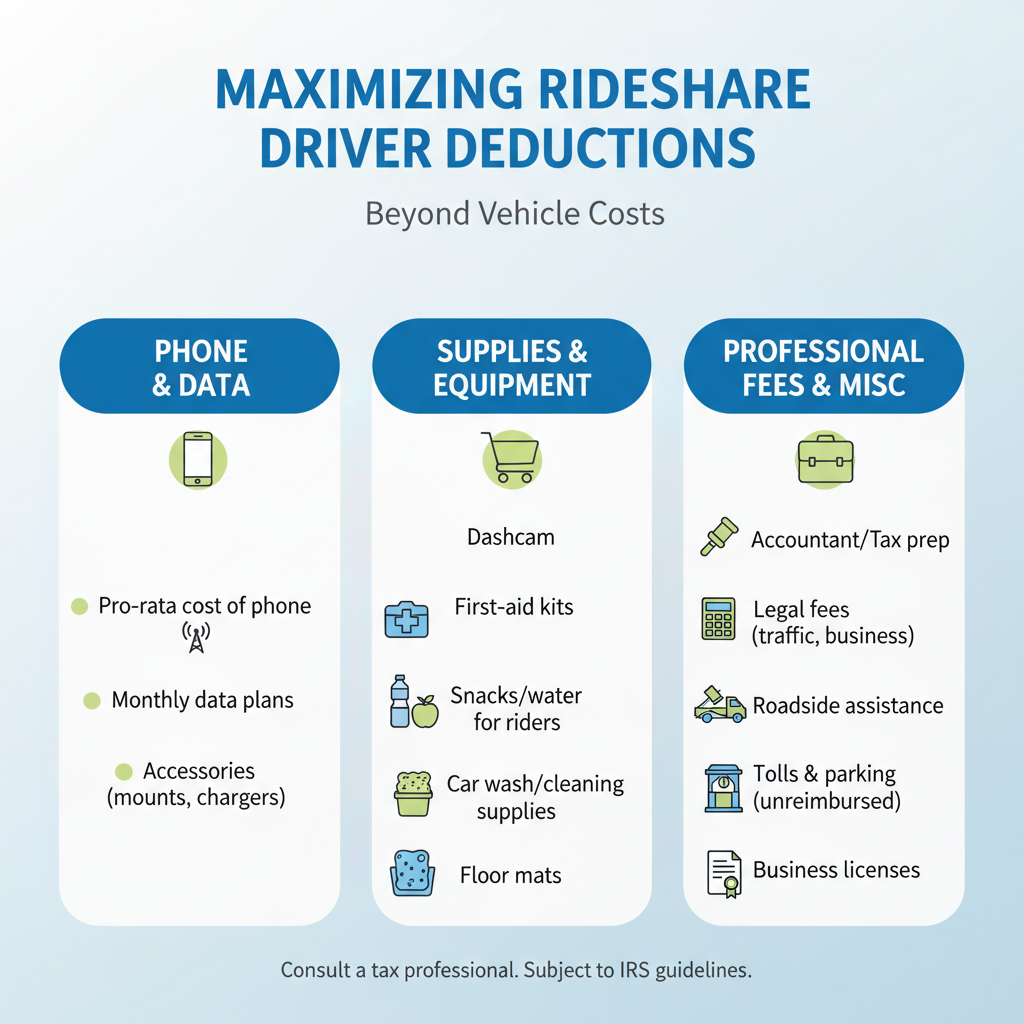
4. Other Deductible Business Expenses
Beyond vehicle expenses, many other costs are deductible for rideshare drivers. These expenses must be ordinary and necessary for your business:
* Cell Phone and Service: A prorated portion of your cell phone bill and the depreciation of your device if used for business. The business-use percentage should be applied here as well.
* Supplies: Items like bottled water, snacks, tissues, hand sanitizer, first-aid kits, or small treats provided to passengers. Even car air fresheners and seat covers can be deductible if primarily for business presentation.
* Commissions and Fees: Any fees paid to the rideshare platform that aren’t already deducted from your gross earnings before reporting on Form 1099-NEC. This includes booking fees or platform service charges.
* Roadside Assistance Memberships: A prorated portion of services like AAA or other motor club memberships if used for business purposes.
* Car Washes/Cleaning: Regular car washes and interior detailing services to maintain a professional appearance for passengers are legitimate business expenses.
* Tolls and Parking Fees: If incurred during business use and not reimbursed by the rideshare platform or passenger. This includes tolls on routes for pickups or drop-offs, and parking fees when waiting for rides in certain areas.
* Professional Services: Fees paid to tax preparers, accountants, or legal professionals who assist with your rideshare business taxes or other business-related matters.
* Training and Education: Courses or materials related to improving your rideshare service, such as defensive driving courses or customer service training.
5. Home Office Deduction
While less common for rideshare drivers who primarily work from their vehicle, if you use a specific area of your home exclusively and regularly as your principal place of business for administrative or management activities (e.g., managing schedules, reviewing earnings, completing tax paperwork for your rideshare business), you might qualify for the home office deduction. This is usually more applicable to drivers who spend significant time on administrative tasks beyond just driving. It can be claimed using either the simplified method or the regular method, each with its own requirements.
Choosing Between Standard Mileage and Actual Expenses: A Strategic Decision
The decision between the Standard Mileage Rate and the Actual Expense Method is one of the most critical tax choices for a rideshare driver. It’s not a one-size-fits-all answer and often depends on several factors that can change from year to year. A careful comparison each tax season can lead to significant savings.
- Age of Vehicle: Older vehicles with higher maintenance and repair costs, or those fully depreciated, might favor the Standard Mileage Rate because their actual depreciation is low, and the standard rate offers a fixed, often generous, allowance for vehicle wear and tear. Newer vehicles with high depreciation, significant loan interest, or expensive insurance premiums might benefit more from the Actual Expense Method, as these specific costs can be substantial.
- Total Mileage: Drivers with very high business mileage often find the Standard Mileage Rate simpler and sometimes more lucrative, as the per-mile deduction adds up quickly without requiring extensive itemization of expenses. Conversely, drivers with moderate business mileage but very high actual costs (e.g., expensive repairs) might lean towards Actual Expenses.
- Cost of Vehicle: A more expensive vehicle will naturally have higher depreciation, interest, and potentially insurance costs. These higher actual costs often make the Actual Expense Method more beneficial, allowing drivers to deduct a larger specific dollar amount.
- Maintenance and Repair Costs: If you had significant repair expenses in a given year (e.g., a major engine repair or accident damage), the Actual Expense Method might yield a much higher deduction than the standard rate, which averages out these costs over many drivers.
- Record-Keeping Preference: If you prefer minimal record-keeping and detest saving receipts, the Standard Mileage Rate is the clear winner for its simplicity. If you are diligent with receipts and mileage logs, and are comfortable tracking every detail, the Actual Expense Method offers more precision and potentially higher deductions, tailored precisely to your individual vehicle’s costs.
Important Note on Switching Methods:
You generally have flexibility in choosing your method each year. However, there are crucial rules to be aware of:
* If you claim actual expenses for a vehicle in the first year it is placed in service for business, and you choose to depreciate it using a method other than the straight-line method (e.g., accelerated depreciation) or you claim a Section 179 deduction or bonus depreciation, you must continue to use the Actual Expense Method for that vehicle in all subsequent years. This locks you into the actual expense method for that specific vehicle.
* If, in the first year, you don’t claim accelerated depreciation (using straight-line instead), you can switch between methods in later years.
* Conversely, if you choose the Standard Mileage Rate in the first year the vehicle is used for business, you can switch to the Actual Expense Method in a later year, but you’ll have to use the straight-line method of depreciation for that vehicle. This nuance is critical and often overlooked, and it can significantly impact your long-term deduction strategy. It’s advisable to consult with a tax professional when making this initial choice and any subsequent changes.
Practical Steps for Rideshare Drivers Regarding Insurance Deductions:
To navigate the complexities of rideshare insurance deductions effectively, proactive measures are key.
1. Understand Your Insurance Policy
Thoroughly review your auto insurance policy. Know exactly what type of coverage you have (personal, rideshare add-on, commercial) and what it specifically covers in different rideshare phases (logged off, logged on waiting, logged on with passenger). This is paramount for both tax purposes (identifying deductible premiums) and personal financial protection (avoiding uninsured liabilities). Don’t assume your personal policy covers rideshare activity; verify it. Many drivers find that a dedicated rideshare add-on or a commercial policy provides superior protection and clarifies deductibility.
2. Track Everything from Day One
Begin tracking your mileage and expenses from the moment you start ridesharing. A robust system (whether manual or app-based) for mileage, fuel, maintenance, and insurance premiums will save you immense headaches at tax time. Consistency is vital. Digital apps are often the most efficient way to capture mileage, as they use GPS to log trips automatically. Keep digital copies of all receipts and statements for at least three years, as this is the typical audit period for the IRS. Good record-keeping not only supports your deductions but also helps you understand the true profitability of your rideshare business.
3. Consult a Tax Professional
Given the complexities of self-employment taxes, vehicle deductions, and the nuances of rideshare insurance, consulting a qualified tax professional who specializes in gig economy taxes is highly recommended. They can help you choose the most advantageous deduction method, ensure compliance with evolving tax laws, and identify all eligible deductions specific to your unique situation. They can also guide you through potential state-specific tax implications, which can vary significantly. A professional can also advise on other business structures or tax planning strategies that could benefit you as an independent contractor.
4. Keep Separate Records
If possible, consider maintaining separate bank accounts or credit cards for business expenses. This creates a clear financial boundary between personal and business finances, simplifying expense tracking, reconciliation, and audit preparedness. When all business transactions flow through a dedicated account, it makes it far easier to compile information for your Schedule C. This practice also helps in identifying all deductible expenses and calculating your business-use percentage more accurately for tax purposes.
Conclusion
The question of whether rideshare insurance is deductible on your US taxes is not a simple yes or no. It fundamentally hinges on the deduction method you choose for your vehicle expenses. If you opt for the simplicity of the Standard Mileage Rate, your insurance premiums are already accounted for within that rate and cannot be deducted separately. This method offers convenience at the cost of itemizing actual insurance costs. However, if you embrace the more rigorous record-keeping required by the Actual Expense Method, then a prorated portion of your rideshare insurance (whether an add-on or a commercial policy, or even your personal policy if used for business) can indeed be a legitimate and valuable business deduction. This method, while demanding more effort, often leads to higher deductions, especially for newer vehicles or those with substantial operating costs.
Navigating the tax landscape as a rideshare driver requires diligence, accurate record-keeping, and a clear understanding of IRS rules. By familiarizing yourself with the nuances of vehicle expense deductions, the specific treatment of different insurance types, and other available deductions for self-employed individuals, you can optimize your tax position, minimize your tax liability, and ensure you remain compliant with tax law. This proactive approach allows you to focus on earning income in the dynamic gig economy with confidence and peace of mind, knowing your tax affairs are in order.

Leave a Reply