
Quarterly Estimated Taxes: How to Calculate and Pay Form 1040-ES to Avoid Penalties
The American tax system operates on a “pay-as-you-go” principle, meaning taxpayers are generally expected to pay income tax as they earn or receive income throughout the year. For most wage earners, this obligation is met through paycheck withholdings. However, a significant portion of the workforce, including freelancers, independent contractors, small business owners, and individuals with substantial investment or rental income, do not have taxes withheld from their earnings. This often leads to a rude awakening at tax time when they discover they owe a large sum and, worse, face an unexpected underpayment penalty from the IRS. This article delves into the intricacies of quarterly estimated taxes, focusing on who needs to pay, the critical deadlines, and how to accurately calculate and submit payments using Form 1040-ES to avoid those unwelcome IRS interest charges.
Understanding Estimated Taxes: Who Needs to Pay?
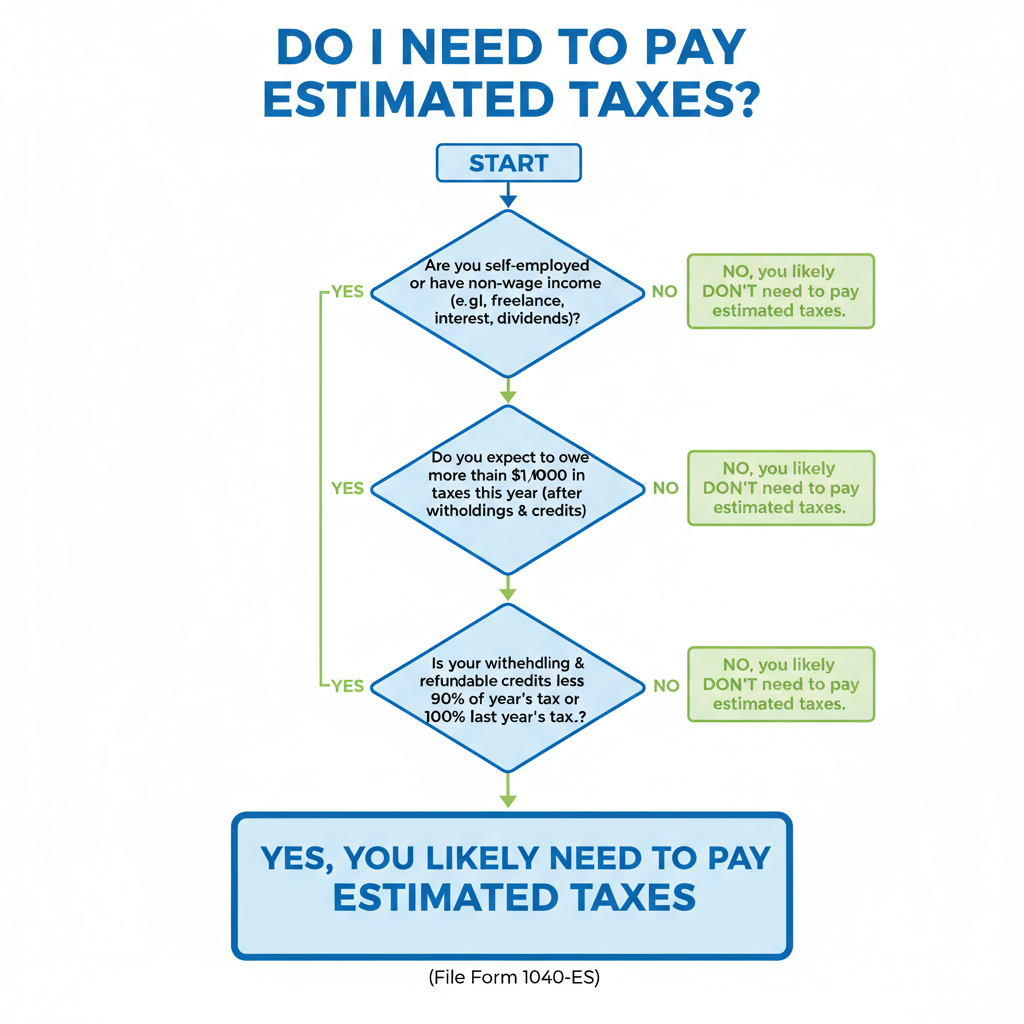
The fundamental rule for estimated taxes is straightforward: if you expect to owe at least $1,000 in tax for the year, and that amount isn’t covered by withholding (or you have no withholding), you are generally required to pay estimated taxes quarterly. This threshold applies to federal income tax, self-employment tax, and any other taxes you expect to owe. The IRS’s “pay-as-you-go” system is designed to ensure a steady flow of revenue throughout the year, rather than a single lump sum at the tax deadline. Failing to meet this ongoing obligation can result in penalties, even if the total tax due is eventually paid.
Common Scenarios Requiring Estimated Payments:
- Self-Employed Individuals: This comprehensive category includes independent contractors, gig workers, small business owners operating as sole proprietors, partners in a partnership, or members of a multi-member LLC taxed as a partnership. Income from these sources is not subject to employer withholding, making estimated payments a necessity. This applies to a wide range of professions, from freelance graphic designers and consultants to ride-share drivers and artisans selling goods online. For drivers, understanding obligations like the 1099-K Myth: Why Rideshare Drivers Still Owe Taxes is crucial even without a specific tax form. Even if self-employment is a part-time endeavor, if it generates significant income, estimated taxes become a critical consideration.
- Individuals with Significant Non-Wage Income: This can include:
- Investment Income: Interest from savings accounts or bonds, dividends from stocks, and capital gains from the sale of stocks, real estate, or other assets. These gains can often be unpredictable but must be accounted for.
- Rental Income: From properties you own, after deducting allowable expenses. Landlords, whether managing a single property or a portfolio, fall into this category.
- Alimony: For divorce agreements executed before 2019, alimony received is taxable and may necessitate estimated payments.
- Prizes and Awards: Substantial winnings from lotteries, sweepstakes, or even game shows can lead to a significant tax liability.
- Retirement Income: If your pension or annuity payments are not fully withheld, or if you’re taking distributions from an IRA or 401(k) without sufficient tax being withheld.
- Certain Pass-Through Business Income: For owners of S corporations or partnerships, where business profits are passed through to their personal tax returns. While the business itself may not pay corporate tax, the individual owners are taxed on their share of the profits.
- Individuals with Insufficient Withholding: Even if you have a W-2 job, you might need to make estimated payments if your income from other sources is substantial, or if your W-4 withholding isn’t accurately adjusted to cover your total tax liability. This often happens when individuals have multiple jobs, significant investment income, or have undergone life changes like marriage or the birth of a child that impact their overall tax picture.
The “Safe Harbor” Rules:
To avoid an underpayment penalty, you generally need to pay at least 90% of your current year’s tax liability or 100% of your prior year’s tax liability, whichever is smaller, through a combination of withholding and estimated tax payments. For higher-income taxpayers (those with an adjusted gross income (AGI) exceeding $150,000 in the prior year, or $75,000 for married individuals filing separately), the “prior year” safe harbor increases to 110% of the prior year’s tax liability. Meeting one of these safe harbors throughout the year ensures you won’t face a penalty, even if your final tax bill is higher. These rules provide a clear benchmark for taxpayers aiming to avoid penalties. The IRS provides detailed guidance on estimated taxes for a deeper understanding of these requirements.
Exceptions to the Rule:
While the $1,000 threshold and safe harbors cover most taxpayers, some exceptions exist:
* Farmers and Fishermen: Special rules apply, generally allowing them to make one payment by January 15 of the following year if they pay at least 2/3 of their tax by that date, or file their return and pay all tax by March 1. This recognizes the seasonal nature of their income.
* Casualty or Disaster Victims: The IRS may waive penalties in certain circumstances where an underpayment is due to an unforeseen and severe event, making it inequitable to impose a penalty.
* Retirees and Disabled Individuals: Penalties may be waived if the underpayment was due to reasonable cause and not willful neglect, especially for newly retired or disabled individuals. This consideration acknowledges significant life changes that can impact income and ability to plan for tax obligations.
Understanding whether you fall into one of these categories is the first crucial step in managing your tax obligations and proactively preventing penalties. Neglecting this initial assessment is a common pitfall for many taxpayers.
The Four Annual Deadlines: Mark Your Calendar!
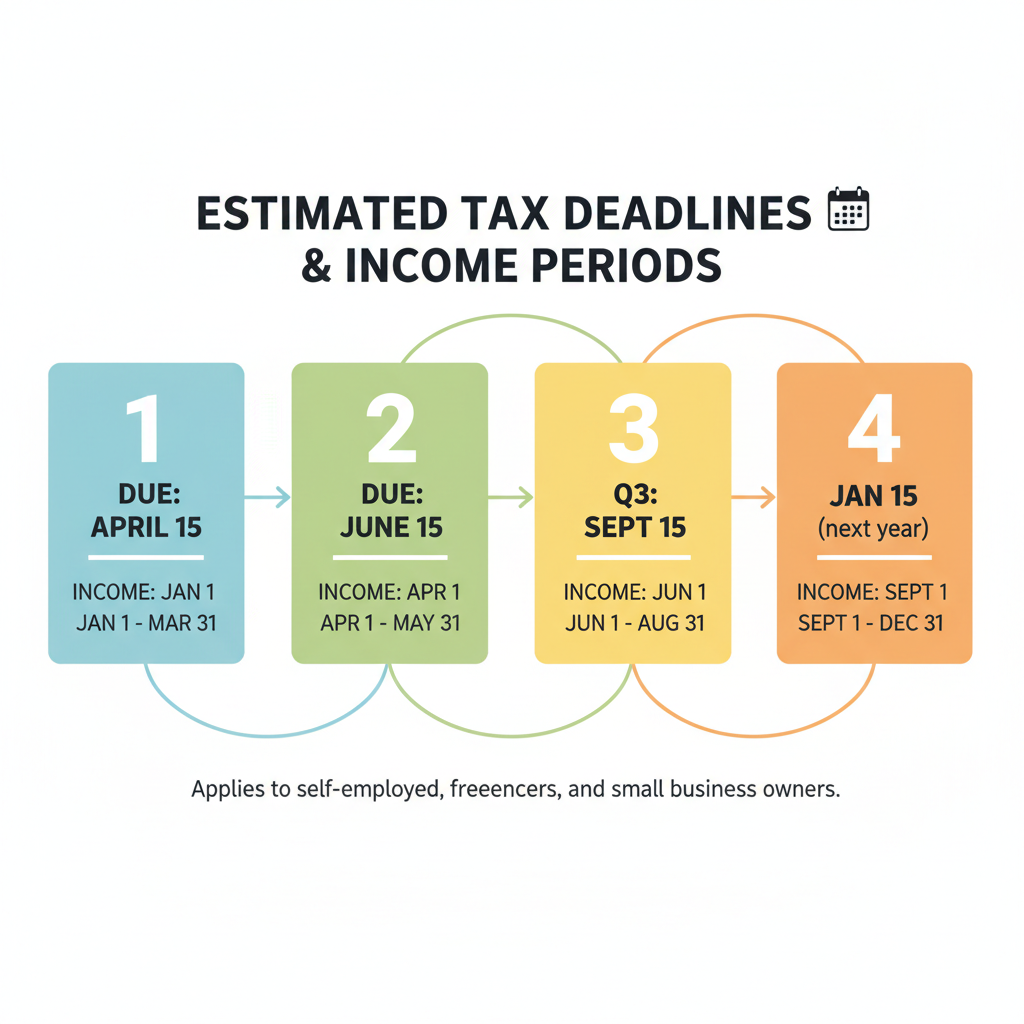
Estimated tax payments are generally due in four installments throughout the year. These deadlines are crucial, as missing them can trigger penalties, even if you eventually pay the full amount due. The payment periods are not evenly divided, and neither are the deadlines, which can often catch taxpayers off guard. This uneven distribution is a key reason why meticulous planning is necessary.
Here are the four key federal estimated tax deadlines:
-
First Payment: April 15
- Covers Income Earned From: January 1 to March 31 of the current tax year.
- Typical Payment Period: This payment is due shortly after the previous tax year’s filing deadline, often coinciding with the rush of annual tax filings. It represents the first three months of income.
-
Second Payment: June 15
- Covers Income Earned From: April 1 to May 31 of the current tax year.
- Typical Payment Period: This payment covers a shorter, two-month period compared to the first, reflecting the rapid progression through the first half of the year.
-
Third Payment: September 15
- Covers Income Earned From: June 1 to August 31 of the current tax year.
- Typical Payment Period: Another three-month period, covering the summer months and leading into the final quarter.
-
Fourth Payment: January 15 of the Next Year
- Covers Income Earned From: September 1 to December 31 of the current tax year.
- Typical Payment Period: This payment covers the final quarter of the tax year, summarizing the last portion of the income earned. Although it falls in the new calendar year, it pertains to the previous tax year’s income.
Important Considerations for Deadlines:
- Weekends and Holidays: If any of these due dates fall on a weekend or legal holiday, the deadline is shifted to the next business day. For example, if April 15 is a Saturday, the deadline moves to Monday, April 17. This is a common IRS rule for many tax deadlines.
- State Estimated Taxes: Many states also require estimated tax payments, often following a similar schedule to the federal deadlines. It’s essential to check your specific state’s requirements, as the payment amounts and rules can vary significantly. Ignoring state obligations can lead to additional penalties from state tax authorities.
- Farmers and Fishermen (Revisited): As noted, if at least two-thirds of your gross income for the current or prior tax year was from farming or fishing, you have the option to make just one estimated tax payment by January 15 of the following year. Alternatively, you can file your annual tax return and pay all tax by March 1 of the following year, bypassing estimated payments entirely. This flexibility acknowledges the unique income patterns in these industries.
- Late Payments: Penalties for underpayment of estimated taxes are generally calculated based on the IRS interest rate applied to the amount underpaid for the period it was unpaid. Even if you pay the full amount due by the April 15 filing deadline, if your quarterly payments were insufficient or late, a penalty can still apply. This emphasizes that timeliness of payments throughout the year is as crucial as the total amount paid.
Timely payment is just as important as accurate calculation. Missing a deadline can trigger penalties, negating the effort put into proper tax planning. Setting reminders, utilizing calendar alerts, or automating payments through electronic systems can be an effective strategy to stay on track and avoid the stress and cost of late payments.
Calculating Your Estimated Tax: The Form 1040-ES Worksheet
The core of managing estimated taxes lies in accurately projecting your income, deductions, and credits for the entire tax year. The IRS provides Form 1040-ES, Estimated Tax for Individuals, which includes a worksheet designed to guide you through this process. While the worksheet may seem daunting at first glance, it’s a systematic approach to ensure you’re paying enough to meet your obligations and avoid those dreaded underpayment penalties. It essentially walks you through a hypothetical tax return for the current year.
Here’s a step-by-step breakdown of how to use the Form 1040-ES worksheet:
Step 1: Estimate Your Adjusted Gross Income (AGI)
This is often the most challenging part, especially for self-employed individuals with fluctuating income or those with variable investment gains. Your AGI is your gross income minus certain above-the-line deductions.
- Project All Income Sources: Consider every possible source of income you expect to receive throughout the year. Be thorough and realistic.
- Self-Employment Income: Project your gross receipts from your business or freelance activities. Then, subtract your anticipated ordinary and necessary business expenses (e.g., supplies, home office deductions, advertising, professional fees, cost of goods sold). For drivers, deciding between Standard Mileage vs. Actual Expenses for Drivers is a significant factor in this calculation. This net figure is crucial for both income tax and self-employment tax calculations. Using prior years’ Schedule C figures as a baseline and adjusting for expected growth or decline is a prudent approach.
- Wages and Salaries (if any): If you also have a W-2 job, include your anticipated gross wages. Remember to account for any expected raises or job changes.
- Investment Income: Estimate interest from savings accounts, certificates of deposit (CDs), dividends from stocks (qualified and ordinary), and any capital gains you anticipate from selling assets like stocks, mutual funds, or real estate. This requires foresight, especially for capital gains, but ignoring them can lead to a significant shortfall.
- Rental Income: Project your gross rental income and meticulously subtract anticipated rental expenses (e.g., mortgage interest, property taxes, insurance, repairs, depreciation, management fees).
- Other Income: Include alimony (for pre-2019 agreements), pension/annuity income, Social Security benefits (if taxable), unemployment benefits, gambling winnings, and any other income that is subject to federal income tax.
- Utilize Prior Year’s Return: Your previous year’s Form 1040, Schedule C (for sole proprietors), and Schedule SE (for self-employment tax) are invaluable starting points. They offer a historical snapshot of your income and expenses. Adjust these figures for any expected changes in your business operations, investments (e.g., selling a major asset), or personal financial situation (e.g., marriage, new dependents, retirement).
- Above-the-Line Deductions: Subtract any deductions you expect to take that reduce your AGI, such as deductible IRA contributions, student loan interest, self-employment health insurance premiums, or one-half of your self-employment tax (which will be calculated later in this process). These deductions are particularly important as they directly lower your AGI.
Step 2: Calculate Your Deductions and Credits
- Standard Deduction vs. Itemized Deductions: Decide whether you’ll take the standard deduction (which changes annually based on filing status) or itemize your deductions. If you anticipate your itemized deductions (e.g., state and local taxes, mortgage interest, charitable contributions, certain medical expenses) will exceed the standard deduction amount for your filing status, you’ll need to estimate those. Remember the $10,000 State and Local Tax (SALT) cap.
- Qualified Business Income (QBI) Deduction: If you qualify, estimate your QBI deduction. This deduction allows eligible self-employed and small business owners to deduct up to 20% of their qualified business income. However, it’s subject to AGI limitations and other complex rules, so careful calculation is essential.
- Tax Credits: Identify any tax credits you anticipate claiming. These are particularly valuable as they directly reduce your tax liability dollar-for-dollar. Common credits include the Child Tax Credit, Earned Income Tax Credit, education credits (e.g., American Opportunity Tax Credit, Lifetime Learning Credit), dependent care credit, and credits for energy-efficient home improvements. Be sure to differentiate between non-refundable (can reduce tax to zero) and refundable credits (can result in a refund).
Step 3: Determine Your Estimated Tax Liability
- Calculate Taxable Income: Subtract your total deductions (either the standard deduction or your calculated itemized deductions, plus the QBI deduction) from your estimated AGI. This gives you your estimated taxable income.
- Apply Tax Brackets: Use the current year’s federal income tax rate schedules for your filing status (Single, Married Filing Jointly, Head of Household, etc.) to determine your federal income tax. The IRS publishes these annually.
- Self-Employment Tax: This is a critical component for self-employed individuals. We will delve into this in more detail in the next section. For now, understand that it contributes significantly to your total tax liability and must be included here.
- Other Taxes: Include any other taxes you expect to owe, such as Net Investment Income Tax (NIIT), Additional Medicare Tax (for high earners), or taxes on certain retirement distributions that aren’t subject to withholding.
Step 4: Subtract Withholding and Other Payments/Credits
- Federal Income Tax Withheld: If you have any W-2 income, subtract the total federal income tax you expect to be withheld from your paychecks throughout the year. Review your pay stubs and your W-4 form settings.
- Other Payments: Include any prior year overpayment that you elected to have applied to the current year’s estimated tax.
- Refundable Credits: Subtract any refundable credits you anticipate, such as the refundable portion of the Child Tax Credit or the Earned Income Tax Credit. These credits can reduce your tax liability below zero, potentially resulting in a refund.
Step 5: Calculate Total Estimated Tax Due for the Year
- Total Tax: This is the sum of your estimated income tax, self-employment tax, and any other taxes, minus non-refundable credits.
- Total Payments: This is the sum of your anticipated withholding and refundable credits.
- Net Estimated Tax: Subtract your total payments from your total tax. This is the total amount you need to pay through estimated taxes for the year.
- Divide into Installments: The worksheet will then guide you on how to divide this net estimated tax into four equal installments. If your income is unevenly distributed throughout the year, you’ll need to use the Annualized Income Method, discussed later, which allows for unequal payments.
Remember, the Form 1040-ES worksheet, detailed in IRS Publication 505, is a tool for estimation. It’s a best guess based on your current financial outlook and projections. It’s perfectly acceptable, and often advisable, to revisit and adjust your estimates throughout the year if your income or expenses change significantly. Proactive adjustments are key to avoiding penalties.

Deep Dive: Self-Employment Tax (Schedule SE)
For self-employed individuals, understanding and correctly calculating self-employment tax is paramount. It’s a significant component of your overall tax liability and is distinct from federal income tax. Many self-employed individuals are caught off guard by the magnitude of this tax if they don’t plan for it.
What is Self-Employment Tax?
Self-employment tax is the mechanism by which self-employed individuals pay their Social Security and Medicare taxes. When you work for an employer, these taxes (known as FICA taxes) are split between you and your employer, with each paying half. As a self-employed individual, you are both the employer and the employee, so you are responsible for paying both halves. This dual responsibility makes it a larger percentage of income than an employee typically sees deducted from their paycheck.
Components and Rates:
Self-employment tax comprises:
* Social Security Tax: Currently 12.4% on net earnings up to an annual limit (the Social Security wage base limit, which changes annually). This limit is adjusted for inflation each year.
* Medicare Tax: Currently 2.9% on all net earnings from self-employment, with no income limit. Additionally, an “Additional Medicare Tax” of 0.9% applies to self-employment income exceeding certain thresholds ($200,000 for single filers, $250,000 for married filing jointly), though this is reported directly on Form 8959, not as part of the initial Schedule SE calculation.
* Total Rate: This totals 15.3% on net earnings up to the Social Security wage base limit, and then 2.9% on net earnings above that limit.
How to Calculate Self-Employment Tax:
-
Determine Net Earnings from Self-Employment:
- Start with your gross income from your business or freelance activities (typically reported on Schedule C, line 7, for sole proprietorships).
- Subtract your allowable business expenses (Schedule C, line 28). This gives you your net profit or loss from Schedule C, line 31.
- The IRS states that only 92.35% of your net earnings from self-employment are subject to self-employment tax. This effectively accounts for the “employer portion” deduction, as if your business had paid its half.
- Calculation: Net Profit (from Schedule C, line 31) × 0.9235 = Net Earnings Subject to SE Tax. This intermediate step is critical for accurate calculation.
-
Apply the Rates:
- If your “Net Earnings Subject to SE Tax” are below or equal to the Social Security wage base limit:
- SE Tax = (Net Earnings Subject to SE Tax × 0.124) + (Net Earnings Subject to SE Tax × 0.029) = Net Earnings Subject to SE Tax × 0.153
- If your “Net Earnings Subject to SE Tax” exceed the Social Security wage base limit:
- SE Tax = (Social Security Wage Base Limit × 0.124) + (Net Earnings Subject to SE Tax × 0.029)
- In this scenario, the portion of earnings above the wage base limit is only subject to the 2.9% Medicare tax.
- If your “Net Earnings Subject to SE Tax” are below or equal to the Social Security wage base limit:
Example:
Let’s assume for the tax year:
* Social Security wage base limit = $168,600 (for 2024, for illustrative purposes)
* Your net profit from Schedule C = $100,000
- Net Earnings Subject to SE Tax: $100,000 × 0.9235 = $92,350
- Self-Employment Tax Calculation:
- Since $92,350 is less than the Social Security wage base limit, the full 15.3% applies to this amount.
- SE Tax = $92,350 × 0.153 = $14,129.55
Deducting One-Half of Self-Employment Tax:
A significant benefit for the self-employed is the ability to deduct one-half of their self-employment tax from their gross income when calculating their AGI. This deduction is an “above-the-line” deduction, meaning it reduces your AGI and, consequently, your taxable income. In our example, one-half of $14,129.55 is $7,064.78, which would be deducted from your gross income. This helps offset the burden of paying both halves of Social Security and Medicare taxes, making the effective self-employment tax rate slightly lower than 15.3% when income tax is considered. For more details, the IRS offers a comprehensive guide on Self-Employment Tax.
Importance in Estimated Tax Calculations:
Self-employment tax is included as part of your total tax liability on the Form 1040-ES worksheet. It’s often a substantial portion of the total estimated tax for self-employed individuals. Failing to accurately project and include this amount in your quarterly payments is a common reason for underpayment penalties. Therefore, when completing the Form 1040-ES worksheet, ensure you meticulously calculate your estimated self-employment tax using Schedule SE guidelines, as it can significantly impact your required quarterly payments.
Strategies for Accurate Estimation and Avoiding Underpayment Penalties
Accurate estimation of quarterly taxes can be challenging, especially when income fluctuates. However, several proven strategies can help you meet your obligations, avoid financial surprises, and steer clear of penalties. Proactive planning is the best defense against IRS interest charges.
1. The Annualized Income Method (Form 2210, Schedule AI):
This method is invaluable for taxpayers whose income is not received evenly throughout the year. This often applies to seasonal businesses, individuals with significant capital gains at specific times (e.g., selling stock in one quarter), or those who start a new business mid-year.
- How it Works: Instead of dividing your estimated annual tax into four equal payments, the annualized income method allows you to calculate your income, deductions, and credits for each payment period (e.g., January 1 – March 31, April 1 – May 31, etc.) and then annualize that income. This means you pay tax as you earn the income. If you earn most of your income in the latter half of the year, this method allows you to pay less in the earlier quarters and more in the later ones, preventing underpayment penalties for early periods when income was low.
- When to Use It: If you anticipate your income will vary significantly during the year, or if you had little or no income early in the year and then a sudden surge, the annualized income method on Form 2210, Schedule AI, is your best bet to avoid penalties. It requires more detailed record-keeping and calculation throughout the year but offers a fairer “pay-as-you-go” approach for fluctuating incomes.
- Benefit: It matches your tax payments more closely to when you actually receive the income, providing a more accurate “pay-as-you-go” system for uneven income streams and preventing penalties for periods when you genuinely had little income.
2. Leveraging the Safe Harbor Rules (Revisited):
As discussed earlier, the safe harbor rules are your primary defense against underpayment penalties. They provide clear targets for your payments.
- 90% Rule: Ensure your total payments (withholding + estimated payments) for the year equal at least 90% of your current year’s total tax liability. This requires accurately estimating your current year’s income and deductions.
- 100% / 110% Prior Year Rule: A simpler and often preferred method for those with stable or declining income. If your total payments equal 100% of your prior year’s total tax liability, you avoid a penalty. For high-income taxpayers (AGI over $150,000 in the prior year), this threshold increases to 110%. This method is appealing because your prior year’s tax liability is a known, fixed number, making it easier to plan.
- Strategy: If your income is stable or decreasing, using the prior year’s tax liability as your target payment amount is straightforward and provides certainty. If your income is expected to increase significantly, relying solely on the 100% prior year rule might not be enough to avoid penalties, so you’ll need to aim for 90% of the current year’s estimated tax to be truly safe. Often, taxpayers use the 100%/110% rule as a minimum baseline and then adjust upwards if they foresee a substantial increase in income.
3. Adjusting Payments Throughout the Year:
Don’t view your initial estimated tax calculation as set in stone. Your financial situation can and often does change throughout the year.
- Re-evaluate Periodically: It’s wise to review your income and expenses at least quarterly, ideally before each payment deadline. Have you had an unexpected large gain or loss? Did a major expense materialize? Did your business income surge or decline significantly? Are there new deductions or credits you now qualify for?
- Modify Future Payments: If your projections change, adjust your future estimated tax payments accordingly. You don’t need to amend past payments; simply adjust the remaining installments to account for the overall annual liability. For example, if you earned more than expected in the first quarter, you can increase your payments for the subsequent quarters to make up the difference. Conversely, if income drops, you can reduce future payments to avoid overpaying. The IRS website and tax software provide tools to help re-calculate and adjust your remaining payments.
4. Adjusting Withholding from Wages (Form W-4):
If you have a traditional W-2 job in addition to self-employment or other income, you have a powerful and flexible tool to manage your estimated taxes without making separate quarterly payments: adjusting your W-4 form with your employer.
- Increased Withholding: You can request that your employer withhold additional federal income tax from your paychecks. This can effectively cover your estimated tax liability from other income sources, such as freelance work or investments. This is particularly useful if you find yourself underpaid for the year late in the tax cycle.
- Benefit: Income tax withheld from wages is considered paid evenly throughout the year for penalty calculation purposes, regardless of when it’s actually withheld. This is a crucial distinction. If you realize late in the year that you’ve underpaid your estimated taxes, you can dramatically increase your W-4 withholding for the remaining pay periods, and the IRS will treat those withheld amounts as if they were paid equally throughout the year. This can help you meet a safe harbor and avoid a penalty that might otherwise apply.
- Strategy: Use the IRS Tax Withholding Estimator online tool. This interactive tool can help you determine the correct amount of withholding to have from your W-2 job to cover all your income, including self-employment or investment income. It’s an excellent resource for fine-tuning your “pay-as-you-go” strategy.
By proactively employing these strategies, taxpayers can confidently navigate the complexities of estimated taxes, ensuring they meet their obligations without the shock of an underpayment penalty. The key is consistent monitoring and willingness to adjust as circumstances change.
How to Pay Your Estimated Taxes (Form 1040-ES)
Once you’ve meticulously calculated your estimated tax, the next crucial step is to make the payment. The IRS offers several convenient and secure options for submitting your estimated tax payments. Choosing the right method can enhance convenience and ensure timely processing.
1. Online Payment Options (Recommended):
Paying electronically is generally the quickest, most secure, and most reliable method. It offers instant confirmation and reduces the risk of mail delays or lost payments.
-
IRS Direct Pay:
- Description: This free service from the IRS allows you to make tax payments directly from your checking or savings account. It’s a simple, user-friendly portal.
- Pros: It’s free, offers instant confirmation, and you don’t need to register beforehand. You can schedule payments up to 365 days in advance, making it easy to plan your quarterly payments.
- Use for: Quarterly estimated tax payments (Form 1040-ES), payment for a tax return, or other tax bills.
- Access: Available directly on the IRS website.
-
Electronic Federal Tax Payment System (EFTPS):
- Description: This is a free service provided by the U.S. Department of the Treasury that enables individuals and businesses to pay federal taxes electronically. It offers a more robust platform, especially for those who need to make various types of federal tax payments.
- Pros: Offers more flexibility for scheduling payments (up to 365 days in advance), provides a comprehensive payment history, and is widely used by businesses for all their federal tax obligations.
- Cons: Requires prior enrollment, which can take several business days to process before you can make your first payment. Plan ahead!
- Use for: Estimated tax payments, federal payroll taxes, corporate income taxes, and other business taxes.
- Access: EFTPS.gov
-
Credit/Debit Card or Digital Wallet:
- Description: You can pay your estimated taxes through approved third-party payment processors using a credit card, debit card, or various digital wallet options (e.g., PayPal, PayIt).
- Pros: Extremely convenient, and you may earn credit card rewards (points, cashback) depending on your card. Payments are processed quickly.
- Cons: These processors charge a processing fee. The fee is typically a percentage of the payment for credit/debit cards (often 1.87% to 2.25%) or a flat fee for digital wallet payments. This fee can add up for large payments.
- Access: Links to approved processors are available on the IRS website.
2. Payment by Mail (Using Form 1040-ES Payment Vouchers):
If you prefer traditional methods, you can pay by check or money order through the mail using the payment vouchers provided with Form 1040-ES.
- Process:
- Print the appropriate payment voucher from Form 1040-ES (there’s one for each payment period).
- Carefully fill in your name, address, Social Security Number, and the exact amount of the payment.
- Make your check or money order payable to the “United States Treasury.”
- On the memo line of your check or money order, write your Social Security Number and “20XX Form 1040-ES” (replace XX with the tax year). This is crucial for proper crediting.
- Detach the payment voucher (do not staple it to your payment) and mail it along with your check or money order to the correct IRS address listed in the Form 1040-ES instructions for your state.
- Important: Do NOT staple or paperclip the check/money order to the voucher. Do NOT send cash by mail. Ensure you mail it early enough to be received by the deadline; the postmark date usually counts, but confirm for your specific payment type to avoid late penalties.
3. Payment by Phone:
Similar to credit/debit card payments online, you can also pay by phone through approved third-party payment processors. Like online card payments, fees typically apply. The IRS website provides the phone numbers of these processors.
4. Payment via Tax Software or Tax Professional:
Many popular tax software programs (e.g., TurboTax, H&R Block, TaxAct) allow you to generate and submit estimated tax payments directly from within the software. If you use a tax professional or enrolled agent, they can often facilitate these payments on your behalf, sometimes integrating them into your overall tax planning services.
Record Keeping:
Regardless of the payment method, always maintain meticulous records. For online payments, save confirmation numbers, email confirmations, and screenshots of successful transactions. For mailed payments, keep copies of your checks (front and back), money order receipts, and the completed payment vouchers. These records are crucial proof of payment in case of any discrepancy or IRS inquiry. Proper documentation can save significant headaches later.
Choosing the right payment method depends on your preference for electronic convenience versus traditional mail, and your willingness to pay processing fees for certain options. The key is to ensure your payments are made accurately and on time for each of the four deadlines to remain compliant with your federal tax obligations.
Understanding Underpayment Penalties
The IRS imposes a penalty for underpayment of estimated taxes to encourage taxpayers to meet their “pay-as-you-go” obligation throughout the year. The penalty is essentially interest charged on the amount of underpayment for the period it was unpaid. Many taxpayers are surprised by this penalty, especially if they end up receiving a refund or paying their total tax liability by the April 15 deadline. However, the penalty applies because taxes were not paid as income was earned throughout the year.
What Triggers a Penalty?
You will generally face an underpayment penalty if:
* You paid less than 90% of your current year’s tax liability through a combination of withholding and estimated payments. This is the primary trigger if you don’t meet the prior-year safe harbor.
* You paid less than 100% of your prior year’s total tax liability (or 110% if your prior year’s adjusted gross income (AGI) was over $150,000, or $75,000 for married individuals filing separately) through withholding and estimated payments. This is the common “safe harbor” rule.
* You fail to pay the required amount by any of the four quarterly deadlines. This is crucial: the penalty is calculated on a quarter-by-quarter basis. If you underpaid in the first quarter but overpaid in the fourth, you could still owe a penalty for the first quarter’s underpayment. The penalty can apply even if you are due a refund when you file your tax return, as the refund indicates you overpaid overall but may have underpaid during specific periods.
How the IRS Calculates the Penalty (Form 2210):
The IRS determines the penalty based on three key factors:
1. The amount of the underpayment: This is how much less you paid than required for each installment period.
2. The period of underpayment: This refers to how long each underpayment existed. The penalty accrues from the due date of the installment until the date the payment is made, or the due date of the tax return, whichever is earlier.
3. The penalty rate: This is the federal short-term interest rate plus 3 percentage points. This rate is determined quarterly and can fluctuate, meaning the penalty rate can change throughout the year.
The penalty is calculated on Form 2210, Underpayment of Estimated Tax by Individuals, Estates, and Trusts. The IRS may calculate the penalty for you and send you a bill, which is usually accurate. However, you also have the option to calculate it yourself using Form 2210, especially if you used the annualized income method or qualify for a waiver. If you used the annualized income method or believe you qualify for a waiver, you must complete and attach Form 2210 to your tax return.
Exceptions to the Penalty:
The IRS may waive the penalty in certain specific situations:
* Total Tax Due is Small: If your total tax due for the year (after subtracting your withholding and credits) is less than $1,000, you generally won’t owe a penalty. This threshold provides a buffer for minor discrepancies.
* No Tax Liability in Prior Year: You will not owe a penalty if you had no tax liability in the prior year, were a U.S. citizen or resident for the entire prior year, and your prior tax year covered a full 12-month period. This usually applies to individuals who were not required to file a return in the previous year or whose tax liability was zero.
* Waivers for Reasonable Cause:
* Casualty, Disaster, or Other Unusual Circumstances: If your underpayment was due to a casualty, disaster, or other unusual circumstances (e.g., severe illness, unforeseen job loss that drastically reduced income), and it would be inequitable to impose the penalty. You must demonstrate that the event prevented you from making the payment.
* Retirement or Disability: If you retired (after reaching age 62) or became disabled during the tax year or the preceding tax year, and the underpayment was due to reasonable cause and not willful neglect. This typically applies if you had not made estimated payments for a significant portion of the year due to a change in income or ability to pay.
Requesting a Waiver:
To request a waiver, you generally complete Part II of Form 2210, check the box for the specific reason you are requesting the waiver, and attach a statement explaining your circumstances in detail. It’s important to provide clear, compelling reasons and supporting documentation. The IRS will review your request and determine if the waiver is applicable based on the facts and circumstances.
Minimizing the Risk of Penalties:
* Conservative Estimates: When in doubt, it’s often better to slightly overestimate your income and make slightly higher payments. While this might mean giving the IRS an interest-free loan for a short period, it guarantees you avoid penalties and the stress associated with them.
* Review and Adjust: Regularly review your income and expenses throughout the year and adjust future estimated payments as needed. This proactive approach is the single most effective way to stay on track.
* Utilize W-4 Adjustments: If you have W-2 income, increasing your withholding can be a flexible and powerful way to cover any estimated tax shortfall, especially late in the year. Remember, W-4 withholding is treated as evenly paid throughout the year for penalty calculation purposes.
The underpayment penalty is designed to ensure compliance with the pay-as-you-go system. By understanding the rules, diligently calculating your estimated tax, adhering to deadlines, and proactively adjusting your payments, you can effectively avoid these additional charges and ensure a smoother tax experience.
Conclusion
Navigating quarterly estimated taxes is a critical responsibility for many taxpayers in the U.S. The “pay-as-you-go” system is a cornerstone of federal tax collection, and for those without traditional employer withholdings, it falls to them to fulfill this obligation through Form 1040-ES payments. The shock of an underpayment penalty, often compounded by a significant tax bill at year-end, can be entirely avoided with proper planning and diligent adherence to the rules.
The journey begins with a clear understanding of who needs to pay – primarily those expecting to owe $1,000 or more in tax for the year from various income sources like self-employment, investments, or rentals. This initial self-assessment is paramount, as misjudging this requirement is a common first step towards penalties. From there, marking the four annual deadlines (April 15, June 15, September 15, and January 15 of the following year) is non-negotiable. These dates are pivotal, and missing them can trigger penalties regardless of your total annual payment, underscoring the importance of timely installments.
The most intricate part of the process, calculating what to pay, requires a methodical approach, often guided by the Form 1040-ES worksheet. This involves projecting your entire year’s income, accounting for all deductions and credits, and crucially, integrating the self-employment tax calculation from Schedule SE. The self-employment tax, comprising Social Security and Medicare contributions for the self-employed, significantly impacts the overall estimated liability and must not be overlooked; it is a major factor often underestimated by new entrepreneurs. Strategies like the annualized income method provide flexibility for those with uneven income streams, allowing payments to align more closely with earnings, while leveraging safe harbor rules offers a straightforward path to penalty avoidance.
Finally, knowing how to pay through secure and convenient methods like IRS Direct Pay or EFTPS ensures your payments are recorded accurately and on time. Retaining meticulous records of all payments is a safeguard against potential discrepancies, providing peace of mind and proof of compliance. Should an underpayment occur, understanding the penalty structure and potential waivers through Form 2210 can help mitigate the impact, but proactive planning remains the superior approach.
Ultimately, proactive tax planning is not merely about compliance; it’s about financial foresight and peace of mind. For freelancers, entrepreneurs, and anyone with income not subject to withholding, embracing the quarterly estimated tax system is an essential step towards responsible financial management, ensuring that tax season brings clarity rather than unexpected penalties. By understanding the mechanics, adhering to the schedule, and making timely adjustments, taxpayers can confidently navigate this critical aspect of their financial responsibilities. When in doubt, consulting a qualified tax professional can provide tailored guidance and help navigate complex situations, transforming a potentially stressful obligation into a well-managed financial task.

Leave a Reply