How to Get Your PTC (Private Transportation Company) License in Ontario: A Step-by-Step Guide

Navigating the regulations for Private Transportation Companies (PTC), commonly known as ridesharing services like Uber and Lyft, in Ontario can be a complex journey due to the layered governance between provincial and municipal authorities. While the Province of Ontario sets overarching rules for driver licensing and vehicle safety, individual municipalities—such as Toronto, Mississauga, Ottawa, and their surrounding areas—have significant autonomy in establishing their own specific requirements for PTC drivers and vehicles operating within their boundaries. This comprehensive guide provides a detailed, step-by-step approach to successfully obtaining your PTC license, focusing on the essential nuances in these major urban centers, mandatory training, and understanding the financial aspects including various fees and deductions from platforms like Uber and Lyft. Whether you’re in the Greater Toronto Area, the capital region, or other Ontario cities, understanding these regulations is crucial for a smooth entry into the rideshare economy.
1. Understanding the PTC Landscape in Ontario
A Private Transportation Company (PTC) license, often referred to as a rideshare driver license, private hire vehicle license, or limousine driver license (depending on the municipality’s specific terminology), is the official authorization required to legally operate a vehicle for hire through a digital platform. Unlike traditional taxis, which fall under a different set of bylaws, PTCs operate under distinct regulatory frameworks designed to integrate app-based services into existing transportation ecosystems while prioritizing public safety and consumer protection.
The key distinction in Ontario is that while the provincial Ministry of Transportation (MTO) governs fundamental aspects like driver’s licenses (e.g., G-Class) and vehicle registration, the specific operational permits for ridesharing vehicles and drivers fall under municipal jurisdiction. This decentralized regulatory approach means that a driver wishing to operate in Toronto must comply with Toronto’s bylaws, while a driver in Mississauga must adhere to Mississauga’s bylaws, and so on. These requirements can differ significantly from one city to another. For drivers planning to work across multiple municipalities, it’s crucial to check if their primary city’s license is recognized or if additional permits are needed. Generally, a license obtained in one municipality is only valid for pickups within that municipality, though drop-offs in other municipalities are usually permitted. This local governance emphasizes the need for drivers to thoroughly research and comply with the specific rules of the city where they intend to primarily operate.
The general intent behind these diverse regulations is paramount: public safety and consumer confidence. Municipalities aim to ensure that drivers are properly vetted through thorough background checks, vehicles are maintained to high safety standards, and passengers are adequately insured in case of an incident. This comprehensive approach includes strict requirements for criminal record checks, driver training, regular vehicle inspections, and specialized commercial insurance. Operating without proper licensing not only risks significant fines and potential vehicle impoundment but also invalidates insurance coverage, leading to severe financial and legal repercussions in the event of an accident. Therefore, understanding and meticulously following these guidelines is not merely a bureaucratic hurdle but a fundamental aspect of responsible and legal ridesharing.
2. Prerequisites for All Ontario PTC Drivers
Before delving into city-specific requirements, several fundamental criteria apply to virtually all PTC drivers across Ontario. Meeting these provincial-level standards is the bedrock upon which all municipal applications are built. Ignoring any of these prerequisites will halt your application process before it even begins.
2.1. Valid Ontario Driver’s License
You must possess a full G-Class Ontario driver’s license (G1 or G2 are typically not sufficient for commercial driving due to their restrictions and provisional nature) or higher. Some municipalities and rideshare platforms may require a minimum period of holding a full G license, often three years, to demonstrate a proven track record of driving experience and responsibility. Your license must be in good standing, meaning no suspensions, active prohibitions, or significant accumulated demerit points. A history of multiple traffic infractions can be a disqualifying factor.
2.2. Minimum Age Requirement
Most municipalities and rideshare platforms mandate that drivers be at least 21 years of age. This requirement ensures that drivers possess a certain level of maturity and life experience deemed necessary for transporting passengers responsibly and handling diverse situations that may arise.
2.3. Clean Driving Record (Driver’s Abstract)
You will need to provide a recent driver’s abstract (often a 3-year or 5-year record) from the MTO. This document, officially known as a “Driver’s Record,” details your driving history, including demerit points, convictions, and any accidents. Municipalities typically have strict limits on the number of demerit points or specific types of infractions allowed within a certain period. For instance, major driving offenses such as impaired driving, dangerous driving, or driving under suspension usually result in automatic disqualification from PTC operations. Even multiple minor offenses can raise concerns. For official information on obtaining your driver’s abstract, visit the Ontario Ministry of Transportation’s driver’s licence records page. It’s advisable to check your abstract before applying to ensure your record meets the stringent requirements.
2.4. Criminal Record Check (and Vulnerable Sector Check)
Public safety is paramount in the ridesharing industry. All municipalities require a standard criminal record check. Furthermore, given the nature of transporting members of the public, including potentially vulnerable individuals such as children, the elderly, or persons with disabilities, a Vulnerable Sector Check (VSC) is almost universally required. This enhanced check screens for pardoned sexual offenses and certain other offenses related to vulnerable populations. These checks must be recent (often within 90 days of application) and must show a clear record. Any past convictions, even seemingly minor ones, can be grounds for denial, although some municipalities may review them on a case-by-case basis depending on the nature, recency, and relevance of the offense to public safety.
2.5. Vehicle Requirements
The vehicle you intend to use must meet specific criteria to ensure passenger safety and comfort.
- Age Limit: Most cities impose an age limit on vehicles used for ridesharing, typically between 7 to 10 years old from the model year. This ensures vehicles are relatively modern, equipped with contemporary safety features, and in good condition.
- Safety Standards Certificate (SSC): Your vehicle must pass an annual safety inspection performed by a licensed mechanic and obtain an SSC. This certificate confirms the vehicle meets basic safety standards set by the MTO, including brakes, tires, lights, and other critical components.
- Registration: The vehicle must be properly registered in Ontario. While some platforms allow using a vehicle not registered in your name (e.g., a rental or a family member’s car), municipalities often prefer or require the vehicle to be registered to the applicant, or that the applicant has explicit written permission from the registered owner if it’s a leased or borrowed vehicle.
- Condition: Vehicles must be well-maintained, impeccably clean (both interior and exterior), free of significant damage, and smoke-free. Any modifications should not compromise safety or comfort.
2.6. Commercial Insurance
This is one of the most critical and often misunderstood requirements. Your standard personal auto insurance policy does NOT cover commercial ridesharing activities. Engaging in ridesharing with personal insurance can lead to claim denials and severe financial liability. You must obtain a commercial auto insurance policy, or a rideshare-specific policy (if offered by your insurer) that provides adequate liability coverage. Ontario law and municipal bylaws typically require a minimum of $2,000,000 in third-party liability coverage for vehicles used in PTC operations.
Major rideshare companies like Uber and Lyft often provide contingent insurance policies that kick in when you have a passenger or are en route to pick one up. However, these policies are supplementary and do not negate the need for you to have an appropriate personal policy that covers you when you’re logged into the app but awaiting a ride request, or for your personal use. You should consult with an insurance broker specializing in commercial auto insurance to ensure you have the correct and comprehensive coverage. More information on auto insurance in Ontario can be found on the Financial Services Regulatory Authority of Ontario (FSRA) website. Operating without proper insurance can lead to severe financial penalties, license suspension, and catastrophic legal consequences in the event of an accident. Always verify your coverage with your insurer.

3. Step-by-Step Guide to Obtaining Your PTC License: General Process
While city-specific details vary, the overarching process generally follows these systematic steps. Adhering to this order and preparing thoroughly will streamline your application.
Step 1: Meet General Driver Prerequisites
Before investing time and money, confirm you meet the basic qualifications. Ensure you have a full G-Class Ontario driver’s license that meets the required duration (e.g., 3 years), meet the minimum age of 21, and have a relatively clean driving record. Obtain a current driver’s abstract from the MTO to verify your record and proactively address any potential issues.
* Pro Tip: Don’t guess your driving record; obtain your official driver’s abstract early. Minor infractions can accumulate and impact eligibility.
Step 2: Vehicle Preparation and Documentation
Confirm your vehicle meets the age requirements for your target municipality. Schedule an appointment with a licensed mechanic to obtain a Safety Standards Certificate (SSC). This inspection is thorough and ensures your vehicle is roadworthy. Ensure your vehicle registration is current and in your name (or you have appropriate consent). Take clear photographs of your vehicle as required by rideshare platforms and sometimes municipalities for their records.
* Pro Tip: Get your vehicle inspected well in advance. If repairs are needed to pass the SSC, you’ll need time to address them.
Step 3: Secure Commercial Auto Insurance
This is a critical and potentially time-consuming step. Contact your current insurance provider or, ideally, an insurance broker specializing in commercial or rideshare insurance. Be completely transparent about your intention to drive for a PTC. Obtain proof of commercial auto insurance that meets the minimum $2,000,000 third-party liability coverage. This can be a significantly higher cost than personal insurance, so factor it into your budget and explore multiple quotes.
* Pro Tip: Shop around for quotes. Rideshare insurance is a specialized product, and rates can vary widely between providers.
Step 4: Complete Required Background Checks
Apply for a Criminal Record Check and a Vulnerable Sector Check through your local police service (e.g., Toronto Police Service, Peel Regional Police, Ottawa Police Service). The process typically involves submitting an application form, providing identification, and paying a fee. These can take several weeks to process, especially VSCs, so initiate them as early as possible in your journey.
* Pro Tip: Processing times for background checks can be lengthy. Apply for these as soon as you decide to pursue a PTC license to avoid delays.
Step 5: Medical Examination (If Required)
Some municipalities, or rideshare platforms, may require a medical examination to ensure you are medically fit to drive professionally. This involves a form to be completed by a physician, assessing vision, hearing, and general health. While OHIP may cover the exam if medically necessary, any specific administrative fees for completing the forms might not be covered and will be an out-of-pocket expense.
* Pro Tip: Check your target city’s specific requirements. Not all municipalities mandate a medical exam, but it’s common for professional driving.
Step 6: Complete Mandatory Driver Training (Crucial for Toronto)
If you intend to drive in Toronto, this is a non-negotiable step. Enroll in and successfully complete a City of Toronto-approved third-party driver training course. This specialized training covers crucial topics like defensive driving, customer service, accessibility, and city bylaws. For other cities, check if they have similar mandatory training; if not, rideshare platforms will provide their own onboarding materials and resources.
* Pro Tip: For Toronto, ensure the training provider is officially approved by the city. A certificate from an unapproved course will not be accepted.
Step 7: Apply to Your Municipality for a PTC Driver License
This is where the city-specific requirements become most prominent. Visit the official website of your city’s licensing division (e.g., City of Toronto Municipal Licensing & Standards, City of Mississauga Licensing, City of Ottawa By-law & Regulatory Services) to download application forms and review precise documentation requirements. Prepare all necessary documents (driver’s license, insurance, SSC, background checks, medical form, training certificate, vehicle ownership, photos) and submit your application along with the applicable fees. This often involves an online portal or an in-person submission. Be prepared for potential interviews or follow-up requests for information.
* Pro Tip: Double-check that all documents are current, complete, and meet the specific formatting requirements (e.g., PDFs, image quality) before submission to avoid rejections.
Step 8: Register with Rideshare Platforms (Uber, Lyft, etc.)
Once you have successfully obtained your municipal PTC driver license, you can then apply to become a driver with Uber, Lyft, or other platforms. They will require you to upload your documents (driver’s license, municipal license, insurance, vehicle registration, SSC) and will conduct their own internal checks. This final step integrates you into their system, allowing you to begin accepting rides. For a comprehensive guide on signing up with major platforms, you can refer to our article on Driving for Uber & Lyft in Canada: Registration & Multi-App Guide. To specifically learn about How to Register for Lyft in Canada: Requirements & Setup, you can find detailed information there.
* Pro Tip: While your municipal license is pending, you can start the application process with rideshare platforms by uploading other documents. However, you won’t be activated until your municipal license is approved and verified.
4. City-Specific PTC Driver Licensing Requirements
Understanding the nuances between cities is paramount for a successful application. While the general steps are similar, the specific criteria and application processes differ significantly in major urban centers.
4.1. City of Toronto PTC Driver License Requirements
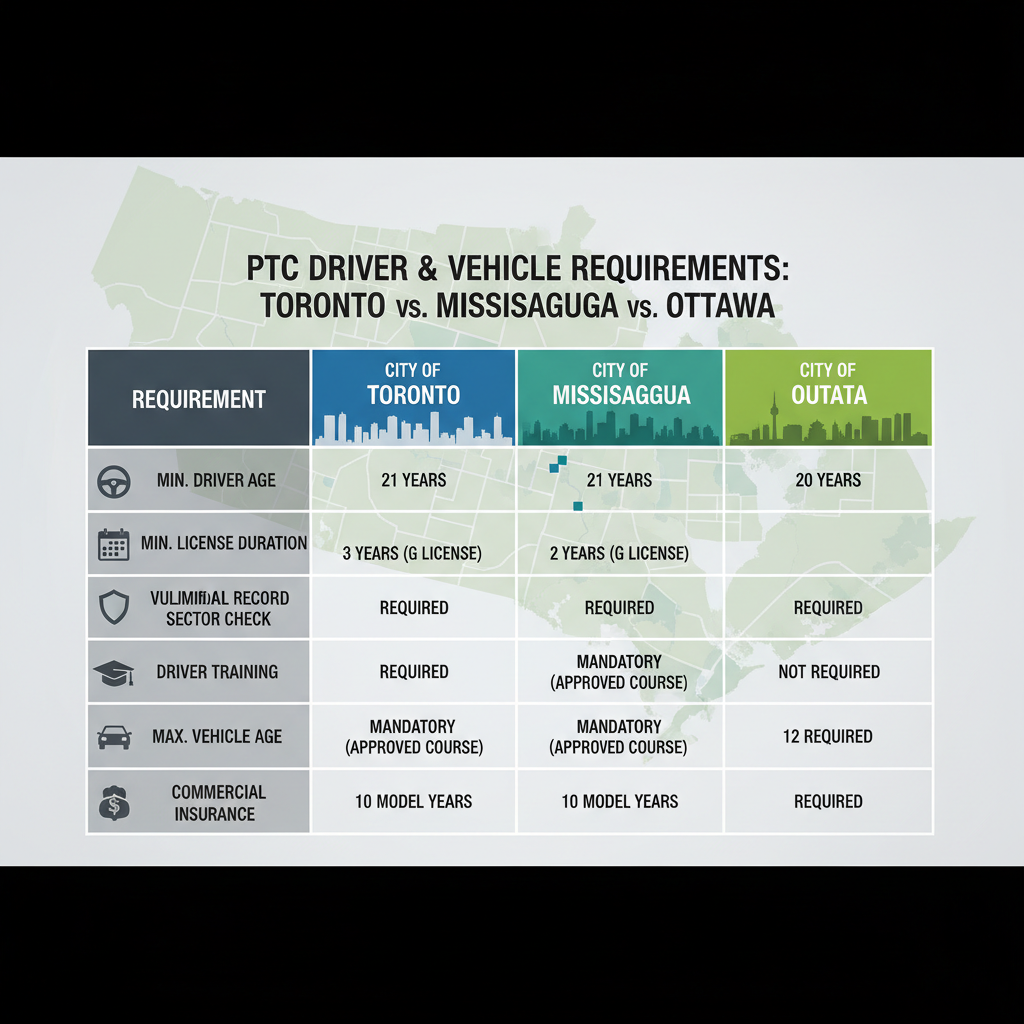
Toronto has some of the most rigorous and comprehensive requirements in Ontario, reflecting its status as Canada’s largest city and a major hub for ridesharing activity. The City of Toronto refers to these as Private Transportation Company (PTC) Driver Licenses.
Driver Requirements:
* Age: Minimum 21 years old.
* Driver’s License: Valid Ontario Class G driver’s license. Drivers must have held a full G license (not G1 or G2) for at least three years, ensuring adequate experience on busy city roads.
* Driving Record: A recent driver’s abstract (3-year or 5-year) showing no more than six demerit points and no major convictions (e.g., impaired driving, dangerous driving, G1/G2 violations) in the past three years. This strict requirement emphasizes responsible driving.
* Criminal Record and Vulnerable Sector Check: Both are mandatory and must be obtained from a Canadian police service (e.g., Toronto Police Service) within 90 days of application. The results must be clear, with any past offenses subject to careful review by the City.
* Medical Form: A completed medical form (provided by the City of Toronto) signed by a physician, attesting to the driver’s physical and mental fitness to operate a commercial vehicle safely.
* Mandatory Driver Training: Successful completion of a City of Toronto-approved third-party driver training program is absolutely required. This comprehensive course covers defensive driving, customer service, accessibility protocols, and specific city bylaws.
* Language Proficiency: Ability to communicate effectively in English, which is crucial for interacting with passengers and navigating emergency situations.
* Application Fee: There is an initial application fee and an annual renewal fee. These fees can vary but typically range in the hundreds of dollars ($100-$300+ annually), covering administrative costs.
Vehicle Requirements:
* Vehicle Age: The vehicle must be no more than seven model years old at the time of application or renewal, ensuring a relatively modern fleet.
* Safety Standards Certificate (SSC): An annual SSC is required for all PTC vehicles, underscoring ongoing vehicle safety.
* Commercial Insurance: A commercially rated automobile liability insurance card (pink card) showing a minimum of $2,000,000 in third-party liability coverage. This must explicitly cover ridesharing operations.
* Vehicle Ownership/Lease: Proof of current valid vehicle ownership or a lease agreement. If the vehicle is not registered to the applicant, a written consent form from the registered owner may be required.
* Appearance: Vehicles must be clean, in good repair, and free of any commercial advertising other than what’s required or permitted by the PTC service.
Application Process in Toronto:
Applications are typically submitted online through the City of Toronto’s e-licensing portal. You will need to upload digital copies of all required documents. After initial submission, an in-person appointment may be required for verification, photograph, or an interview. The entire process, from submitting documents to receiving the license, can take several weeks to a few months due to the thorough nature of the checks.
4.2. City of Mississauga PTC Driver License Requirements
Mississauga, as a prominent city in the Peel Region and part of the Greater Toronto Area, has its own set of bylaws for Private Transportation Companies. While generally aligned with broader provincial standards, they differ from Toronto’s in some key aspects, offering a distinct regulatory environment.
Driver Requirements:
* Age: Minimum 21 years old.
* Driver’s License: Valid Ontario Class G driver’s license. Specific duration of holding the full G license (e.g., 3 years) may be required.
* Driving Record: A recent driver’s abstract (e.g., 3-year) with a satisfactory record, typically limiting demerit points and severe infractions.
* Criminal Record and Vulnerable Sector Check: Mandatory. These checks must be recent and clear, usually obtained from Peel Regional Police.
* Medical Form: A medical certificate or form completed by a physician may be required, similar to Toronto, documenting fitness to drive.
* Training: While Mississauga does not traditionally mandate its own specific third-party driver training course like Toronto, drivers should be prepared to complete any training required by their chosen rideshare platform. In some cases, a certificate from a recognized defensive driving course might be beneficial or required by the platform.
* Application Fee: There are application and annual renewal fees, typically in a similar range to Toronto but can vary; check the official Mississauga licensing website for current amounts.
Vehicle Requirements:
* Vehicle Age: Similar age restrictions as Toronto, usually around 7-10 model years old. Drivers must check current bylaws for the exact and most up-to-date limit.
* Safety Standards Certificate (SSC): An annual SSC is mandatory for all PTC vehicles, ensuring mechanical fitness.
* Commercial Insurance: Proof of commercially rated auto insurance with a minimum of $2,000,000 third-party liability coverage, specifically covering ridesharing.
* Vehicle Ownership: Verification of vehicle ownership or lease documentation is required.
Application Process in Mississauga:
Applications are handled by the City of Mississauga’s Licensing Division. Information and forms are readily available on their official website. Submission is often done online or in person. It’s crucial to ensure all documents are accurate and complete to avoid delays in processing.
4.3. City of Ottawa PTC Driver License Requirements
Ottawa, the nation’s capital, also regulates PTCs within its municipal jurisdiction. Its requirements share commonalities with other major cities but have their own specific details, reflecting the local context and priorities.
Driver Requirements:
* Age: Minimum 21 years old.
* Driver’s License: Valid Ontario Class G driver’s license. The City may specify a minimum period of holding this license, often for several years.
* Driving Record: A recent driver’s abstract (e.g., 3-year) indicating a clean driving history with limits on demerit points and no significant traffic offenses.
* Criminal Record and Vulnerable Sector Check: Mandatory, obtained from Ottawa Police Service or an equivalent Canadian police force, and must be clear and current (within a specified timeframe).
* Medical Form: A medical certificate confirming fitness to drive may be required.
* Training: The City of Ottawa usually does not mandate a specific third-party driver training course for PTC drivers, though this can change with evolving regulations. Drivers are expected to adhere to any training requirements set by their chosen rideshare platform.
* Application Fee: Application and annual renewal fees apply, generally in line with other major municipalities.
Vehicle Requirements:
* Vehicle Age: Age limits usually apply (e.g., 7-10 model years old from the manufacturing date).
* Safety Standards Certificate (SSC): An annual SSC is required, ensuring the vehicle’s roadworthiness and safety features are operational.
* Commercial Insurance: Proof of commercial auto insurance with at least $2,000,000 in third-party liability coverage, explicitly for ridesharing.
* Vehicle Ownership: Documentation proving vehicle ownership or a valid lease agreement is necessary.
Application Process in Ottawa:
Applications for a Private Transportation Company Driver Licence (or similar terminology) are managed by the City of Ottawa’s By-law and Regulatory Services department. Their website provides detailed guides, application forms, and submission methods (often online or by mail/in-person). As with other cities, thorough preparation of documents is key to a smooth process. For the most up-to-date and specific requirements, drivers should consult the City of Ottawa’s official page for Private Transportation Company Driver Licences.
4.4. General Advice for Other Municipalities in Ontario
While Toronto, Mississauga, and Ottawa represent the largest markets, many other municipalities across Ontario also regulate ridesharing. For drivers in these “surrounding areas” or other cities, the fundamental principle remains: check local bylaws.
* Start with your city’s official website: Look for departments related to ‘Licensing,’ ‘By-law Services,’ ‘Transportation,’ or ‘Taxi and Limousine Services.’ They often have dedicated pages or guides for Private Transportation Companies or rideshare drivers.
* Contact the licensing department directly: If information is unclear, a phone call or email to the city’s licensing department can provide definitive answers on requirements, fees, and application processes.
* Assume similar requirements: Many smaller municipalities will have similar core requirements regarding driver’s licenses, age, clean records, vehicle safety, and commercial insurance. However, vehicle age limits, specific training mandates, and fees will almost certainly differ.
* Rideshare platform guidance: Uber and Lyft often provide city-specific guidance to potential drivers. While useful, always cross-reference this information with official municipal sources to ensure compliance.
5. Mandatory Driver Training Courses: A Deeper Dive
While all drivers require competence and responsible behavior, some cities go a step further by mandating specific training programs. This section focuses on Toronto’s unique requirement and contrasts it with practices elsewhere in Ontario.
5.1. Toronto’s Mandatory Third-Party Driver Training
The City of Toronto stands out for its firm requirement for all PTC drivers to complete a specific third-party driver training course. This initiative was implemented to significantly enhance the professionalism, safety, and service quality of rideshare drivers operating within the city, following a comprehensive review of the industry’s impact.
Purpose and Objectives:
The mandatory training aims to equip drivers with specialized skills and knowledge that extend beyond standard driving proficiency. Key objectives include:
* Enhanced Safety: Promoting advanced defensive driving techniques, hazard recognition, accident prevention strategies, and safe navigation in dense urban environments.
* Customer Service Excellence: Training drivers in professional conduct, effective communication skills, conflict resolution, cultural sensitivity, and handling diverse passenger needs and expectations.
* Accessibility Awareness: Educating drivers on the requirements and best practices for transporting passengers with disabilities, including the safe use of mobility aids, service animals, and compliance with the Accessibility for Ontarians with Disabilities Act (AODA) and related municipal bylaws.
* City By-Law Knowledge: Ensuring drivers are intimately familiar with all relevant City of Toronto by-laws pertaining to PTC operations, such as designated pickup/drop-off zones, idling regulations, parking rules, and proper display of license plates and identification.
* Emergency Preparedness: Providing instruction on how to effectively handle various emergencies, ranging from vehicle breakdowns and minor collisions to medical incidents or passenger safety concerns.
Course Content:
Approved courses typically cover a comprehensive curriculum, delivered through a combination of in-class, online, and practical components. Modules often include:
* Road safety best practices and advanced defensive driving techniques.
* Customer service standards, passenger interaction etiquette, and communication skills.
* Accessibility training, including specific procedures for assisting passengers with disabilities.
* Detailed overview of City of Toronto regulations and bylaws for PTC services.
* Vehicle maintenance basics and pre-trip inspection routines.
* Strategies for dealing with difficult situations, argumentative passengers, or potential threats.
* Drug and alcohol awareness, focusing on driver impairment and recognizing impaired passengers.
* Route optimization and efficient navigation in Toronto’s complex road network.
Approved Providers:
The City of Toronto carefully approves specific third-party organizations to deliver this training. Historically, reputable educational institutions like Toronto Metropolitan University (formerly Ryerson University) have been among the approved providers, alongside other specialized driver training companies. Drivers must enroll in and successfully complete a course from an officially recognized provider; certificates from unapproved sources will not be accepted.
Duration and Cost:
These courses typically span several hours, often delivered in one full day (e.g., 6-8 hours) or over multiple shorter sessions to accommodate driver schedules. The cost is borne entirely by the driver and can range from approximately $150 to $300, varying by provider and course structure. This fee represents an upfront investment required before a PTC license can be issued or renewed in Toronto.
Certification:
Upon successful completion of the training, drivers receive a certificate of completion. This certificate is a mandatory document that must be submitted as part of the PTC driver license application to the City of Toronto. Without it, the license will not be granted or renewed, underscoring its critical importance.
5.2. Training in Other Municipalities
In contrast to Toronto, most other Ontario municipalities, including Mississauga and Ottawa, do not currently mandate a specific third-party driver training course for PTC drivers as a prerequisite for their municipal license. This difference highlights the varying regulatory approaches across the province.
- Rideshare Platform Training: In these cities, the primary source of training often comes directly from the rideshare companies themselves (Uber, Lyft). These platforms typically provide online modules, instructional videos, and digital resources covering their specific policies, app usage, safety protocols, customer service expectations, and basic legal compliance relevant to their operations. This training is usually integrated into the driver onboarding process and is often mandatory for platform activation.
- Focus on General Safe Driving: While not mandated by the city, drivers are still expected to maintain high standards of safe driving and professional conduct. Some platforms might encourage or require drivers to complete general defensive driving courses, but these are usually not tied directly to municipal licensing.
- Evolving Regulations: It’s important for drivers to stay informed, as municipal regulations can evolve. What is not mandatory today could become a requirement in the future, especially if cities observe specific safety or service gaps or decide to harmonize standards. Always check the current bylaws of your operating city.
6. Fees, Costs, and Automatic Deductions by Uber/Lyft
Becoming a PTC driver involves various financial considerations, from upfront licensing costs to ongoing operational expenses and understanding how rideshare platforms structure their payments and deductions. A clear understanding of these financial aspects is crucial for managing your income and maintaining profitability.
6.1. Upfront and Recurring Costs for Drivers
Drivers must budget for several significant expenses both before starting and throughout their operation as a PTC driver. These costs directly impact your net earnings.
- Municipal License Application/Renewal Fees: These are paid directly to the city for the privilege of operating within its jurisdiction.
- Toronto: Initial application fees can be around $200-$300, with annual renewal fees in a similar range.
- Mississauga/Ottawa: Fees are comparable, often ranging from $100-$250 for application and annual renewal, but always verify current rates on official municipal websites.
- Criminal Record Check & Vulnerable Sector Check Fees: Police services charge a fee for processing these checks. Expect to pay between $20-$70 per check, depending on the police service and the type of check required.
- Medical Exam Fees: If a medical exam is required, the cost for the physician to complete the administrative form may not be covered by OHIP. This out-of-pocket expense can range from $50-$150.
- Safety Standards Certificate (SSC) Inspection: An annual vehicle inspection is required. The cost for this inspection typically ranges from $80-$150, depending on the mechanic, and does not include any potential repair costs needed to pass the inspection.
- Mandatory Driver Training (Toronto): As discussed, this is a one-time upfront cost of approximately $150-$300 for Toronto drivers, which must be factored into the initial investment.
- Commercial Insurance: This is often the most significant ongoing cost. Commercial auto insurance for ridesharing can be substantially more expensive than personal insurance, potentially costing thousands of dollars annually, depending on your driving record, vehicle type, location, and the extent of your coverage. It’s crucial to get quotes from multiple providers specializing in rideshare insurance.
- Vehicle Maintenance: Due to higher mileage and continuous operation, rideshare vehicles require more frequent maintenance. Budget for regular oil changes, tire rotations, brake service, fluid top-ups, and other wear-and-tear repairs. Fuel costs are also a major and often variable ongoing expense.
- Vehicle Cleaning Supplies: Maintaining a consistently clean and presentable vehicle is essential for good passenger ratings and comfort. This includes regular car washes, interior cleaning, and air fresheners.
- HST Registration (if applicable): If your gross income from ridesharing (and all other taxable activities) exceeds $30,000 in any 12-month period, you are legally required to register for and collect/remit Harmonized Sales Tax (HST) to the Canada Revenue Agency (CRA). This is not a direct fee but a crucial tax obligation that requires careful financial management, including accurate record-keeping and potentially setting aside funds.
- Other Tax Deductibles: As an independent contractor, you can deduct various business expenses to reduce your taxable income. These include a portion of your car’s operating costs (fuel, insurance, maintenance, depreciation), cell phone bills, professional cleaning costs, and supplies. Accurate record-keeping is vital.
6.2. Uber and Lyft Deductions/Commissions
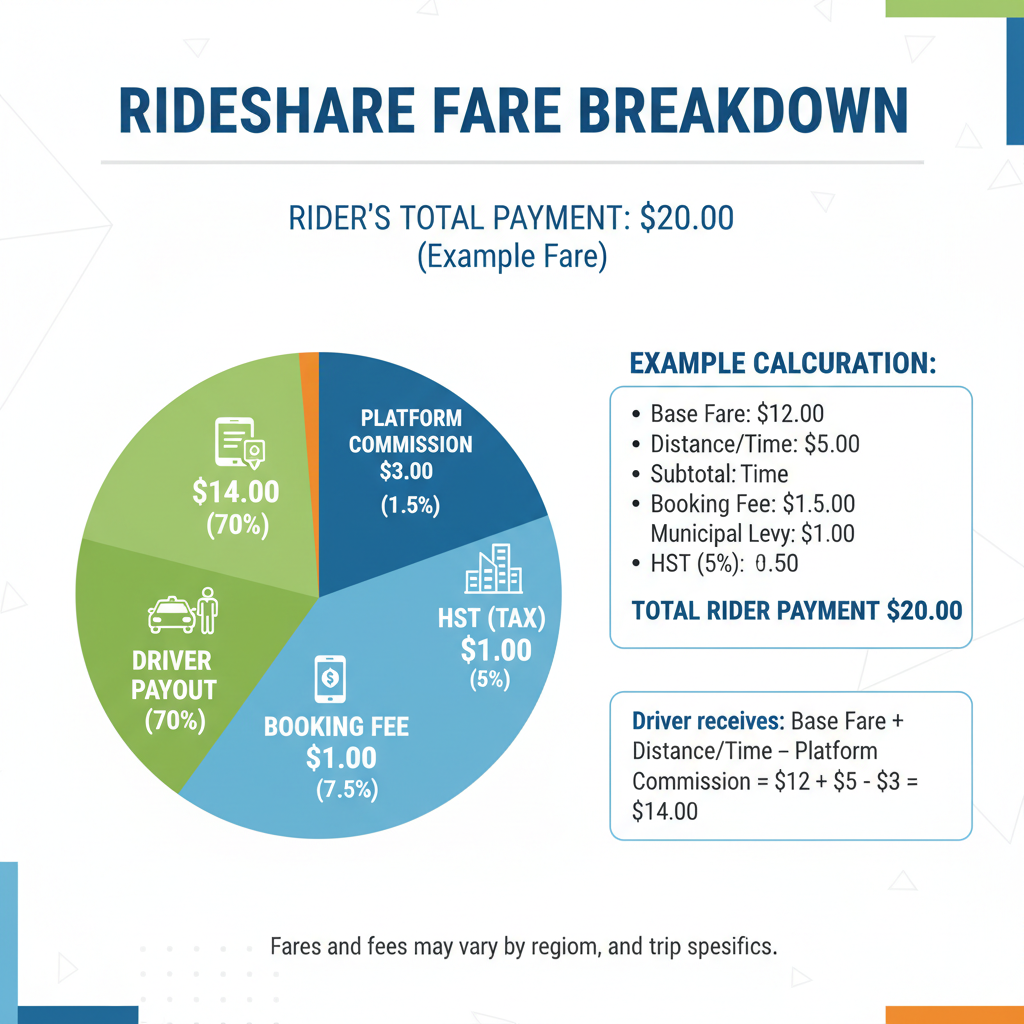
When you complete a trip, the fare paid by the rider is not entirely yours. Uber and Lyft (and other PTC platforms) deduct various fees and commissions before paying out the driver. Understanding these deductions is crucial for accurately calculating your net earnings.
- Service Fee/Commission: This is the primary deduction. It’s a percentage of the fare (excluding taxes, tolls, and certain fees). This percentage can vary significantly based on the market, the type of service (e.g., standard, XL, premium), promotional periods, and the specific platform. Historically, these commissions have ranged from 20% to 35% or even higher on certain fare components. Platforms may also use dynamic pricing models where their commission structure can vary per trip.
- Booking Fees/Platform Fees: These are typically charged to the rider as a separate line item to cover operational costs, technology development, and customer support. While primarily paid by the rider, the platform retains this fee, and it’s not part of the driver’s gross fare calculation for commission purposes.
- Third-Party Fees (e.g., HST, Airport Fees, Municipal Levies):
- HST: For drivers registered for HST, Uber and Lyft often facilitate the collection of HST from the rider on behalf of the driver. This amount is then passed through to the driver, who is responsible for remitting it to the CRA. It’s not a deduction by the platform but a tax collected for you.
- Airport Fees: Many airports impose a fee for commercial pickups and drop-offs within their premises. These fees are typically passed on to the rider and then deducted from the driver’s payout, who then remits it to the airport authority (often facilitated by the platform).
- Municipal Surcharges: Some cities, like Toronto, have implemented ground transportation levies or surcharges per trip. These are collected from the rider and then deducted from the driver’s earnings to be remitted to the municipality.
- Payment Processing Fees: While not always explicitly shown as a direct deduction to the driver per trip, the cost of processing credit card payments and managing financial transactions is factored into the platform’s overall business model and commission structure.
- Driver Incentives/Bonuses: To encourage drivers and ensure supply during peak hours, platforms often offer various incentives, such as guaranteed hourly earnings, “quest” bonuses for completing a certain number of trips, or surge pricing multipliers. These can significantly boost gross earnings and help offset the impact of deductions.
- Breakdown of a Typical Fare (Illustrative Example):
- Rider Pays: $20.00 (Base Fare) + $3.00 (Booking Fee) + $1.00 (Toronto Levy) + $3.12 (HST on fare+levy) = $27.12 Total
- Platform Collects: $27.12
- Platform Deductions (Example):
- Booking Fee: $3.00 (retained by platform)
- Toronto Levy: $1.00 (passed to city)
- HST: $3.12 (passed to driver for remittance if registered)
- Service Fee (25% of $20 fare): $5.00 (retained by platform)
- Driver Payout: The driver’s gross earnings from the fare before platform commission is $20.00. After the $5.00 service fee, the driver’s net fare component is $15.00. Adding the HST ($3.12) and subtracting the Toronto Levy ($1.00) results in a total payout of $17.12. (Note: The driver’s gross earnings for tax purposes would be the $20 fare plus any HST collected, minus the Toronto Levy, before considering deductible business expenses.) This calculation is simplified, as actual payouts can vary based on platform accounting methods and specific terms. Always check your weekly earnings statement carefully.
Understanding Payouts:
Drivers typically receive payouts weekly, though some platforms offer instant cash-out options for a small fee. All platforms provide detailed earnings statements accessible through the driver app or web portal, showing the breakdown of each trip, total gross earnings, and all deductions. It’s crucial to review these statements regularly for accuracy, understand your true earnings, and for meticulous tax record-keeping.
7. Maintaining Your PTC License and Compliance
Obtaining your PTC license is just the beginning of your journey as a rideshare driver. Ongoing compliance is absolutely essential to avoid penalties, ensure continuous operation, and build a sustainable career.
- Annual Renewals: All municipal PTC licenses require annual renewal. This process usually involves re-submission of updated documents such as new criminal record checks and vulnerable sector checks, a current driver’s abstract, proof of valid commercial insurance, and an updated Safety Standards Certificate for your vehicle. Renewal fees also apply, and deadlines must be strictly adhered to.
- Keeping Documents Up-to-Date: Always ensure your personal driver’s license, vehicle registration, and commercial insurance are current and valid. Any expiry or suspension of these core documents can lead to immediate suspension of your ability to drive for PTCs, potentially without warning. Report any changes in your driving record or criminal record status to your municipality immediately.
- Vehicle Maintenance and Cleanliness: Regularly service your vehicle according to manufacturer recommendations and keep it impeccably clean, both inside and out. Annual SSC inspections are mandatory, but proactive, ongoing maintenance prevents issues between inspections, reduces breakdowns, and ensures passenger safety and comfort.
- Adhering to City By-laws: Familiarize yourself with and strictly follow all municipal by-laws related to PTC operation. This includes rules for parking, idling, designated pickup/drop-off zones (especially at airports and entertainment venues), and the proper display of required decals or signage. Ignorance of bylaws is not a valid defense and can result in significant fines.
- Maintaining High Service Standards: Your success as a rideshare driver heavily depends on passenger satisfaction. Maintaining high service standards, reflected in good ratings and positive feedback from passengers, is crucial for continued access to rideshare platforms and maximizing your earning potential. This involves safe driving, professional conduct, excellent customer service, respectful interaction with passengers, and ensuring a comfortable and clean environment.
- Tax Compliance and Record-Keeping: As an independent contractor, you are responsible for your own tax obligations. This includes tracking all income and meticulously recording all deductible expenses (fuel, maintenance, insurance, cleaning, cell phone, etc.). If applicable, regularly collect and remit HST to the CRA. Maintaining accurate financial records is vital for tax season and helps in understanding your true profitability.
- Staying Informed: Regulations can change. Stay informed about updates to municipal bylaws, provincial MTO rules, and platform policies. Regularly check official municipal websites and communications from rideshare companies.
By diligently adhering to these ongoing compliance requirements, you can ensure a long and successful career as a Private Transportation Company driver in Ontario.

Leave a Reply