How to Register for Uber and Lyft in Quebec: SAAQ & Tax Rules
Embarking on a career as a ride-sharing driver in Quebec, whether with Uber or Lyft, presents a unique set of challenges and regulatory hurdles not found in most other Canadian provinces. Quebec operates under its own distinct legal framework, heavily emphasizing passenger safety, driver qualifications, and stringent tax compliance. For aspiring drivers in major cities like Montreal, Quebec City, and Gatineau, understanding and meticulously navigating these regulations is not just a suggestion but a mandatory prerequisite for legal operation. This comprehensive guide will walk you through each critical step, ensuring you meet the requirements set by the Société de l’assurance automobile du Québec (SAAQ) for driver authorization, complete the necessary provincial training, and correctly register for both federal Goods and Services Tax (GST) and provincial Quebec Sales Tax (QST) from your very first fare. Ignoring any of these steps can lead to severe penalties, including fines, operational bans, and significant tax liabilities for anyone driving for Uber or Lyft in Quebec.
The Unique Landscape of Ride-Sharing in Quebec
Quebec’s approach to ride-sharing services like Uber and Lyft is designed to integrate them more closely with traditional taxi industry standards while adapting to modern technology. This means drivers are often subject to a hybrid regulatory model that combines aspects of both sectors. The key difference lies in the provincial government’s active role through the SAAQ in vetting drivers and mandating specific training, as well as its strict enforcement of tax collection from the outset of business operations. Unlike other provinces where GST/HST registration might only become mandatory after reaching $30,000 in revenue, Quebec ride-sharing drivers must register for GST and QST immediately. This guide aims to demystify these requirements, providing a clear, step-by-step pathway to becoming a compliant and successful ride-sharing driver in La Belle Province.
Step 1: Obtaining Your Authorized Driver’s Permit from the SAAQ
The Société de l’assurance automobile du Québec (SAAQ) is the provincial body responsible for overseeing driver licensing, vehicle registration, and road safety in Quebec. For anyone looking to transport passengers for remuneration, including ride-sharing drivers for platforms like Uber and Lyft, obtaining a specific authorization from the SAAQ is paramount. This permit, often referred to as a “permit de chauffeur de taxi ou de véhicule de transport en commun” or similar designation for ride-sharing, ensures that all drivers meet rigorous standards for safety and reliability. This is the cornerstone of legal operation in Quebec for any professional driver.
1.1 Eligibility Criteria: Laying the Foundation
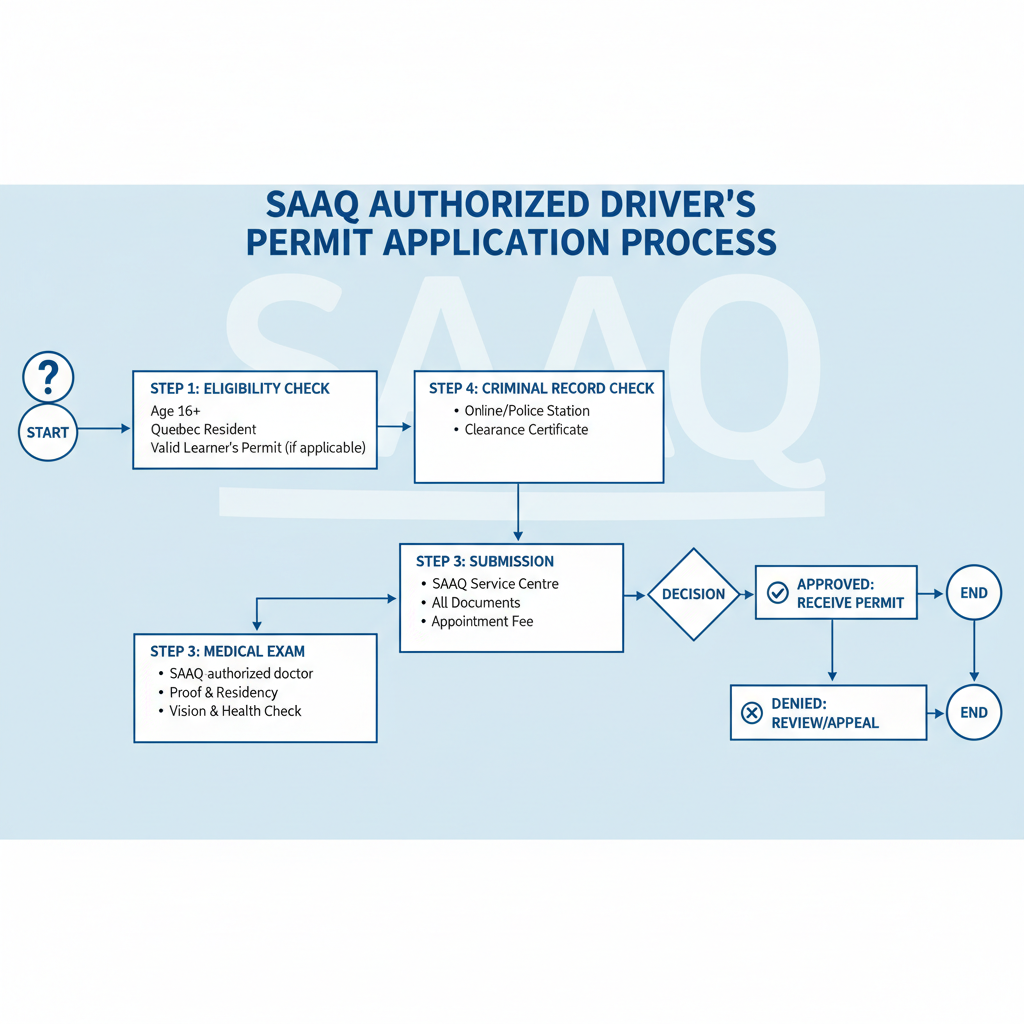
Before you even begin the application process, you must meet fundamental eligibility criteria set by the SAAQ. These are non-negotiable and form the bedrock of your application, designed to guarantee a high level of driver competence and public safety:
- Valid Quebec Driver’s License: You must possess a valid Class 5 (passenger vehicle) driver’s license issued by the SAAQ. This license must be held for a minimum period, typically at least two years (24 months) prior to your application for the authorized permit. The SAAQ imposes this requirement to ensure you have sufficient practical driving experience under Quebec’s specific road conditions, including diverse weather challenges and traffic patterns commonly found in cities like Montreal, Quebec City, and Gatineau. Furthermore, your license must be free of any restrictions that would impede your ability to drive professionally, such as restrictions on night driving or specific vehicle types. This requirement confirms a baseline level of driving proficiency and responsibility before you are entrusted with the safety of passengers.
- Minimum Age: Applicants generally must be at least 18 years old. While 18 is the legal age of majority in Quebec, the two-year driving experience requirement means most eligible applicants will naturally be slightly older, typically 20 years or more, by the time they can apply.
- Clean Driving Record: The SAAQ will conduct a thorough review of your driving record, known as your “dossier de conduite.” This scrutiny includes checking for accumulated demerit points, serious traffic infractions, and past license suspensions. A history of significant driving offenses will likely disqualify you from obtaining a permit for remunerated passenger transport. The SAAQ maintains strict criteria; for instance, accumulating 4 or more demerit points in the last two years, or having more serious infractions like excessive speeding, impaired driving (DUI), hit-and-run incidents, or operating a vehicle while prohibited, will often lead to immediate disqualification. Even minor infractions will be scrutinized, as the SAAQ’s primary objective is passenger safety, and a clean driving record is a direct indicator of a responsible and safe driver. You can proactively request a copy of your own driving record from the SAAQ before applying to assess your standing and address any potential issues.
- Criminal Record Check: You will be required to undergo a comprehensive police background check, typically conducted by local police forces (such as the Service de police de la Ville de Montréal (SPVM), Service de police de la Ville de Québec, or Service de police de la Ville de Gatineau) or the Sûreté du Québec, which may include federal databases. This check is not just a formality; the SAAQ needs assurance that you do not have a criminal record that would pose a risk to passengers or compromise public trust. The types of offenses that typically lead to disqualification include those related to violence (e.g., assault, threats), sexual assault, theft, fraud, drug trafficking, and any crimes involving moral turpitude or dishonesty. The check aims to identify any past convictions that could indicate a risk to public safety or trust. The SAAQ has specific guidelines on which offenses are disqualifying and for how long, and it’s imperative that your background check results meet their stringent standards. For more information on gig driver background checks, you can consult our guide on Canadian Gig Driver Background Checks: Resolve Delays & Rejections.
- Medical Fitness: Driving professionally requires a certain level of physical and mental fitness to ensure you can operate a vehicle safely for extended periods and transport passengers responsibly. The SAAQ mandates a medical examination, which usually involves a specific form (such as the “Rapport médical” form) to be filled out by a medical doctor (your family doctor or a clinic physician). This assessment will comprehensively cover various aspects of your health, including your vision (assessing visual acuity, peripheral vision, and color perception), hearing, cardiovascular health (e.g., blood pressure, presence of heart conditions), neurological status (e.g., history of epilepsy, stroke, or other neurological disorders), cognitive function (attention, memory, judgment), and any other conditions that might impair your ability to drive safely (e.g., severe diabetes requiring frequent insulin adjustments, certain psychiatric conditions, or sleep disorders like severe sleep apnea). Depending on your age and health profile, follow-up medical reports may be required periodically to ensure ongoing fitness.
1.2 The Application Process: Navigating SAAQ Bureaucracy
Once you’ve confirmed your eligibility, you can initiate the application process for the authorized driver’s permit. This involves several critical steps and requires careful attention to detail to avoid delays.
- Gather Required Documents: Prepare all necessary identification and supporting documents. This typically includes:
- Your valid Quebec driver’s license (Class 5).
- Proof of residency in Quebec (e.g., a recent utility bill, lease agreement, or municipal tax bill).
- Proof of legal status in Canada (e.g., Canadian birth certificate, Canadian passport, Permanent Resident card, or a valid work permit if applicable).
- You will also need the specific medical report form provided by the SAAQ, which your doctor will complete.
- Consent forms for background checks, if applicable, for direct submission to police services.
- Contact the SAAQ & Obtain Forms: The best way to start is to visit an SAAQ service outlet or consult their official website. Navigate to the section for “Chauffeur de taxi et de véhicule de transport rémunéré de personnes” or similar. They will provide you with the most current application forms and instructions specific to your situation. Be explicit about your intention to drive for Uber or Lyft, as specific categories or endorsements within the “remunerated passenger transport” class might apply to your application. The official Société de l’assurance automobile du Québec (SAAQ) website provides detailed guides and checklists online.
- Medical Examination: Schedule an appointment with your family doctor or a clinic to complete the SAAQ’s mandatory medical report form. Ensure your doctor fills out all sections accurately and thoroughly, disclosing all relevant medical history. This form will need to be submitted directly to the SAAQ, often by your doctor or by you in a sealed envelope to maintain confidentiality. You are responsible for any fees associated with this medical exam, which are typically not covered by RAMQ.
- Criminal Background Check: The SAAQ will either initiate this check on your behalf after you provide consent, or they will instruct you on how to obtain the necessary police background check from your local police force (e.g., Service de police de la Ville de Montréal, Service de police de la Ville de Québec, Service de police de la Ville de Gatineau). This often involves visiting the police station, providing identification, and paying a processing fee. The police certificate or report will then need to be submitted to the SAAQ. The processing time for these checks can vary significantly, from a few weeks to several months, so it’s advisable to get this started as early as possible in your overall application timeline.
- Driving Record Review: The SAAQ will automatically review your driving record as part of the application process. There’s no separate action required from you for this step, beyond ensuring your record is clean and up-to-date, and reflecting a responsible driving history.
- Application Submission: Once all forms are completed and supporting documents are gathered, submit your complete application package to the SAAQ. This is typically done in person at an SAAQ service outlet to ensure all documents are present and correctly filled. Ensure all sections are filled out completely and accurately to avoid any processing delays. Pay any associated application fees, which can vary. Always keep a receipt of your payment for your records.
- Follow-Up: After submission, actively track your application status. The SAAQ may contact you for additional information, clarification, or to schedule an interview if needed. Be prepared for processing times that can range from a few weeks to several months, depending on the volume of applications, the complexity of background checks, and the completeness and accuracy of your submission. Patience is a virtue in this bureaucratic process.
1.3 Potential Pitfalls and Tips for Success
Navigating government applications can be complex. Being aware of common pitfalls can save you significant time and frustration.
- Incomplete or Inaccurate Applications: The most common cause of delays and outright rejections is incomplete or incorrectly filled-out forms. Double-check every field, ensure all required signatures are present, and attach all necessary supporting documents before submission. A missing piece of information, even a minor one, can send you back to the start of the queue and significantly prolong the process.
- Undisclosed Medical Conditions: Be entirely honest and transparent with your doctor and the SAAQ about any existing medical conditions or new diagnoses. While some conditions might require further assessment, modifications to your permit, or periodic reviews, withholding information can lead to severe consequences, including permit revocation, significant fines, and can void your insurance coverage in the event of an accident. The SAAQ prioritizes safety above all else, and honest disclosure helps them determine appropriate measures to ensure your safety and that of your passengers.
- Past Driving Infractions: If you have a questionable driving record, it’s essential to address it proactively. While serious offenses may be unequivocally disqualifying, for borderline cases, demonstrating a commitment to safety (e.g., by voluntarily taking advanced driving courses, even if not required) might help, though it is not a guarantee of approval. Understand the SAAQ’s specific criteria for disqualification due to demerit points or infractions, and don’t assume anything.
- Language Barrier: The SAAQ primarily operates in French. All official forms, instructions, and communications will be in French. Ensure you understand all instructions and forms completely. If French is not your first language and you are not proficient, it is highly advisable to bring someone who can assist with translation or seek assistance from SAAQ staff who may be bilingual. Do not sign any documents you do not fully comprehend.
- Keep Copies: Always make and keep clear photocopies or digital scans of all documents you submit to the SAAQ for your personal records. This includes application forms, medical reports, police certificates, and payment receipts. This collection will be invaluable if any documents go missing, if there are questions about your submission, or if disputes arise later on.
1.4 Maintaining Your SAAQ Permit
Obtaining the permit is not a one-time event; it’s a commitment to ongoing compliance and maintenance.
- Renewals: Authorized driver permits typically have an expiry date (e.g., every 1 to 5 years, depending on various factors including age and medical status) and must be renewed well in advance. Keep track of this critical date and initiate the renewal process several months before expiry to avoid any lapse in your operating authorization. Renewals usually involve updated background checks, a review of your driving record, and potentially new medical examinations to ensure continued fitness.
- Reporting Changes: You have a legal obligation to inform the SAAQ of any significant changes in your circumstances that could affect your driving ability or eligibility. This includes:
- Any new medical condition that develops or the worsening of an existing one that could impair your driving ability.
- Any changes in your driving record (e.g., new traffic infractions, accumulation of demerit points, license suspensions).
- Any changes to your legal address.
- Any criminal charges or convictions.
- Failure to report these changes can lead to fines, permit suspension, or outright revocation, jeopardizing your ability to drive professionally.
- Compliance with Regulations: Always adhere to all SAAQ rules and regulations, as well as the Highway Safety Code. Any serious infraction while operating as a ride-sharing driver can lead to permit suspension or revocation, jeopardizing your ability to earn income. Regularly checking the SAAQ website for updated regulations and guidelines is highly recommended to stay informed and compliant.
Step 2: Mandatory Training Course Requirements in Quebec
Beyond meeting SAAQ’s rigorous driver qualification standards, Quebec also mandates specific training for ride-sharing drivers. This requirement distinguishes Quebec from many other jurisdictions and underscores the province’s commitment to professionalizing the ride-sharing industry. The training is designed to equip drivers with essential skills and knowledge beyond basic driving, focusing on customer service, safety protocols, and understanding Quebec’s unique cultural and regulatory context. This is a critical, non-negotiable step towards operating legally and successfully in the province for Uber and Lyft drivers in cities like Montreal, Quebec City, and Gatineau.
2.1 What the Training Entails: A Comprehensive Curriculum
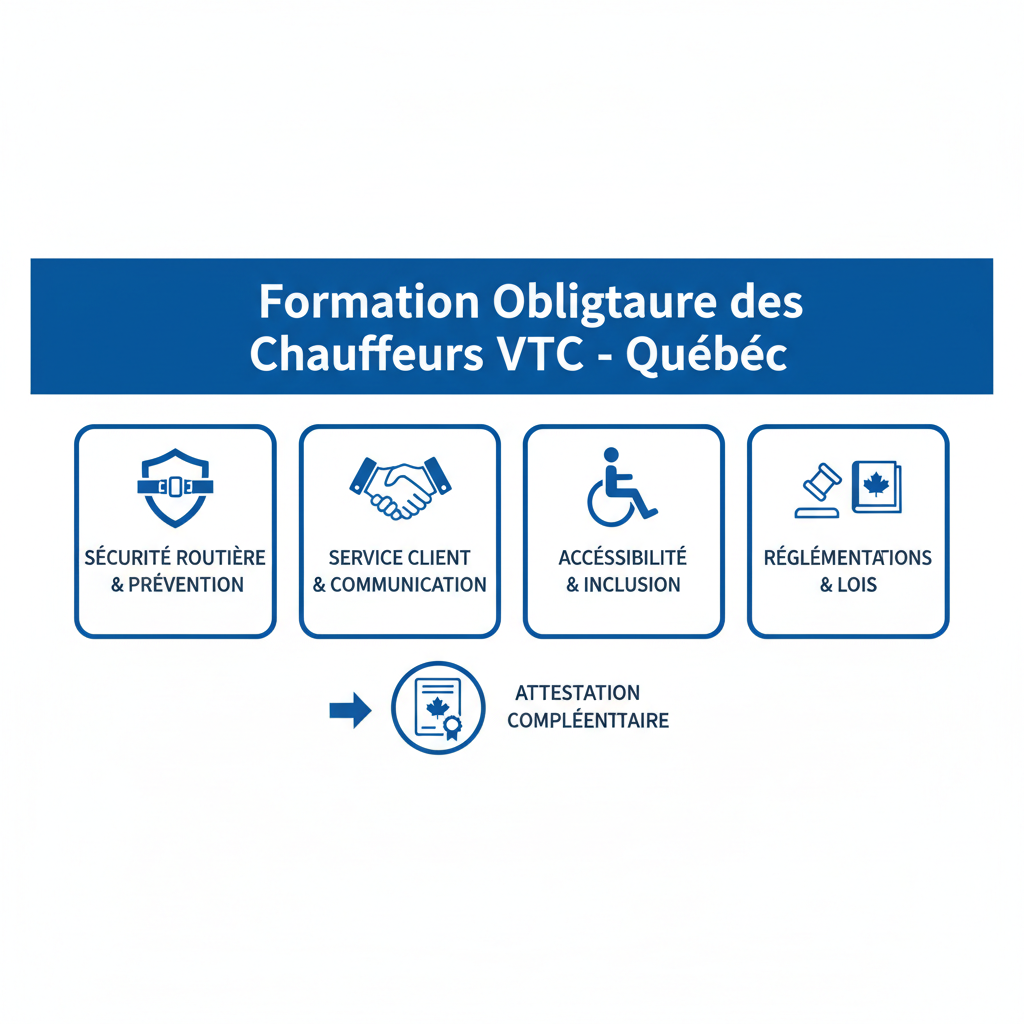
The mandatory training course is typically comprehensive, ranging from 20 to 40 hours of instruction, depending on the accredited provider and the specific modules included. This intensive program ensures drivers are well-prepared for the multifaceted demands of transporting passengers for remuneration, going far beyond typical driving school content. The curriculum is meticulously designed to cover several critical areas:
- Highway Safety and Advanced Defensive Driving Techniques: While you already possess a valid driver’s license, this module often reinforces and builds upon advanced defensive driving techniques, emphasizing proactive hazard perception, thorough risk assessment, and safe operating procedures specifically tailored for professional passenger transport. It highlights accident prevention strategies, how to anticipate potential dangers on Quebec’s roads, and effective techniques for reacting safely and decisively in emergency situations (e.g., adverse weather conditions, sudden obstacles, aggressive drivers). It may also cover essential topics like fatigue management and practical strategies to avoid driver distraction, which are crucial for long hours behind the wheel.
- Customer Service Excellence and Professionalism: This is a cornerstone of the training, as ride-sharing is fundamentally a service industry. Drivers are trained on best practices for interacting positively with a diverse range of passengers, effective verbal and non-verbal communication, maintaining a consistently professional demeanor, handling difficult or intoxicated passengers with tact, managing passenger expectations, and creating a positive, respectful, and safe experience for everyone. Topics include proper etiquette, conflict resolution strategies, de-escalation techniques, and the importance of maintaining a clean and comfortable vehicle environment.
- Passenger Rights and Driver Responsibilities: Understanding the rights of passengers, particularly in a service context, is vital. This includes respecting passenger privacy, ensuring their safety and security, non-discrimination (based on race, religion, gender, disability, sexual orientation, etc.), and freedom from harassment. Drivers also learn about their own responsibilities, limitations (e.g., strict prohibition on consuming alcohol or drugs while on duty, not using a handheld phone while driving, strict adherence to all traffic laws), and detailed protocols for what to do in case of passenger complaints or emergencies.
- Basic Vehicle Maintenance and Safety Checks: This module provides practical knowledge on performing daily pre-trip vehicle checks (e.g., checking tire pressure, fluid levels like oil and windshield washer fluid, verifying lights, signals, and brakes), understanding the importance of routine scheduled maintenance, and how to identify potential safety issues with your vehicle that could compromise passenger safety or lead to unexpected breakdowns. It covers basic troubleshooting and when it is absolutely necessary to seek professional mechanical assistance. You may also need to consider your Canadian Rideshare Auto Insurance: Get Approved & Stay Covered requirements, which are often tied to vehicle safety.
- Road Network and Navigation in Quebec: While modern GPS technology is ubiquitous, a strong foundational understanding of Quebec’s specific road network, major arteries, specific regional considerations (especially in dense urban areas like Montreal, Quebec City, and Gatineau, including knowledge of one-way streets, frequent construction zones, and rush hour patterns), and an ability to navigate efficiently, even without relying solely on a device, can significantly improve service quality, reduce travel times, and enhance passenger experience. This section may also touch upon local points of interest and landmarks.
- Accessibility for Passengers with Disabilities: A significant and compassionate portion of the training often focuses on serving passengers with reduced mobility or other disabilities, ensuring truly inclusive transport. This includes proper procedures for assisting individuals using wheelchairs, walkers, canes, service animals (e.g., guide dogs), and ensuring an accessible, respectful, and dignified experience for all passengers. Understanding the legal obligations under Quebec’s accessibility laws and emphasizing empathy, patience, and appropriate communication is paramount.
- Quebec’s Specific Regulatory Framework for Ride-Sharing: This module provides a deep dive into the specific laws, rules, and regulations governing ride-sharing services in Quebec. It covers detailed driver obligations, stringent vehicle requirements (e.g., mandatory inspections, specific insurance requirements), permit conditions, potential fare regulations, and the significant penalties for non-compliance. This section often reiterates and expands upon information about the SAAQ’s role, relevant municipal bylaws, and other provincial specificities, ensuring drivers have a comprehensive understanding of their unique legal operating environment.
- Ethics and Professional Conduct: This module emphasizes the critical importance of ethical behavior, integrity, honesty, and maintaining a consistently professional image while representing a ride-sharing service. This includes respecting passenger privacy, strictly avoiding discrimination, refraining from solicitation, and generally upholding the public trust placed in professional drivers.
2.2 Accredited Training Providers: Where to Get Trained
The mandatory training must be completed through an institution or organization specifically accredited by the Quebec government or the SAAQ. It is absolutely crucial to ensure any provider you choose is officially recognized for this specific ride-sharing training, as unaccredited courses will not satisfy the provincial requirement.
- Check with Uber/Lyft: Your first and best step should be to consult the driver-partner section of the Uber or Lyft website specific to Quebec (e.g., Uber Québec, Lyft Québec). They will typically list approved training providers, often have direct links to their registration pages, and may even have special arrangements or discounts for their prospective drivers.
- SAAQ Website: The SAAQ website is another authoritative source for this information. Look for sections related to “Permis de chauffeur,” “Formation obligatoire,” or “Véhicule de transport rémunéré de personnes.” They may list accredited training centers directly or provide guidance on how to find them.
- Private Driving Schools: Some established private driving schools in Quebec specialize in professional driver training. You can search online for “formation chauffeur VTC Québec” (VTC stands for Véhicule de Tourisme avec Chauffeur) or “cours de conduite professionnelle Québec.” When contacting them, always confirm that their specific course is recognized and accredited for ride-sharing drivers by the Quebec government/SAAQ. Ask for explicit proof of accreditation before committing.
2.3 Registration Process and Costs
- Enrollment: Once you identify an accredited provider, you will need to enroll in their ride-sharing driver training program. This usually involves filling out an application form, providing your SAAQ driver’s license details (and sometimes proof of intent to apply for the SAAQ permit), and agreeing to their terms and conditions.
- Course Schedule: Training programs can be offered in various formats to accommodate different schedules: intensive weekend sessions, evening classes spread over several weeks, or even blended learning models (part online, part in-person). Choose a schedule that best fits your availability and learning style. Some providers offer courses in both French and English.
- Cost: The cost of the mandatory training course can vary significantly between providers but typically ranges from several hundred dollars to over a thousand dollars (e.g., $500 – $1200+ CAD). This represents a significant upfront investment that you must factor into your initial setup costs. Be aware that these fees are generally non-refundable once the course begins. It is advisable to inquire about payment plans or financing options if available. Some ride-sharing companies may offer partial reimbursement or have partnerships that reduce the cost for their prospective drivers; always inquire about such programs with Uber or Lyft directly before enrolling.
- Certification: Upon successful completion of all modules and any required assessments (which may include written exams, practical simulations, or strict attendance requirements), you will receive an official certificate of completion from the training provider. This document is critical.
2.4 Certification and Proof of Completion
- Submitting Proof: You will need to provide this official certificate to the SAAQ as definitive proof that you have fulfilled the mandatory training requirement. The SAAQ will not finalize your authorized driver status without it, and its absence will prevent you from operating. You will also typically need to upload a copy of this certificate to your driver profile on your chosen ride-sharing platform (Uber/Lyft) as part of their onboarding and verification process.
- Keep Records: Always keep a physical and digital copy of your certificate for your personal records. This document may be required for future audits by regulatory bodies, for platform re-verification, or if you need to re-apply for a permit or change platforms in the future.
2.5 Importance of This Step for Compliance
- Legal Requirement: This training is not optional; it is a legal requirement under Quebec’s regulations for remunerated passenger transport. Operating a ride-sharing service without having completed this mandatory training can result in significant fines (potentially thousands of dollars), immediate suspension of your ability to drive for ride-sharing services, and could ultimately lead to the revocation of your SAAQ authorized driver permit, permanently barring you from professional driving.
- Enhanced Safety and Professionalism: Beyond mere compliance, the training genuinely enhances your skills, making you a safer, more professional, and more customer-focused driver. This ultimately translates into better passenger ratings, increased customer satisfaction, more consistent fares, and a more sustainable and successful career in ride-sharing. It also actively reduces risks for both you and your passengers, contributing to a safer transportation ecosystem.
- Insurance Implications: While specific links to insurance rates are not always direct, operating compliantly and having completed all mandatory training contributes significantly to your overall professional standing. In the unfortunate event of an incident or accident, being fully compliant with all provincial requirements can be highly beneficial when dealing with insurance claims. Your ride-sharing insurance policy may even stipulate that drivers must meet all provincial regulatory requirements, including comprehensive training, for coverage to remain valid.
Step 3: Dual Tax Registration: GST (CRA) & QST (Revenu Québec) from Day One
One of the most critical and often misunderstood aspects of becoming a ride-sharing driver for Uber or Lyft in Quebec is the immediate obligation to register for both federal Goods and Services Tax (GST) and provincial Quebec Sales Tax (QST). Unlike many other small businesses in Canada that only need to register for GST/HST once their revenue exceeds $30,000 in a 12-month period, ride-sharing services are classified differently under Canadian tax law. For Uber and Lyft drivers in Quebec (including those operating in Montreal, Quebec City, and Gatineau), this $30,000 “small supplier” threshold does not apply; registration for both GST and QST is mandatory from your very first dollar earned. This is a non-negotiable requirement enforced by the Canada Revenue Agency (CRA) and Revenu Québec, and failure to comply can lead to severe penalties, including retroactive assessments, significant fines, and substantial interest charges.
3.1 Understanding GST/QST for Ride-Sharing
- Goods and Services Tax (GST): This is a federal value-added tax applied to most goods and services sold in Canada. For Quebec, the rate is a flat 5%. As a registered driver, you are required to collect this tax on behalf of the federal government from your passengers.
- Quebec Sales Tax (QST): This is a provincial value-added tax applied to most goods and services sold in Quebec. The rate is currently 9.975% of the selling price, and uniquely in Quebec, it is generally calculated on the price including GST. This means QST is applied to the base fare plus the GST on that fare, creating a “tax-on-tax” system. You collect this on behalf of the provincial government.
- Ride-Sharing as a “Taxi Business”: Under Canadian tax law, specifically the Excise Tax Act (for GST/HST) and Quebec’s Act respecting the Québec sales tax (for QST), services like Uber and Lyft are explicitly included in the definition of a “taxi business” or commercial passenger road transportation. This specific classification is what triggers the mandatory GST/QST registration from day one, regardless of your income levels. As a driver, you are effectively deemed a tax collector on behalf of both federal and provincial governments from the moment you start offering rides for remuneration.
3.2 Why Registration is Mandatory from $1 (Not $30k)
The common “small supplier” threshold of $30,000 in annual taxable supplies (revenue) that applies to many small businesses does not apply to individuals operating a “taxi business” or a “commercial passenger road transportation” service. The relevant sections of the Excise Tax Act (Subsection 240(1) for GST/HST) and Quebec’s Act respecting the Québec sales tax (Section 344) specifically exclude persons operating a “taxi business” from the small supplier exception. This is a crucial distinction that many new ride-sharing drivers overlook at their peril. It means that if you intend to offer ride-sharing services, you are legally obligated to register for both GST and QST before you start operating and collecting fares. Any income earned through ride-sharing, even if it’s your first fare for $5, triggers this immediate registration requirement. Failing to register can lead to severe back-taxes, penalties, and interest charges. Our comprehensive guide on GST/HST Registration for Canadian Rideshare Drivers: Before First Trip provides further detail on this critical obligation across Canada.
3.3 Step-by-Step Guide for GST Registration with CRA
The Canada Revenue Agency (CRA) manages federal tax registration and compliance.
- Information Required: Before you begin the registration process, gather the following essential information to ensure a smooth application:
- Your Social Insurance Number (SIN).
- Your business name (if you’re operating as a sole proprietor, this will be your legal name).
- Your primary business activity (e.g., “taxi service,” “ride-sharing driver,” “transportation of passengers,” “passenger transport for remuneration”).
- Your business start date (the exact day you intend to start driving for Uber/Lyft). This is important for determining your initial tax period.
- Your estimated annual taxable revenue (even if low for a new business, you must provide an estimate; accuracy isn’t paramount for new businesses but avoid drastically under-estimating).
- Your fiscal year-end (for most sole proprietors, this is typically December 31st).
- Your preferred reporting period (monthly, quarterly, or annually). For new businesses with moderate expected revenue, quarterly is the most common and often easiest to manage. Monthly might be required if you expect very high revenue, and annual reporting is typically only allowed if your annual taxable supplies are under $1.5 million.
- Registration Methods:
- Online (Recommended): This is the easiest, fastest, and most efficient method, often resulting in immediate registration. Use the CRA’s Business Registration Online (BRO) service.
- Ensure you have a CRA My Account. If not, register for one first, as it’s essential for managing all your federal tax affairs.
- Log in to your CRA My Account.
- Navigate to the “Business accounts” section (or search for “Register for a business number (BN)”).
- Select “Register for a Business Number (BN) and certain CRA program accounts.” If you already have a BN from other self-employment activities, you will simply add a GST/HST account to it.
- Follow the step-by-step prompts. You will be asked about your business structure (select “sole proprietorship” if you’re an individual driver).
- Specify your industry (e.g., “taxi and limousine service,” or “other road transportation of passengers”).
- Provide your business start date, estimated revenue, and selected reporting period.
- Review all information carefully before submitting.
- By Phone: Call the CRA’s business enquiries line at 1-800-959-5525. Have all your required information ready before calling, as the representative will walk you through the process and help you register over the phone.
- By Mail or Fax: Complete Form RC1, Request for a Business Number (BN) and Certain Program Accounts, and mail or fax it to your tax centre. This is the slowest method and generally not recommended for urgent registration, as processing can take several weeks.
- Online (Recommended): This is the easiest, fastest, and most efficient method, often resulting in immediate registration. Use the CRA’s Business Registration Online (BRO) service.
- Business Number (BN): If you don’t already have one, the CRA will issue you a nine-digit Business Number (BN) upon successful registration. This BN is your primary identifier for all your CRA business accounts, including GST/HST, payroll (if you ever hire employees), and corporate income tax (if you incorporate in the future). Keep this number safe and readily accessible. For more details on registration, refer to the Canada Revenue Agency (CRA) guide on registering for a business number (BN) and CRA program accounts.
3.4 Step-by-Step Guide for QST Registration with Revenu Québec
Revenu Québec manages provincial tax registration and compliance. You must register for QST separately from GST, but your QST account will be linked to your federal BN.
- Information Required: Similar to GST registration, have your SIN, business name, activity, start date, and estimated revenue ready. Crucially, you will also need your federal Business Number (BN) once you’ve obtained it from the CRA, as Revenu Québec uses this to link your QST account.
- Registration Methods:
- Online (Recommended): Use Revenu Québec’s “Clic Sécure” services for businesses.
- Go to the official Revenu Québec website.
- Look for “Register a business” or navigate to “Services en ligne pour les entreprises” (Online Services for Businesses).
- You may need to create an account for “My Account for businesses” if you don’t have one already.
- Follow the guided steps to register for a QST account. You will be specifically asked for your federal BN.
- Specify your business activity, start date, and estimated revenue.
- Select your reporting period (monthly, quarterly, or annually). It’s generally advisable to align this with your GST reporting period for simplicity in tax administration.
- Review all information carefully and submit.
- By Phone: Call Revenu Québec at 1-800-567-4692 (toll-free). Be prepared to provide all necessary details over the phone, including your federal BN.
- By Mail or Fax: Complete Form LM-1-V, Registration – Act respecting the Québec sales tax and the Act respecting the Régie de l’assurance maladie du Québec, and mail or fax it to Revenu Québec. Again, this is the slowest option and should be avoided if possible.
- Online (Recommended): Use Revenu Québec’s “Clic Sécure” services for businesses.
- QST Identification Number: Upon successful registration, Revenu Québec will provide you with a QST identification number, which is distinct from your federal BN. This number typically follows the format “10 digits + TQ0001”.
3.5 Keeping Records and Understanding Tax Obligations
Registration is merely the first step. Ongoing compliance, meticulous record-keeping, and timely remittances are crucial for avoiding tax issues and maintaining financial health as an Uber or Lyft driver in Quebec.
- Collect Taxes: You are legally responsible for collecting GST and QST on all your fares. Ride-sharing platforms like Uber and Lyft typically handle the calculation and collection of these taxes from the passenger on your behalf. They will then remit the gross fare (including taxes) to you and subsequently deduct their commission. However, it is paramount to understand that you, the driver, remain legally responsible as the GST/QST registrant for ensuring the correct amounts are reported and remitted to the CRA and Revenu Québec. It is absolutely essential to understand how Uber/Lyft report this to you. They will provide detailed tax summaries (e.g., weekly or monthly statements, annual tax summaries) that break down fares, commissions, and collected taxes. These summaries are vital for your accurate tax filings.
- Reporting Periods and Filing Returns: You must file GST and QST returns according to your assigned reporting periods (e.g., quarterly). These returns summarize your total sales, total GST/QST collected, and total GST/QST paid on eligible business expenses (Input Tax Credits/Refunds). Even if you had no activity or no net tax to remit for a period, you must still file a “nil” return. Failure to file on time can result in penalties.
- Input Tax Credits (ITCs) and Input Tax Refunds (ITRs): As a GST/QST registrant, a significant benefit is your ability to claim ITCs (for GST) and ITRs (for QST) for the taxes you pay on eligible business expenses related to your ride-sharing activity. These credits reduce the amount of net tax you owe to the government. Therefore, it is critical to keep detailed records of all your business expenses and the GST/QST paid on them. Examples of eligible expenses include:
- Fuel and oil for your vehicle.
- Vehicle maintenance and repairs.
- Commercial vehicle insurance premiums specific to ride-sharing.
- Vehicle lease payments or interest on a vehicle loan used for business.
- Vehicle depreciation (Capital Cost Allowance) for a purchased vehicle.
- Car washes and cleaning supplies for your vehicle.
- The business portion of your mobile phone and data plan.
- Commissions paid to Uber/Lyft (though these are usually deducted before payout, the GST/QST on the commission is still a valid ITC/ITR).
- The mandatory training course cost and related fees.
- Accounting and bookkeeping fees.
- Safety equipment (e.g., first-aid kit).
- You must retain original receipts showing the GST/QST paid for all claimed expenses.
- Remitting Taxes: Any net GST or QST (taxes collected minus eligible ITCs/ITRs) must be remitted to the CRA (for GST) and Revenu Québec (for QST) by the respective due dates for each reporting period. These payments can typically be made online through your financial institution’s online banking portal, directly through the CRA/Revenu Québec websites (via My Account for Business), or by mail with a remittance voucher. Failure to file or remit on time will result in penalties and interest charges.
- Record Keeping: Maintaining meticulous and organized records of all income and expenses is non-negotiable. Both the CRA and Revenu Québec require you to keep all supporting documents for at least six years from the end of the last tax year they relate to. This includes:
- All fare receipts and weekly/monthly statements from Uber/Lyft.
- All expense receipts (fuel, maintenance, insurance, phone bills, etc.) clearly showing GST/QST paid.
- Bank statements showing business transactions.
- Annual tax summaries provided by Uber/Lyft.
- Detailed mileage logs for business use of your vehicle (essential for accurately claiming vehicle expenses).
3.6 Penalties for Non-Compliance
The CRA and Revenu Québec have strict penalties for failing to register, collect, or remit GST/QST correctly and on time. These penalties can be substantial and significantly impact your financial well-being:
- Failure to Register: If you operate without registering for GST/QST as required, you can be assessed for all uncollected taxes from the date you were legally required to register, plus significant penalties and interest compounded over time.
- Failure to Collect: Even if you weren’t registered, if you operated a ride-sharing service, you may still be assessed for the tax you should have collected from passengers, along with penalties and interest.
- Failure to File or Remit: Penalties for late filing (often a percentage of the amount owing) and late payment (interest on overdue amounts) are applied. Repeated failures can lead to more severe penalties and increased scrutiny.
- Audits: Non-compliance significantly increases your risk of being audited by tax authorities. An audit can be a time-consuming and stressful process, potentially leading to further assessments, more penalties, and a re-evaluation of past tax years.
- Gross Negligence Penalties: In cases where tax authorities believe there was intentional disregard for tax laws or gross negligence, severe penalties (often 25% or 50% of the understatement of tax) can be applied on top of all other penalties and interest charges.
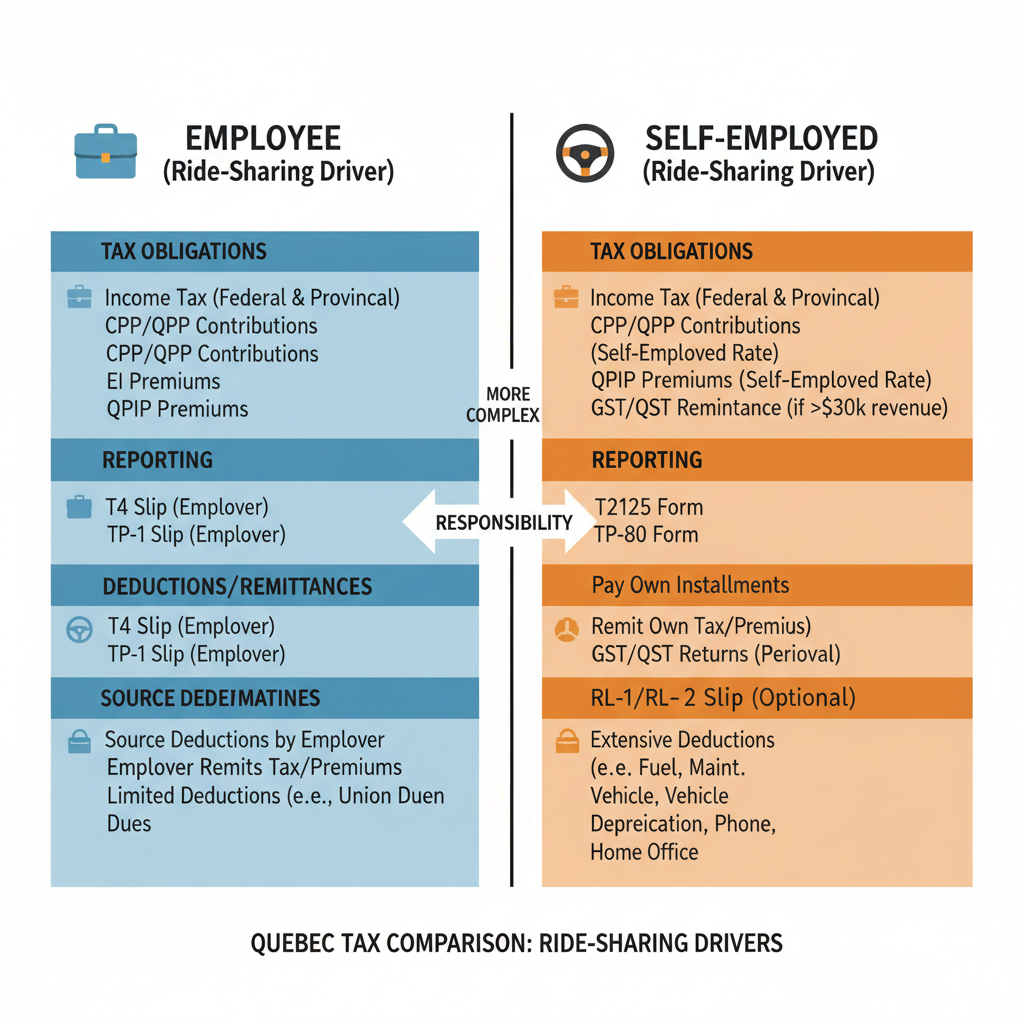
3.7 Differences Between Employee vs. Self-Employed for Tax Purposes
As an Uber or Lyft driver in Quebec, you are generally considered an independent contractor or self-employed individual, not an employee of Uber or Lyft. This distinction has several crucial tax implications that you must understand:
- No Source Deductions: Unlike an employee, no income tax, Employment Insurance (EI) premiums, or Canada Pension Plan (CPP) contributions are deducted from your earnings by Uber/Lyft. You are solely responsible for calculating and setting aside money throughout the year to pay your own income tax (both federal and provincial), your share of CPP contributions (which includes both the employee and employer portions, making it higher than an employee’s contribution), and potentially EI premiums (if you opt-in for special benefits for the self-employed, which is voluntary).
- Business Expenses: As a self-employed individual, a significant advantage is your ability to deduct eligible business expenses from your gross income to reduce your net business income, which is then subject to income tax. This can significantly lower your overall tax burden. Therefore, meticulous record-keeping for expenses is paramount. Keep detailed records for:
- Vehicle Expenses: This is usually the largest deduction. You can deduct a portion of your actual vehicle expenses based on your business mileage (e.g., fuel, oil, maintenance, repairs, commercial insurance, registration fees, car washes, and capital cost allowance (depreciation) or lease payments). A detailed mileage log (differentiating business vs. personal kilometers) is absolutely mandatory for substantiating these claims.
- Cell Phone Expenses: A percentage of your cell phone bill and data plan that is legitimately used for business purposes.
- Supplies: Cleaning supplies for your vehicle, water bottles for passengers, chargers, etc.
- Commissions/Fees: Any service fees or commissions paid to Uber/Lyft or other platforms.
- Professional Fees: Accounting, bookkeeping, or tax preparation fees related to your business.
- Training Costs: The mandatory training course cost and any other job-related professional development.
- Tax Remittances (Installments): If you expect to owe more than $3,000 in federal tax and $1,800 in provincial tax in a year (this includes income tax and CPP contributions), the CRA and Revenu Québec may require you to pay your estimated income tax and CPP contributions in quarterly installments throughout the year (typically due on March 15, June 15, September 15, and December 15). This helps you avoid a large tax bill at year-end and potential interest charges for underpayment.
- GST/QST Remittances: Separate from income tax, you must remit your net GST and QST collected according to your assigned reporting periods (e.g., quarterly, monthly).
Navigating the regulatory and tax landscape for ride-sharing with Uber and Lyft in Quebec can seem daunting, but by meticulously following these steps, you can establish yourself as a fully compliant and successful driver in cities like Montreal, Quebec City, and Gatineau. From securing your authorized SAAQ permit and completing mandatory provincial training to meticulously registering for and managing your GST and QST obligations from day one, each stage is critical for legal operation and financial health. Remember, proactive compliance not only avoids severe penalties but also builds a foundation of professionalism, reliability, and peace of mind. Keep thorough records, stay informed about any regulatory changes (which can occur periodically), and strongly consider consulting with a tax professional or accountant experienced with self-employed individuals and ride-sharing drivers in Quebec to optimize your financial management and ensure ongoing compliance. With diligence and attention to detail, you can confidently contribute to Quebec’s ride-sharing ecosystem.

Leave a Reply