Quick Method vs. Regular Method: How Canadian Drivers Save on GST/HST Remittances
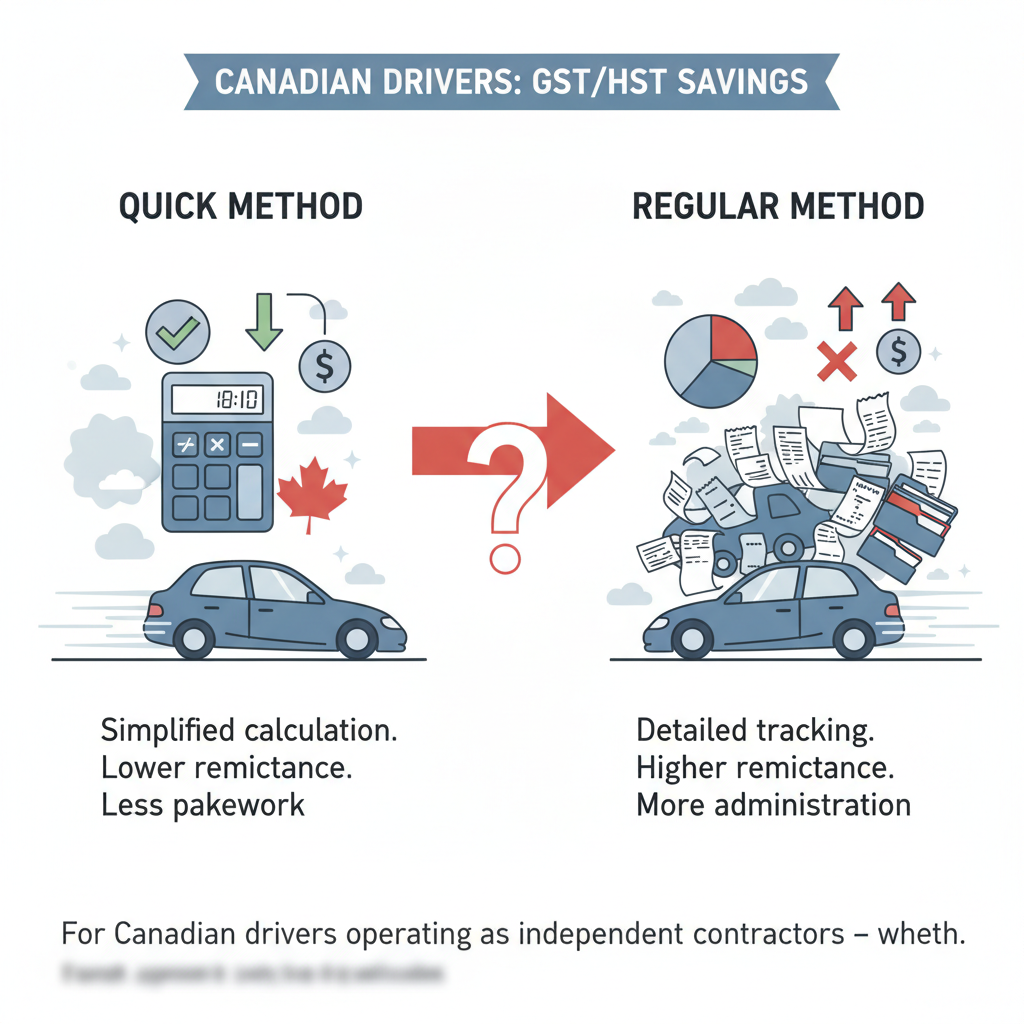
For Canadian drivers operating as independent contractors – whether for ride-sharing platforms, courier services, long-haul trucking, or local deliveries – navigating the complexities of the Goods and Services Tax (GST) and Harmonized Sales Tax (HST) can be a significant administrative and financial challenge. Understanding how to remit these taxes to the Canada Revenue Agency (CRA) efficiently and cost-effectively is paramount to maximizing take-home income and ensuring compliance. The choice between the Regular Method and the Quick Method of GST/HST remittance is a strategic decision that can have a profound impact on a driver’s financial health and administrative burden. This comprehensive guide will delve into the intricacies of both methods, offering detailed explanations, practical considerations, and scenario-based comparisons to help Canadian drivers determine the easiest and cheapest way to manage their GST/HST obligations. For general information on these taxes, the Canada Revenue Agency provides extensive resources on GST/HST for Businesses.
Understanding GST/HST for Canadian Drivers
Before diving into the remittance methods, it’s essential for Canadian drivers to grasp the fundamentals of GST/HST for independent contractors. The GST is a 5% federal tax applied to most goods and services in Canada. In provinces where the GST has been harmonized with provincial sales tax, it becomes the HST, with rates ranging from 13% to 15%. As an independent contractor, you are generally considered a “registrant” if your total taxable supplies (revenue before expenses) exceed $30,000 in any single calendar quarter or over the last four consecutive calendar quarters. Once this threshold is met, registration is mandatory, and you must begin collecting GST/HST on your services. You can register for a GST/HST account through the CRA.
The primary obligation of a GST/HST registrant is to collect the applicable tax from customers on taxable supplies and then remit it to the CRA. However, businesses are not merely tax collectors; they can also recover the GST/HST they pay on their business-related expenses. This recovery mechanism is known as Input Tax Credits (ITCs). For more detailed information on this, refer to the CRA’s guide on GST/HST Input Tax Credits. The challenge for drivers often lies in the fluctuating nature of their income, diverse range of expenses, and the administrative effort required to meticulously track these elements.
For many drivers, the business involves significant operational costs, including fuel, vehicle maintenance, insurance, leasing payments, cleaning supplies, and potentially professional fees for accounting or vehicle inspections. Each of these expenses might include a GST/HST component, making the choice of remittance method crucial for financial optimization. The “easiest” method typically refers to administrative simplicity and reduced record-keeping, while the “cheapest” method refers to the one that results in the lowest net tax remittance to the CRA. Sometimes, these two objectives align, but often, a trade-off is involved.
The Regular Method: Precision and Input Tax Credits (ITCs)
The Regular Method of GST/HST remittance is the standard approach for most businesses in Canada. Under this method, a driver collects the applicable GST/HST on all taxable supplies (e.g., fares for ride-sharing, delivery fees). At the end of each reporting period (monthly, quarterly, or annually, depending on election and revenue), the driver calculates the total GST/HST collected. From this total, they subtract the Input Tax Credits (ITCs) they are eligible to claim for the GST/HST paid on their business expenses. The net amount (GST/HST collected minus ITCs claimed) is then remitted to the CRA. If the ITCs exceed the GST/HST collected, the driver is eligible for a refund. The CRA provides guidance on calculating the net tax using the regular method.
Detailed Explanation of ITCs
Input Tax Credits are crucial for understanding the Regular Method’s financial benefits. An ITC allows a GST/HST registrant to recover the GST/HST paid or payable on purchases and expenses used in commercial activities. For a driver, this means any GST/HST included in the cost of items essential for running their driving business can be claimed back. It’s important to differentiate between expenses for personal use and those incurred solely for commercial activities. Only the latter are eligible for ITCs, and in cases of mixed use (e.g., a personal vehicle also used for business), the ITCs must be pro-rated accordingly. This precision ensures that businesses only recover the tax on the portion of goods and services used to generate taxable revenue. Understanding the specific rules for vehicle-related deductions can be complex, and drivers often find guidance on topics like CCA Class 10 & 10.1 for Canadian Drivers: Vehicle Depreciation Guide valuable when considering vehicle purchases and associated ITCs.
Examples of Common Driver Expenses Eligible for ITCs:
- Vehicle Purchase/Lease: If a vehicle is purchased or leased for business use, the GST/HST paid on the purchase price or lease payments (pro-rated for business use) can be claimed as an ITC. Note that for passenger vehicles, specific ITC restrictions may apply if the cost exceeds a certain limit for capital assets or if there’s a significant personal-use component.
- Fuel Costs: A significant and recurring expense for any driver. The GST/HST charged on gasoline, diesel, or electric charging can be claimed. Precise tracking of fuel consumption related to business mileage versus personal mileage is critical for accurate claims.
- Vehicle Maintenance and Repairs: Costs associated with keeping the vehicle roadworthy, such as oil changes, tire rotations, brake repairs, and accident repairs, including the GST/HST portion. These expenses are often unforeseen but necessary for continued operation, directly impacting a driver’s ability to earn income.
- Vehicle Insurance: While some insurance premiums are exempt from GST/HST, many commercial vehicle insurance policies do include it, which can then be claimed. It’s essential to check your policy breakdown to identify the GST/HST component.
- Vehicle Accessories: Business-related accessories like dash cams, specialized phone mounts, external lighting, or safety equipment that enhance operational efficiency or compliance.
- Cleaning Supplies: Products used to maintain the cleanliness and presentation of the vehicle for passengers or deliveries, essential for maintaining a professional image and meeting customer expectations.
- Professional Fees: Accounting services for tax preparation, legal advice related to the business (e.g., licensing, contracts), or vehicle inspection fees required for commercial operation. These services ensure compliance and smooth business operations.
- Communication Expenses: A portion of cellular phone and internet bills if used for business operations (e.g., navigation, ride-hailing apps, communication with clients, managing online bookings). The business use percentage must be reasonably determined and supported.
- Office Supplies: For managing records, invoicing, or other administrative tasks related to the driving business, if applicable. This can include stationery, printer ink, and other general office consumables.
- Parking Fees and Tolls: If incurred directly for business purposes, such as while waiting for a passenger, during a delivery, or transporting goods. These must be clearly tied to revenue-generating activities.
- Meals and Entertainment (with restrictions): For long-haul drivers, eligible meals (typically 50% claimable) and other travel-related expenses that include GST/HST, subject to specific CRA rules for deductibility. These are often subject to stringent documentation requirements.
Record-Keeping Requirements:
The Regular Method demands meticulous record-keeping. To claim ITCs, drivers must retain all invoices, receipts, and other supporting documentation for a minimum of six years. Each document should clearly show the supplier’s GST/HST registration number, the amount of GST/HST charged (or sufficient information to calculate it), the date of the purchase, and a clear description of the goods or services. Without proper documentation, ITCs cannot be claimed, and in the event of a CRA audit, unsupported claims could be disallowed, leading to reassessments, penalties, and interest. This stringent requirement contributes significantly to the administrative burden of the Regular Method, necessitating a robust system for receipt management, whether digital or physical. For vehicle-related expenses, maintaining a detailed logbook is often critical to audit-proof your claims. Learn more about how to ensure your vehicle deductions stand up to scrutiny by understanding the CRA Logbook Rule: Audit-Proof Your Vehicle Deductions.
Pros of the Regular Method:
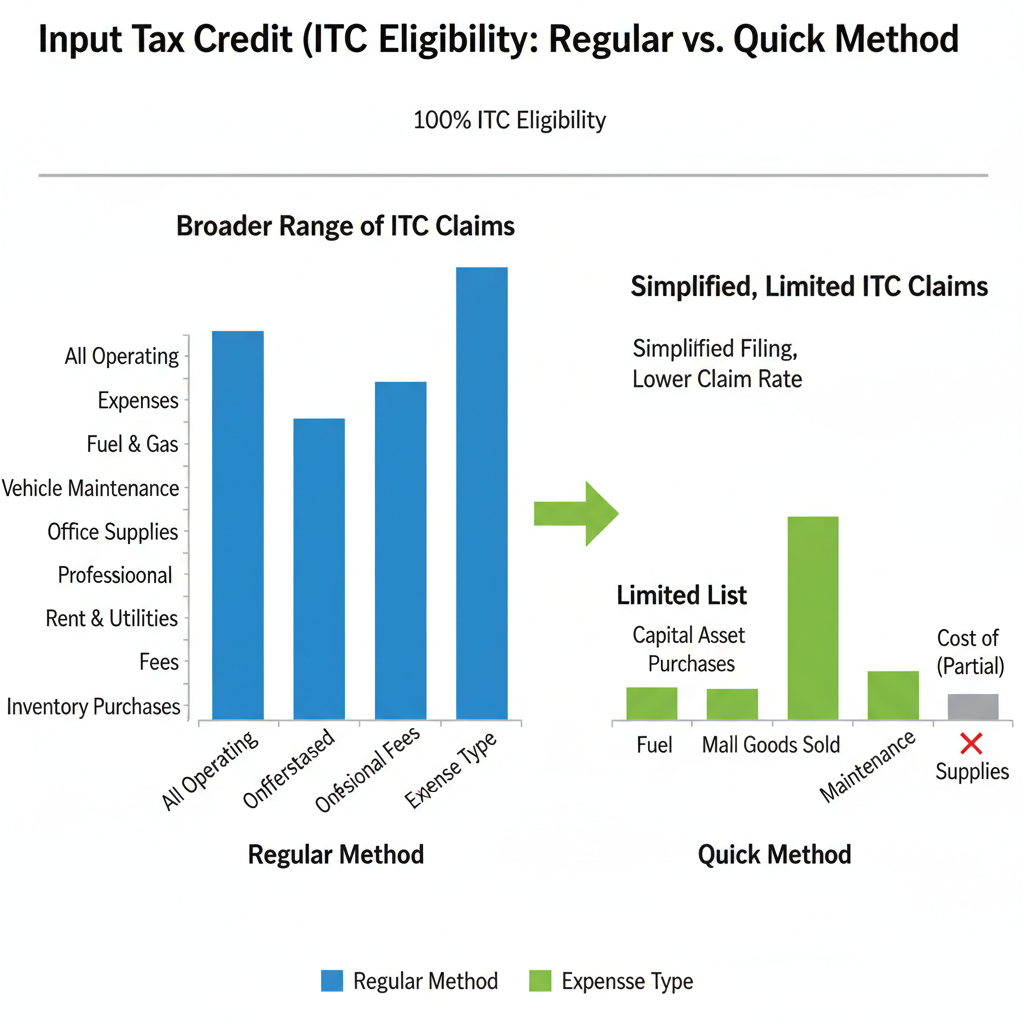
- Maximize Tax Recovery: Allows drivers to claim ITCs on virtually all eligible business expenses, leading to the lowest possible net GST/HST remittance to the CRA. This is particularly advantageous for businesses with high expenses relative to their revenue, or those incurring significant capital expenditures like purchasing a new vehicle. The ability to recover tax on a wide range of inputs directly reduces the overall tax burden.
- Potential for Refunds: If ITCs exceed the GST/HST collected in a reporting period, the CRA will issue a refund, providing a cash flow benefit. This can be crucial for new businesses with significant upfront investments or during periods of substantial growth requiring new assets. These refunds can act as an important financial lifeline.
- No Revenue Cap: There is no upper limit on annual revenue for businesses using the Regular Method, making it suitable for growing enterprises that anticipate exceeding the Quick Method’s $400,000 threshold. It offers limitless scalability in terms of revenue.
- Flexibility for Large Purchases: Full ITCs can be claimed on capital asset purchases, regardless of their value, which is a major advantage for businesses that frequently upgrade or acquire expensive equipment or vehicles. This ensures maximum recovery on major investments.
Cons of the Regular Method:
- Complex Record-Keeping: Requires diligent tracking and retention of every business receipt and invoice, detailing GST/HST paid. This can be time-consuming and prone to error, especially for drivers who are constantly on the go and generate numerous small transactions. The sheer volume of paperwork can be overwhelming.
- Higher Administrative Burden: More intricate calculations are needed for each reporting period, potentially requiring more time or the services of an accountant, which incurs additional costs. The need to verify each ITC claim and ensure its eligibility adds to this burden, diverting time from core business activities.
- Cash Flow Impact: Businesses must hold onto the collected GST/HST until it’s remitted, which can affect immediate cash flow if not managed properly. While ITCs eventually reduce the remittance, the initial collection can feel like a liability that needs careful management, requiring a dedicated bank account or careful financial planning.
The Quick Method: Simplicity and Simplified Remittance
The Quick Method of accounting for GST/HST is a simplified accounting option designed for eligible small businesses. Its primary appeal lies in reducing the administrative burden associated with tracking ITCs on every purchase. Instead of calculating GST/HST collected minus ITCs, businesses using the Quick Method remit a fixed, lower percentage of their gross sales (including the GST/HST collected) to the CRA. In exchange for this simplification, they generally forfeit the right to claim ITCs on most of their business purchases. The CRA offers detailed guidance on the Quick Method of Accounting for GST/HST.
Who is Eligible?
To be eligible for the Quick Method, a driver’s annual worldwide taxable supplies (including zero-rated supplies) from all businesses must be $400,000 or less in any four consecutive fiscal quarters over the last five fiscal quarters, and they must expect their total taxable supplies to be $400,000 or less in their current fiscal year. Certain businesses (e.g., accountants, lawyers, financial institutions) are excluded, but independent drivers typically qualify if they meet the revenue threshold. This threshold is important as it ensures the method is utilized by businesses for whom the administrative relief is most impactful, primarily small to medium-sized operations.
How it Works:
Upon electing to use the Quick Method, the CRA provides specific remittance rates based on the province or territory where the services are primarily rendered, and the type of business. These rates are significantly lower than the actual GST/HST rate (5% GST, or 13-15% HST) because they are applied to your total sales (including the tax you collected) and are designed to approximate the net tax you would remit under the Regular Method, considering average ITC claims for small businesses.
For instance, in a 5% GST-only province (e.g., Alberta), a service provider might have a Quick Method remittance rate of 3.6% on the first $30,000 of taxable sales (including GST) and 1.8% on taxable sales (including GST) above $30,000. In an HST province like Ontario (13% HST), the rates for a service provider could be 8.8% on the first $30,000 and 4.4% on sales above $30,000. These rates are subject to change by the CRA and vary by specific business category. It is crucial to always consult the most current CRA publication for the precise rates applicable to your business and province, as using outdated rates could lead to incorrect remittances and potential penalties.
What ITCs Can Still Be Claimed?
While the Quick Method simplifies ITC claims, it does not eliminate them entirely. Registrants using the Quick Method can still claim ITCs for purchases of capital assets that cost $50,000 or more (before tax). This typically refers to major equipment or vehicles. For example, if a driver purchases a new vehicle specifically for business use that costs $55,000 (before tax), they can claim the GST/HST paid on that purchase as an ITC, even while using the Quick Method. However, ITCs cannot be claimed for the vast majority of day-to-day operating expenses like fuel, maintenance, or supplies. This exception for large capital assets is a key feature, preventing businesses from being unfairly penalized for major, infrequent investments, acknowledging that such large purchases can still significantly impact a business’s financial position.
Calculating the Quick Method Remittance:
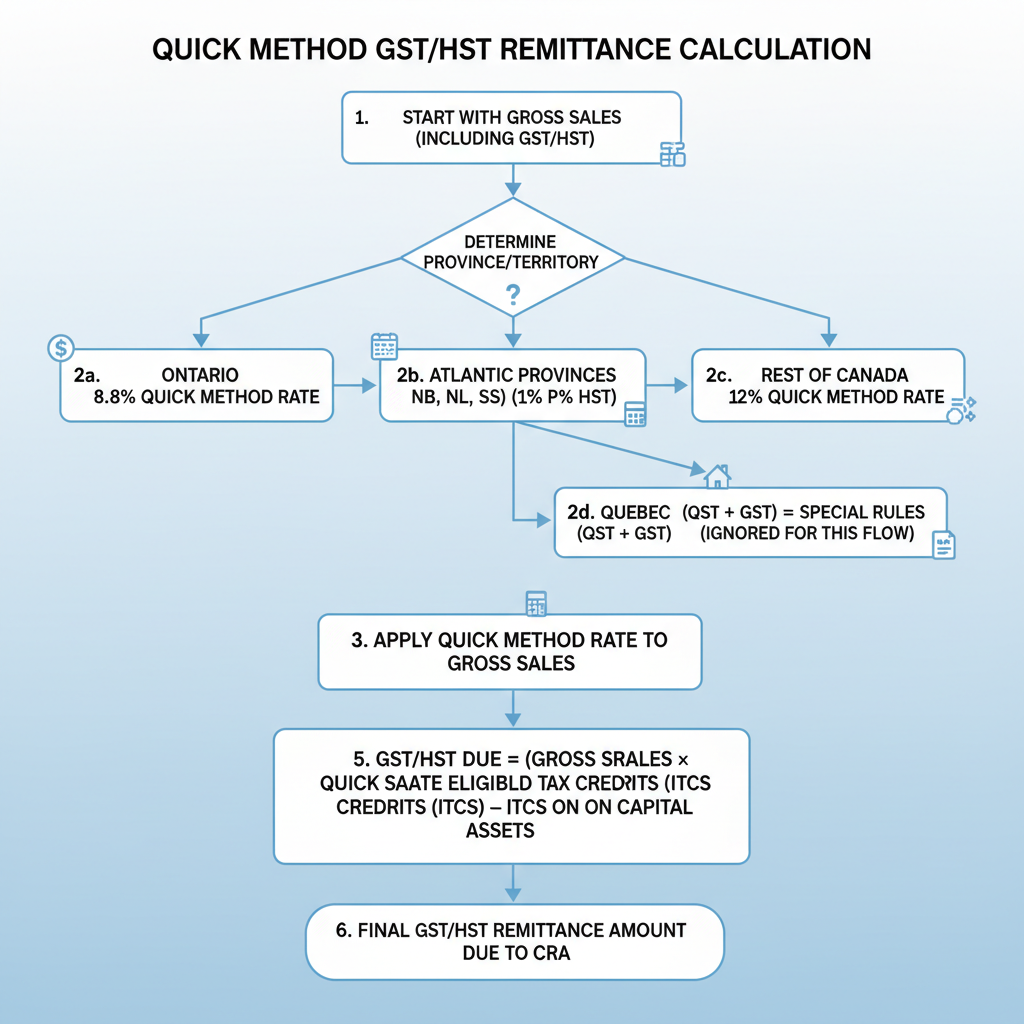
The calculation is straightforward:
1. Determine Gross Sales (including tax): Add the total value of your taxable sales (excluding collected GST/HST) to the GST/HST you collected during the reporting period.
2. Apply Quick Method Rate: Multiply your Gross Sales (including tax) by the specific Quick Method remittance rate applicable to your business and province.
3. Result: The resulting amount is what you owe to the CRA.
Example: If a driver in an Alberta (5% GST) scenario has $60,000 in gross sales (including collected GST) and the rates are 3.6% on the first $30,000 and 1.8% on the remainder:
* First $30,000 x 3.6% = $1,080
* Remaining $30,000 ($60,000 – $30,000) x 1.8% = $540
* Total Remittance = $1,080 + $540 = $1,620
This simplified calculation is a core benefit, reducing the complexity often associated with tax compliance and making it accessible even for those without extensive accounting backgrounds.
Pros of the Quick Method:
- Reduced Paperwork: Significantly simplifies record-keeping as you don’t need to track GST/HST paid on most individual expenses for ITC purposes. This means fewer receipts to organize and less time spent on calculations, directly contributing to the “easiest” objective. You primarily need to track your total sales.
- Simpler Calculations: The remittance calculation is much easier, reducing the chances of errors and saving administrative time. This ease of calculation is a major draw for small business owners who manage their own books, freeing them from complex ITC reconciliations.
- Predictability: The fixed remittance rates can make it easier to forecast tax liabilities, aiding in financial planning and budgeting. This allows for more stable cash flow management throughout the year, as the tax liability is a predictable percentage of sales.
- Potential for Savings: For businesses with relatively low operating expenses that don’t include significant GST/HST components, or where the administrative savings outweigh the lost ITCs, the Quick Method can result in a lower net remittance compared to the Regular Method, fulfilling the “cheapest” objective for certain profiles.
- Focus on Core Business: By reducing administrative burden, drivers can spend more time on their core driving activities rather than extensive bookkeeping. This shift in focus can lead to increased productivity and profitability in their primary service.
Cons of the Quick Method:
- Forfeit Most ITCs: The biggest drawback is giving up the ability to claim ITCs on most business expenses. This can lead to a higher net remittance if your business has substantial GST/HST-bearing expenses, particularly those below the $50,000 capital asset threshold. This means the GST/HST paid on fuel, repairs, and supplies becomes an unrecoverable cost.
- Revenue Threshold: Limited to businesses with annual taxable supplies of $400,000 or less, restricting its use for higher-earning drivers. Once this threshold is consistently exceeded, drivers must switch to the Regular Method, requiring a transition period and adjustment to new accounting procedures.
- Less Control: Less flexibility to recover tax on specific high-value operational expenses (under $50,000 capital assets), meaning some legitimate GST/HST costs cannot be reclaimed. This can be a significant financial disadvantage if you make frequent, moderately-sized business purchases.
- Rate Variations: Remittance rates vary by province/territory and business type, requiring careful attention to ensure the correct rate is applied and stays current with CRA updates. Incorrect rates can lead to under or over-remittance, both of which can cause issues with the CRA.
Choosing the Right Method: A Strategic Decision for Drivers
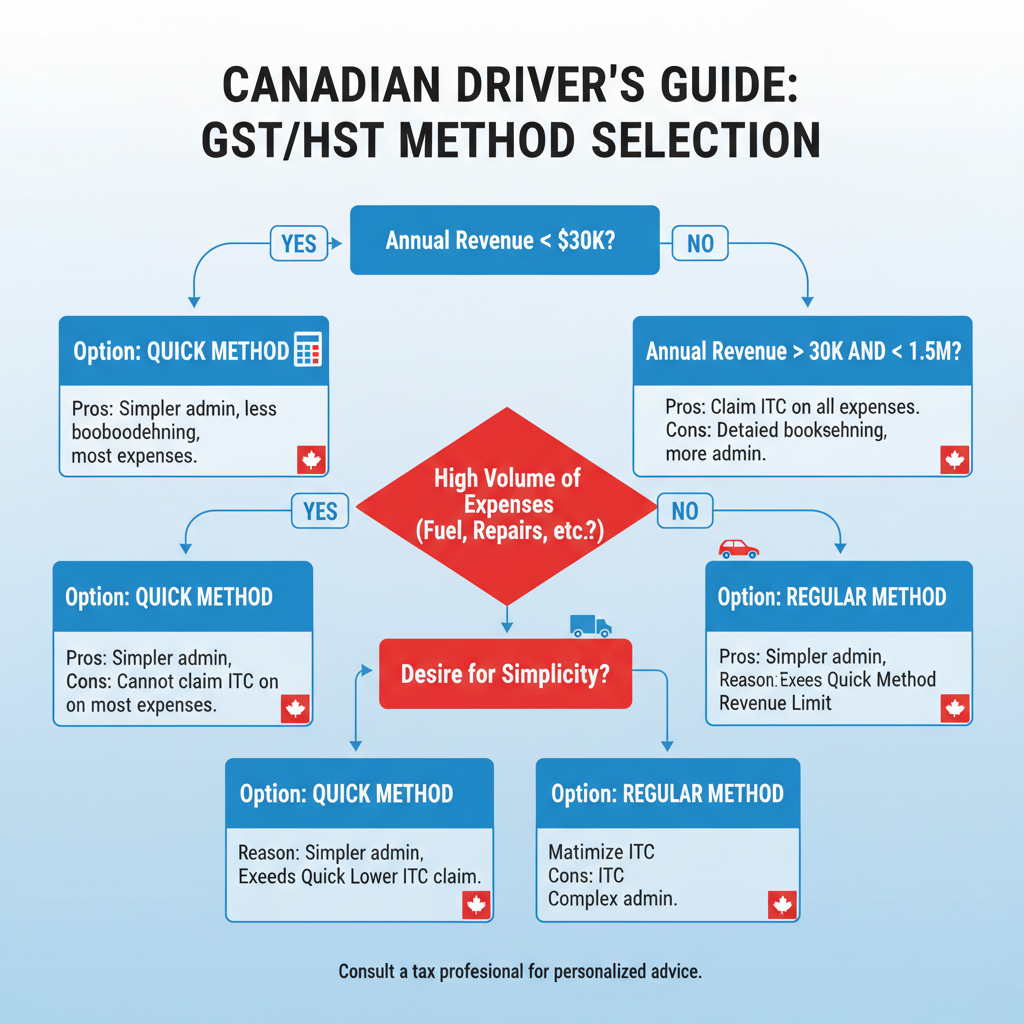
The choice between the Regular and Quick Method is not one-size-fits-all; it’s a strategic decision that hinges on several factors specific to a driver’s business model and financial situation. Drivers should carefully evaluate their circumstances to determine which method aligns best with their “easiest” and “cheapest” objectives. A careful comparison can reveal thousands of dollars in annual savings or significant reductions in administrative time.
Factors to Consider:
- Annual Revenue: If your annual taxable supplies consistently exceed $400,000, you are ineligible for the Quick Method and must use the Regular Method. If you are close to the threshold, consider future growth projections. A driver anticipating rapid growth might choose the Regular Method from the outset to avoid a forced transition later. This forward-thinking approach can prevent complications down the road.
- Volume of Expenses Subject to GST/HST: This is perhaps the most critical factor.
- High Expenses: Drivers with significant GST/HST-bearing expenses (e.g., new vehicle purchases, substantial ongoing maintenance, high fuel consumption due to long distances, commercial leases, frequent equipment upgrades) are more likely to benefit from the Regular Method to maximize ITC claims. For them, every dollar of reclaimable GST/HST adds up quickly, making the administrative effort worthwhile.
- Low Expenses: Drivers with relatively low expenses, or expenses that are largely exempt from GST/HST (e.g., certain insurance premiums, interest on loans, or older, fully depreciated vehicles with minimal upkeep), might find the Quick Method more advantageous. The administrative simplicity often outweighs the minimal ITCs they would claim under the Regular Method, leading to a net saving in time and potentially money.
- Administrative Capacity and Desire for Simplicity: If you prefer minimal paperwork, simpler calculations, and are willing to potentially forego some ITC recovery for ease of administration, the Quick Method is attractive. It reduces the need for constant receipt hoarding and detailed categorization, which can be a significant relief for busy drivers. If you are meticulous with record-keeping, already use sophisticated accounting software that automates ITC tracking, or employ a bookkeeper, the Regular Method’s administrative burden might be manageable and its financial benefits potentially greater. The choice often comes down to a trade-off between time spent on administration and potential tax savings.
- Type of Driving Business:
- Ride-sharing/Courier: These drivers often have consistent but moderate fuel, maintenance, and cleaning costs. The Quick Method could be beneficial if these ITCs are not substantial enough to outweigh the administrative ease and potential net tax savings provided by the simplified remittance rates. They often have many small transactions, making detailed ITC tracking burdensome. The volume of individual receipts can be a major headache under the Regular Method.
- Long-Haul Trucking: Often involves significant fuel costs, vehicle depreciation, cross-border expenses, and specialized equipment. These businesses frequently have high ITCs, making the Regular Method typically more suitable due to the sheer volume and value of GST/HST paid on inputs. The large scale of their operations means ITCs can amount to significant sums.
- New Business vs. Established: New businesses often incur significant start-up costs (e.g., vehicle acquisition, initial repairs, equipment, specialized licensing). The Regular Method can be very beneficial in the initial phase due to high ITCs from these purchases, potentially leading to refunds which can be a vital cash injection. Once these initial costs are absorbed, and expenses normalize and stabilize, re-evaluating the Quick Method might be worthwhile. This highlights the possibility of strategic switching between methods over the life of a business, adapting to its evolving lifecycle.
The “sweet spot” for the Quick Method often lies with businesses that have gross sales up to the $400,000 threshold and relatively low input costs that carry GST/HST. Conversely, if your business has high input costs that consistently include a significant amount of GST/HST, the Regular Method is generally the financially superior choice. It is crucial to perform a comparative calculation annually, or whenever your business operations change significantly, to ensure you are using the most advantageous method. This proactive approach ensures continuous optimization of your GST/HST remittance strategy.
Scenario-Based Comparison: Which Method Benefits Which Driver?
To illustrate the financial implications, let’s explore three hypothetical scenarios for Canadian drivers, assuming a 5% GST-only province for simplicity of calculation (e.g., Alberta, where service providers might use Quick Method rates of 3.6% on first $30,000 and 1.8% on sales above $30,000). These scenarios are designed to highlight how varying expense profiles directly impact the optimal choice.
Scenario 1: The New Driver with Significant Upfront Vehicle Costs
- Driver Profile: “Sarah,” a new independent contractor starting a courier service. She purchased a new van for her business costing $45,000 (excluding GST). She also spent $2,000 on initial business setup (GPS, shelving, branding) and $3,000 on initial fuel and insurance (all including 5% GST). Her gross taxable sales for the first year are $50,000.
- GST/HST Collected: Sarah collects 5% GST on her $50,000 in sales, totaling $2,500.
Regular Method Calculation:
1. GST/HST Collected: $2,500
2. ITCs on Van Purchase: $45,000 (vehicle cost) * 5% GST = $2,250. This is a direct recovery of tax paid on a significant asset.
3. ITCs on Setup Costs: To extract the GST from a tax-included price, we use the formula: Amount * (GST rate / (1 + GST rate)). So, $2,000 * (5/105) = $95.24.
4. ITCs on Initial Fuel/Insurance: Similarly, $3,000 * (5/105) = $142.86.
5. Total ITCs: $2,250 (van) + $95.24 (setup) + $142.86 (fuel/insurance) = $2,488.10.
6. Net Remittance: $2,500 (Collected) – $2,488.10 (ITCs) = $11.90. Sarah remits $11.90. This minimal remittance demonstrates the power of ITCs for new businesses with high initial costs.
Quick Method Calculation:
1. Gross Sales (including collected GST/HST): $50,000 (sales) + $2,500 (collected GST) = $52,500. This is the base for the Quick Method calculation.
2. Quick Method Remittance Rate (Alberta example for service providers):
* First $30,000 of gross sales * 3.6% = $1,080.
* Remaining gross sales: $52,500 (total) – $30,000 (first tier) = $22,500.
* $22,500 * 1.8% = $405.
3. Total Quick Method Remittance: $1,080 + $405 = $1,485.
4. ITC on Van Purchase: Since the van cost $45,000, it is below the $50,000 threshold for capital asset ITCs under the Quick Method. Therefore, Sarah cannot claim the $2,250 ITC on the van purchase. She also cannot claim ITCs on other expenses like setup or fuel.
5. Net Remittance: $1,485 (She remits $1,485 and cannot claim most ITCs).
Conclusion for Scenario 1: For Sarah, the Regular Method ($11.90 remittance) is significantly cheaper than the Quick Method ($1,485 remittance). This is because her initial year involved a substantial capital purchase and start-up expenses, generating high ITCs that were mostly forfeit under the Quick Method. The Regular Method is the clear winner for new drivers with significant upfront GST/HST-bearing costs, often resulting in minimal remittances or even refunds. The lost ITCs under the Quick Method in this scenario are too substantial to make it financially viable.
Scenario 2: The Established Driver with Low Operational Expenses
- Driver Profile: “Mark,” an experienced independent ride-sharing driver. He owns an older vehicle that is fully paid off, requires minimal maintenance, and his fuel consumption is efficient. His gross taxable sales for the year are $70,000. His annual expenses with GST/HST are very low, totaling $5,000 (e.g., fuel, occasional repairs, cleaning supplies).
- GST/HST Collected: Mark collects 5% GST on his $70,000 in sales, totaling $3,500.
Regular Method Calculation:
1. GST/HST Collected: $3,500.
2. ITCs on Expenses: Mark’s $5,000 in expenses includes GST. So, to find the GST component: $5,000 * (5/105) = $238.10.
3. Net Remittance: $3,500 (Collected) – $238.10 (ITCs) = $3,261.90. Mark remits $3,261.90.
Quick Method Calculation:
1. Gross Sales (including collected GST/HST): $70,000 (sales) + $3,500 (collected GST) = $73,500.
2. Quick Method Remittance Rate (Alberta example):
* First $30,000 * 3.6% = $1,080.
* Remaining gross sales: $73,500 (total) – $30,000 (first tier) = $43,500.
* $43,500 * 1.8% = $783.
3. Total Quick Method Remittance: $1,080 + $783 = $1,863.
4. Net Remittance: $1,863 (He remits $1,863 and cannot claim ITCs on his $5,000 in expenses as they are not capital assets over $50,000).
Conclusion for Scenario 2: For Mark, the Quick Method ($1,863 remittance) is significantly cheaper than the Regular Method ($3,261.90 remittance). Because his GST/HST-bearing expenses are very low, the ITCs he can claim under the Regular Method are minimal. The simplified Quick Method rate results in a substantially lower net tax payment, illustrating that for drivers with minimal input costs, foregoing ITCs for administrative ease and lower remittance is highly beneficial. This scenario highlights how drivers with low operational expenses are prime candidates for the Quick Method, benefiting both financially and from administrative ease.
Scenario 3: The High-Volume Driver with Moderate, Consistent Expenses
- Driver Profile: “David,” a busy independent delivery driver, generating $100,000 in gross taxable sales annually. His vehicle is a few years old, and he has consistent, moderate expenses with GST/HST, totaling $25,000 per year (e.g., high fuel consumption, regular maintenance, commercial tires, vehicle depreciation not exceeding $50K capital asset threshold).
- GST/HST Collected: David collects 5% GST on his $100,000 in sales, totaling $5,000.
Regular Method Calculation:
1. GST/HST Collected: $5,000.
2. ITCs on Expenses: David’s $25,000 in expenses includes GST. So, to find the GST component: $25,000 * (5/105) = $1,190.48.
3. Net Remittance: $5,000 (Collected) – $1,190.48 (ITCs) = $3,809.52. David remits $3,809.52.
Quick Method Calculation:
1. Gross Sales (including collected GST/HST): $100,000 (sales) + $5,000 (collected GST) = $105,000.
2. Quick Method Remittance Rate (Alberta example):
* First $30,000 * 3.6% = $1,080.
* Remaining gross sales: $105,000 (total) – $30,000 (first tier) = $75,000.
* $75,000 * 1.8% = $1,350.
3. Total Quick Method Remittance: $1,080 + $1,350 = $2,430.
4. Net Remittance: $2,430 (He remits $2,430 and cannot claim ITCs on his $25,000 in expenses, as it’s not a capital asset over $50K).
Conclusion for Scenario 3: In this case, the Quick Method ($2,430 remittance) is also cheaper for David than the Regular Method ($3,809.52 remittance). Despite having moderate expenses, the Quick Method’s simplified rate results in a lower overall payment. This demonstrates that even with consistent, average expenses, the Quick Method can be financially advantageous, especially when combined with its administrative simplicity. It suggests that for many independent drivers, the Quick Method offers a compelling blend of ease and cost-effectiveness, provided their expenses don’t generate exceptionally high ITCs that would be lost. This scenario often represents the typical independent driver’s situation, where the Quick Method provides a tangible benefit.
Important Note on Calculations: The Quick Method rates are designed so that the net tax paid is generally comparable to or slightly less than what would be paid under the Regular Method for businesses with typical expense profiles. However, as these scenarios show, individual circumstances with very high or very low expenses can significantly skew the outcome. Always use the current CRA Quick Method rates for your specific province/territory and business type when performing your own calculations, as these rates are subject to periodic adjustments by the Canada Revenue Agency.
Transitioning Between Methods
Canadian drivers are not locked into one method forever. Businesses can elect to switch between the Regular and Quick Methods, but there are rules governing these transitions, ensuring stability in tax reporting.
- Entering the Quick Method: You can elect to use the Quick Method at any time, but the election must be made by the due date of the return for the first reporting period in which you want to use it. Once you elect, you must use the Quick Method for at least one full fiscal year, unless you cease to be eligible (e.g., by exceeding the revenue threshold). This commitment period ensures consistency for both the taxpayer and the CRA.
- Leaving the Quick Method: If you stop using the Quick Method, you must notify the CRA in writing. Generally, you cannot re-elect to use the Quick Method for at least one year after you revoked your election, or were deemed ineligible. This “cooling off” period prevents frequent switching, which could complicate tax administration. If your business grows beyond the $400,000 annual taxable supply threshold, you automatically become ineligible for the Quick Method and must switch to the Regular Method in the subsequent reporting period. The CRA will typically notify you if you’ve exceeded the threshold.
Strategic switching can be beneficial. For instance, a new driver might use the Regular Method in their first year to claim significant ITCs on a new vehicle purchase and start-up costs, generating a substantial refund or greatly reducing initial remittances. Then, in subsequent years, if their expenses normalize to a moderate level where the Quick Method becomes financially advantageous and administratively easier, they could make the switch. This flexibility allows businesses to adapt their tax strategy to their evolving operational and financial realities, ensuring they always use the most suitable method for their current circumstances.
Important Considerations & Best Practices
- Record-Keeping is Always Essential: Even with the Quick Method, you must still keep meticulous records of all your sales and purchases. These records are vital to justify your gross revenue (for Quick Method calculations) and to accurately track expenses for income tax purposes (even if ITCs aren’t claimed for GST/HST). For the Regular Method, detailed GST/HST invoices are paramount, each clearly showing the GST/HST paid. Digital record-keeping solutions and apps can significantly streamline this process.
- Consult a Tax Professional: The examples provided are illustrative and simplified. Tax rules can be highly complex and are specific to individual circumstances and provincial variations. Consulting a qualified accountant or tax professional who specializes in GST/HST for independent contractors can provide tailored advice and ensure full compliance. They can perform a precise comparative analysis based on your actual figures and current CRA rates, helping you make the most informed decision.
- Review Annually: Business operations, expenses, and revenue can change significantly from year to year. It’s good practice to review which method is most beneficial for your business at least once a year, ideally before the start of your fiscal year, to make an informed decision. This annual review can uncover opportunities for substantial savings or administrative efficiencies, adapting your strategy to your business growth or changes in expenses.
- Impact on Pricing: While GST/HST is collected from the customer, the choice of remittance method does not directly impact the amount you charge (you still collect the applicable GST/HST rate). However, the net remittance directly affects your business’s profitability, as it represents funds that would otherwise remain with the business. A lower net remittance means more money stays in your business.
- CRA Audits: Regardless of the method chosen, the CRA has the authority to audit your GST/HST records. Maintaining organized, accurate, and complete records is crucial for a smooth audit process and to avoid potential penalties or reassessments. Being prepared for an audit reduces stress and potential financial repercussions.
- Provincial Differences: Remember that Quick Method rates and specific rules can vary by province and territory, especially for HST-participating provinces. Always verify the rates and eligibility criteria specific to your operational jurisdiction. For drivers operating across provincial lines, understanding how GST/HST applies to their services and where they are required to collect and remit is crucial. This can also impact the calculation of GST/HST rules for Uber and DoorDash and similar platforms.
Conclusion
For Canadian drivers operating as independent contractors, selecting the optimal GST/HST remittance method is a critical decision that balances administrative ease with financial savings. The Regular Method, while demanding meticulous record-keeping and detailed tracking of every eligible expense, offers the maximum recovery of GST/HST paid on business inputs through Input Tax Credits. It is typically the “cheapest” option for drivers with high GST/HST-bearing expenses, especially those with significant capital asset purchases or substantial ongoing operational costs that generate a large volume of ITCs.
Conversely, the Quick Method champions simplicity, significantly reducing the administrative burden by allowing drivers to remit a lower, fixed percentage of their gross sales instead of tracking individual ITCs for most expenses. This method often proves to be both “easiest” and “cheapest” for drivers with lower GST/HST-bearing expenses or where the value of foregone ITCs is outweighed by the reduced administrative effort and potentially lower net tax payable, as vividly demonstrated in our scenarios. It frees up valuable time that can be reinvested in growing the business, or simply enjoying a better work-life balance.
Ultimately, there is no universal “best” method. The ideal choice depends on a driver’s specific annual revenue levels, the nature and volume of their business expenses, and their personal capacity or willingness to manage detailed tax records. By thoroughly understanding the mechanics, eligibility, pros, and cons of both the Regular and Quick Methods, and by performing a personalized comparative analysis of their own financial situation, Canadian drivers can make an informed decision that optimizes their GST/HST remittances, ensuring both compliance with tax laws and maximum financial efficiency for their independent driving business. Regularly reviewing this choice with a qualified tax professional is a best practice to adapt to changing business circumstances and maximize long-term savings.

Leave a Reply