

When you toggle the toggle switch to “Go Online” on apps like Uber, Lyft, DoorDash, SkipTheDishes, or Instacart, the promise of flexibility is immediate. You set your own hours, choose your routes, and watch direct deposits hit your bank account every week. It feels like simple, quick cash.
However, when tax season arrives, millions of rideshare and delivery drivers experience severe sticker shock. They expect a routine process similar to filing a standard employment tax return, only to discover they owe thousands of dollars in back taxes, self-employment contributions, and potential late-payment penalties.
Why does this happen? Because taxes for gig workers are not standard.
Unlike traditional employees who receive paystubs with taxes pre-deducted, gig workers are legally classified as independent contractors. In the eyes of both the Internal Revenue Service (IRS) in the United States and the Canada Revenue Agency (CRA) in Canada, you are a small business owner running a sole proprietorship.
Understanding this distinction is the difference between keeping your gig earnings profitable and losing your margins to tax debt, audits, and compliance fines. This comprehensive guide breaks down everything rideshare and delivery drivers must know about tax obligations, cross-border system comparisons between Canada and the USA, deductible expenses, and financial management strategies.
1. The Mindset Shift: Employee vs. Small Business Owner
To navigate gig taxes successfully, you must first dismantle the myth that gig driving is just a “side job with paychecks.”
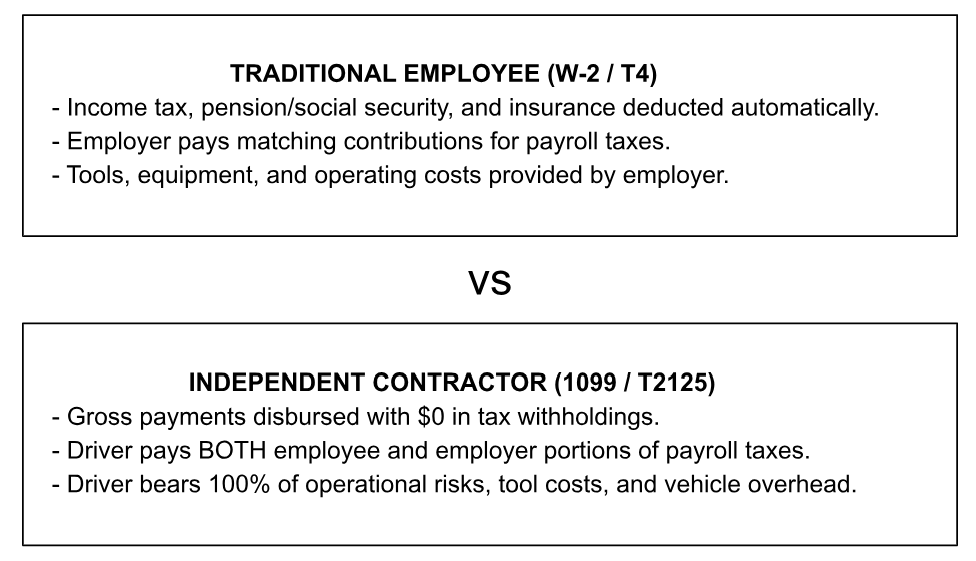
The Payroll Tax Difference
When you work as a traditional employee:
- In the USA: You receive a Form W-2. Your employer automatically withholds Federal Income Tax, State Income Tax, and your share of FICA taxes (6.2% Social Security + 1.45% Medicare = 7.65%). Your employer pays an additional matching 7.65% behind the scenes.
- In Canada: You receive a Form T4. Your employer automatically withholds Income Tax, Canada Pension Plan (CPP) contributions (5.95%), and Employment Insurance (EI) premiums (1.66%). Your employer matches your CPP and pays 1.4 times your EI contribution.
When you drive for a gig platform:
- The platform acts as a client, not an employer. They send you 100% of your gross earnings (minus their platform service fees). They do not withhold income taxes, pension contributions, or social security.
- You pay double payroll tax. Because you are both the employer and the employee of your sole proprietorship, you are responsible for paying both halves of social security/pension taxes out of your own pocket.
2. Deep Dive: United States Gig Economy Tax System (IRS)
If you drive for rideshare or delivery platforms in the United States, your tax profile is managed under the IRS framework for self-employed individuals.
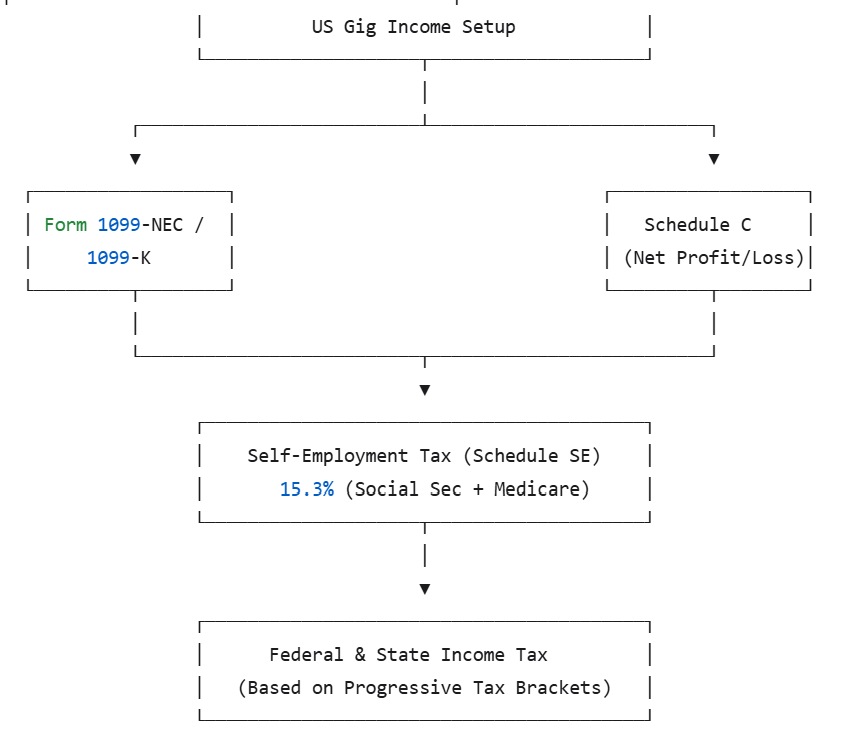
Key IRS Forms for Drivers
- Form 1099-NEC / Form 1099-K: Platforms report your earnings to you and the IRS on these forms.
- 1099-NEC (Nonemployee Compensation): Used for direct promotional payments, referral bonuses, or incentives paid directly by the app.
- 1099-K (Payment Card and Third Party Network Transactions): Used for passenger fares and delivery payments processed through the app platform.
- Schedule C (Form 1040) – Profit or Loss From Business: This is where you calculate your net income. You report your total gross revenue from all apps, subtract your deductible business expenses, and calculate your net taxable profit.
- Schedule SE (Form 1040) – Self-Employment Tax: Used to calculate the social security and Medicare taxes owed on your net Schedule C earnings.
The Self-Employment (SE) Tax Penalty
The Self-Employment tax rate in the US is 15.3%. This consists of:
- 12.4% for Social Security (covers earnings up to the annual wage base limit)
- 2.9% for Medicare (covers all net earnings)
As an employee, you only pay 7.65%. As an independent contractor driver, you pay the full 15.3% on your net business income (though you can deduct half of your self-employment tax on your personal Form 1040).
Estimated Quarterly Taxes (Form 1040-ES)
Because taxes are not withheld automatically, the IRS requires self-employed workers who expect to owe $1,000 or more in taxes to pay Quarterly Estimated Taxes. If you wait until April to pay your full tax bill, the IRS will assess underpayment penalties and interest.
US Quarterly Tax Deadlines:
- Q1 (Jan 1 – Mar 31): Due April 15
- Q2 (Apr 1 – May 31): Due June 15
- Q3 (Jun 1 – Aug 31): Due September 15
- Q4 (Sep 1 – Dec 31): Due January 15 of the following year
3. Deep Dive: Canadian Gig Economy Tax System (CRA)
In Canada, self-employed gig workers fall under the jurisdiction of the Canada Revenue Agency (CRA). While the general concept is similar to the US, specific tax rules surrounding pension contributions, vehicle logging, and sales taxes differ dramatically.
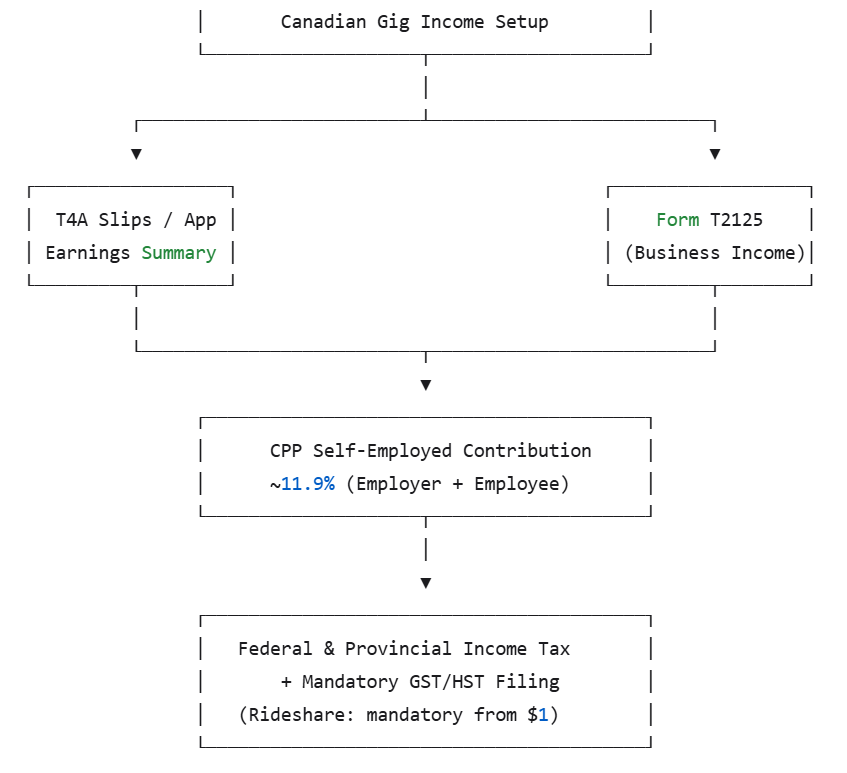
Key CRA Forms for Drivers
- T4A Slip (Statement of Distribution Income): Some platforms issue a T4A under Box 048 (Fees for Services). However, many platforms simply provide an annual tax summary statement in your driver portal. You are required to report all income regardless of whether a formal T4A slip is generated.
- Form T2125 (Statement of Business or Professional Activities): This is the Canadian equivalent of US Schedule C. You detail your main industry code (e.g., 485310 for Taxi and Rideshare Services or 492210 for Local Couriers and Delivery), gross earnings, itemized vehicle costs, and operating expenses to calculate your Net Business Income.
Double Canada Pension Plan (CPP) Contributions
Self-employed workers in Canada must pay both the employee and employer share of the Canada Pension Plan (CPP) on self-employment net earnings above the $3,500 basic exemption threshold.
- The combined self-employed CPP rate is 11.9% (up to the maximum pensionable earnings ceiling).
- Employment Insurance (EI): Self-employed workers do not pay EI premiums on business income unless they voluntarily opt into the Special Benefits program for self-employed individuals (which covers maternity, parental, and sickness benefits, but not job loss coverage).
The GST/HST Trap: Rideshare vs. Delivery Drivers
One of the costliest errors Canadian gig drivers make involves Sales Tax (GST/HST). The CRA treats passenger transport and food delivery under fundamentally different rules:
1. Delivery Drivers (DoorDash, SkipTheDishes, Instacart, Uber Eats)
Follow the standard Small Supplier Rule. If your total gross revenues from all worldwide business activities are under $30,000 CAD across four consecutive calendar quarters, you are not required to register for or collect GST/HST.
2. Rideshare Drivers (Uber, Lyft)
The Small Supplier Exemption DOES NOT APPLY to Rideshare. Under the Canadian Excise Tax Act, taxi drivers and rideshare drivers are legally classified under the same mandatory commercial operator regulations.
Crucial CRA Rule: Rideshare drivers MUST register for a GST/HST account and collect/remit GST/HST from their very first dollar of passenger fare earned. There is zero threshold. If you drive one passenger on Uber in Canada, you must have an active CRA GST/HST business account.
(Note: Major platforms like Uber and Lyft automatically collect GST/HST on passenger fares in Canada on your behalf and remit it or pass it to you to remit, depending on the province and platform setup. However, you remain legally responsible for holding an active registration number and filing annual or quarterly GST/HST returns.)
4. Vehicle Expense Deduction: The Big US vs. Canada Difference
Vehicle expenses are usually a gig driver’s largest tax deduction. However, the IRS and the CRA calculate these deductions through completely different methodologies. This is where drivers making cross-border assumptions get caught in audits.
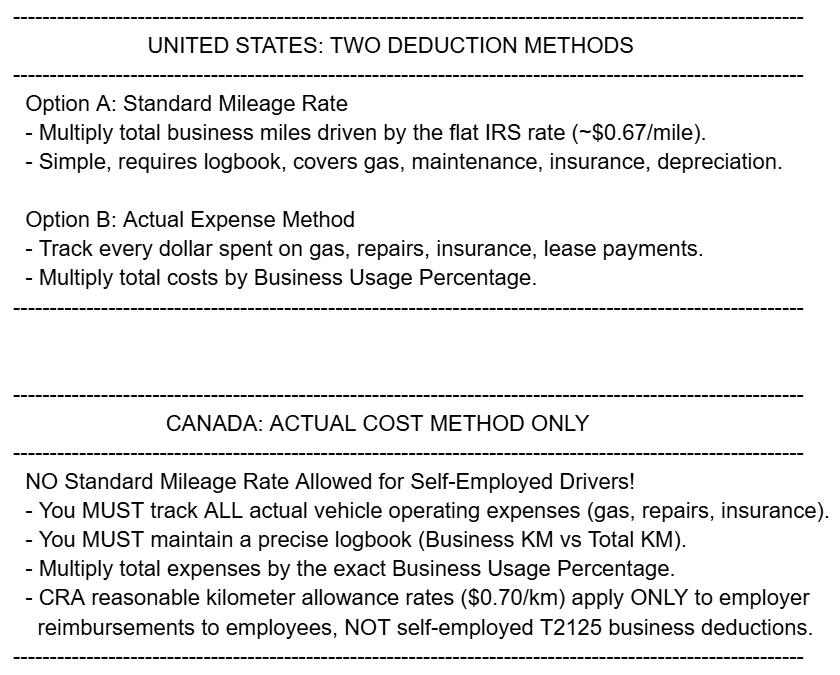
The US Approach: Choice Between Standard Rate or Actual Expenses
In the US, the IRS gives drivers a choice on Schedule C during their first year of business use:
- Standard Mileage Rate: The IRS sets an official annual rate per business mile driven (e.g., 67 cents per mile for 2024). This rate incorporates fuel, wear-and-tear, depreciation, insurance, and maintenance. If you drive 20,000 business miles, your deduction is simply
20,000×$0.67=$13,400 - Actual Expense Method: You tally up actual costs (gas, oil, tires, repairs, insurance, registration fees, lease payments or vehicle depreciation via Form 4562) and multiply the total by your business-use percentage.
The Canadian Approach: Actual Expenses Only
There is no flat standard per-kilometer deduction rate for self-employed individuals in Canada.
A common mistake among Canadian drivers is multiplying their business kilometers by the CRA’s reasonable mileage rate (e.g., $0.70 per km). That rate is strictly reserved for employers reimbursing employees. If you use that method on Form T2125, the CRA will reject the claim during a review.
In Canada, you must use the Actual Expense Method:
- Add up every dollar spent on gas, maintenance, insurance, registration, licensing fees, car wash costs, lease payments, and Capital Cost Allowance (CCA depreciation).
- Calculate your business percentage:
-
- Multiply total expenses by your Business Usage Percentage.

Canadian Calculation Example:
- Total Kilometers Driven in Year: 30,000 km
- Business Kilometers Driven (Uber/Delivery): 21,000 km
- Business Percentage: 70% (
21,000/30,00021,000/30,000) - Total Annual Vehicle Operating Expenses (Gas, Insurance, Repairs, Lease): $10,000 CAD
- Allowable Business Tax Deduction:
$10,000×70%=$7,000 CAD$10,000×70%=$7,000 CAD
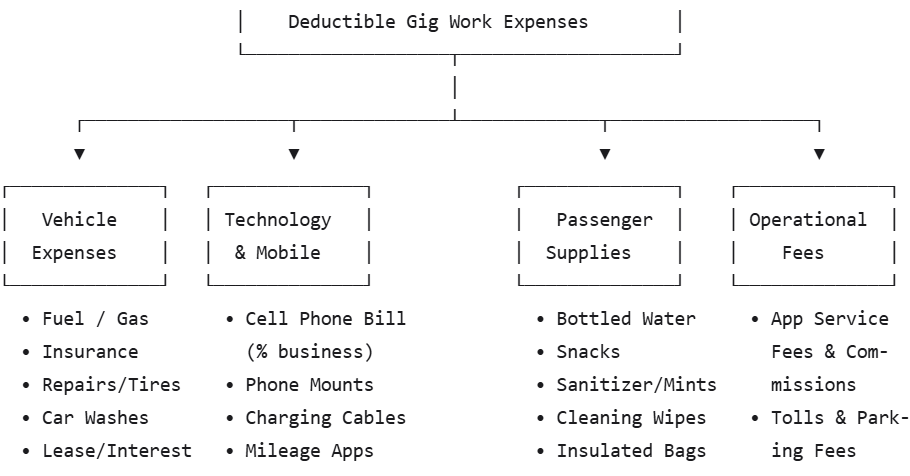
5. Comprehensive Write-Off Checklist for Rideshare & Delivery Drivers
Because your taxes are calculated on Net Income (Gross Earnings minus Allowable Business Expenses), every valid write-off directly lowers your taxable income and reduces your tax liability.
1. Mobile Phone & Data Plan
You cannot run a gig business without a smartphone and a mobile data plan.
- US & Canada Rule: You can deduct the percentage of your monthly phone bill used for work. If 60% of your total screen/data time is dedicated to gig applications, you write off 60% of your cell phone bill, plus 100% of dedicated accessories (mounts, chargers, power banks).
2. Platform Service Fees and Commissions
When Uber or Lyft displays your gross earnings, they often show total passenger payment before deducting their 20%–35% platform service fee.
- You must report the Gross Fare as revenue and deduct the Platform Service Fees under management/processing fees. Failing to deduct platform fees means paying tax on revenue you never received.
3. Passenger Amenities & Delivery Supplies
- For Rideshare: Bottled water, mints, tissues, hand sanitizer, backseat trash bags, floor mats, seat covers, and dash cams.
- For Delivery: Insulated hot/cold bags, pizza bags, drink carriers, reflective safety vests, bike helmets (if delivering by bicycle), and thermal blankets.
4. Parking and Tolls
- Parking fees incurred while picking up orders or dropping off passengers/deliveries are 100% tax-deductible.
- Toll charges incurred while actively on a trip or returning from a trip are fully deductible (provided you were not reimbursed directly by the app).
- Note: Parking tickets or traffic violations are never tax-deductible in either country.
5. Professional Services and Software
- Subscriptions for mileage tracking software (MileIQ, Stride, Everlance).
- Fees paid to an accountant, CPA, or tax preparation software (TurboTax, TaxAct, Wealthsimple Tax) to prepare your business returns.
6. USA vs. Canada: Side-by-Side Comparison Matrix
| Tax Category | United States (IRS) | Canada (CRA) |
| Worker Classification | Independent Contractor (Sole Proprietor) | Independent Contractor (Sole Proprietor) |
| Primary Income Forms | Form 1099-NEC / 1099-K | Form T4A / App Tax Summary Statements |
| Business Income Schedule | Schedule C (Form 1040) | Form T2125 |
| Self-Employment Taxes | 15.3% SE Tax (12.4% Social Security + 2.9% Medicare) | 11.9% CPP (Combined Employer + Employee) |
| Vehicle Mileage Deduction Method | Standard Mileage Rate OR Actual Expense Method | Actual Expense Method ONLY (No standard mileage rate allowed) |
| Sales Tax Obligations | State sales tax generally does not apply to passenger transport/delivery fares directly driven by contractors. | Mandatory GST/HST registration from $1 for Rideshare. Delivery under $30k uses Small Supplier Exemption. |
| Quarterly Tax Threshold | Required if you expect to owe $1,000+ in federal tax. | Required if net tax owed exceeds **3,000CAD∗∗(3,000CAD∗∗(1,800 for Quebec) in current or prior years. |
| Audit Requirement for Vehicle | Written logbook or digital GPS log of business miles. | Detailed logbook recording Starting KM, Ending KM, Date, and Purpose of every business trip. |
7. Common Pitfalls That Cause Audits and Huge Tax Bills
5 CRITICAL GIG WORK TAX MISTAKES
1. Mixing Personal & Business Banking (Triggers Audits)
2. Failing to Log “Empty Miles” (Losing Thousands in Deductions)
3. Ignoring Canadian GST/HST Registration for Rideshare ($1 Rule)
4. Skipping Quarterly Tax Payments (Accruing Penalty Interest)
5. Over-claiming 100% Vehicle Use Without Proof
Pitfall 1: Assuming App Mileage Summaries Show 100% of Business Miles
At the end of the year, platforms like Uber or DoorDash issue a summary showing “On-Trip Miles” or “Active Miles.” This number is almost always significantly lower than your actual business mileage.
- What the app tracks: Miles driven from the exact moment you accept an order or passenger until the drop-off is complete.
- What the tax law allows: Miles driven while driving to a high-demand area, waiting for order requests, driving after a drop-off back to a commercial hub, or driving between delivery pickups.
If you rely solely on the app’s tax summary, you miss out on thousands of dollars in legitimate “deadhead” or relocation mileage deductions. You must use an independent, continuous GPS mileage tracking app or maintain a written logbook from the moment you leave your driveway for work to the moment you finish.
Pitfall 2: Commingling Personal and Business Funds
Using your personal bank account for gas, car washes, fast food, personal groceries, and app payouts creates financial chaos. During an audit, tax authorities (IRS or CRA) may challenge your claims if business expenses are mixed in with personal transactions.
- Solution: Open a separate, dedicated checking account and credit card for your gig business. Direct all app payouts to this account, and pay for all business expenses (gas, maintenance, phone bill) strictly from this dedicated account.
Pitfall 3: Claiming 100% Business Use on a Personal Vehicle
Claiming that your primary personal vehicle is used 100% for business is an immediate red flag for both the IRS and the CRA.
Unless you own a secondary vehicle dedicated strictly to personal use, tax agencies know you use your primary car for grocery shopping, errands, or personal trips. Claiming 100% business use without absolute documentation almost guarantees disallowed expenses and penalties upon review.
Pitfall 4: Neglecting Canadian GST/HST Remittances
Many Canadian Uber and Lyft drivers collect GST/HST payments embedded inside their payouts without realizing it, spending that money throughout the year. When tax filing time arrives, they discover they owe thousands of dollars to the CRA for sales taxes collected on behalf of the government.
8. Building a Financial System: Step-by-Step Action Plan
To run your gig work like a successful business owner, implement this step-by-step financial operating procedure.

Step 1: Establish Separate Banking
Open a clean personal checking account or dedicated business checking account used exclusively for your gig revenue and expenses.
Step 2: Automate Mileage & Expense Tracking
Download a dedicated mileage-tracking application (e.g., MileIQ, Stride, Everlance) that runs in the background. Tag every drive as “Business” or “Personal” daily. Keep digital receipts for every vehicle repair, gas purchase, and equipment expense using receipt scanning apps or cloud storage.
Step 3: Implement the “30% Tax Reserve Rule”
Every time you receive a payout from DoorDash, Uber, SkipTheDishes, or Instacart, immediately transfer 25% to 30% of your gross earnings into a high-yield business savings account.
- Why 30%? This cushion covers your combination of:
- Self-Employment Tax (US) / CPP Contributions (Canada)
- Federal Income Tax
- State or Provincial Income Tax
- Local/Sales Taxes
Treat this savings account as off-limits—it belongs to the government, not to you.
Step 4: Pay Quarterly Taxes
Calculate and submit estimated taxes four times a year:
- US Drivers: Pay via IRS Direct Pay (using Form 1040-ES) and your state’s department of revenue portal.
- Canadian Drivers: Pay via CRA My Account or online banking bill payment under “CRA (Revenue) – Tax Amount Owing.”
Frequently Asked Questions (FAQ)
Conclusion: Take Control of Your Gig Business
Driving for rideshare or delivery platforms provides valuable flexibility and earning potential, but it comes with real business responsibilities. Treating your gig work like an employee job leads to severe financial surprises when taxes are due.
By shifting your mindset from “employee receiving extra cash” to “small business owner operating a vehicle service company,” you gain full control over your finances:
- Keep 100% compliant logbooks to capture every mile and kilometer driven.
- Track every allowable business deduction to lower your overall net income.
- Set aside 25% to 30% of gross earnings every single week.
- Pay quarterly estimated taxes to avoid interest and underpayment penalties.
- Understand your regional requirements, from Canadian GST/HST rules to IRS Schedule C reporting.
When you manage your tax obligations proactively, you protect your bottom line, eliminate tax-season anxiety, and ensure that your gig income stays truly profitable.
Disclaimer: This article is for informational and educational purposes only and does not constitute formal accounting, legal, or tax advice. Tax laws vary by jurisdiction and individual financial situation. Always consult a certified tax professional, CPA, or Enrolled Agent in the US or Canada for guidance on your specific tax return.